ADHD and Play Therapy: The Benefits of Multi-Sensory Tools Like Superspace
Becky WilsonPicture this: Your child with ADHD has been building forts out of couch cushions and blankets all morning, but the moment you suggest a structured activity, they lose interest completely.
Sound familiar? You're not alone.
Millions of parents face this daily challenge, watching their children struggle with traditional learning approaches while craving activities that actually engage their unique minds.
The solution isn't forcing your child to adapt to conventional methods—it's finding tools that work with their natural learning style.
Multi-sensory play therapy, particularly with tools like Superspace, offers a breakthrough approach that transforms these daily frustrations into opportunities for growth, focus, and genuine engagement.

Key Takeaways
- Multi-sensory play therapy engages multiple brain areas simultaneously, creating stronger neural pathways for children with ADHD
- Multi-sensory building systems with magnetic components can provide immediate tactile feedback that helps maintain attention and builds sustained focus
- Executive functioning skills like planning, organization, and impulse control develop naturally through structured play activities
- Research shows significant improvements in attention, emotional regulation, and social skills when using multi-sensory tools
- Play therapy meets children where they are developmentally, reducing frustration while building essential life skills
- Parents can implement these strategies at home to support their child's growth between therapy sessions
Table of Contents
- What Is ADHD and How Can Play Therapy Help?
- The Science Behind Multi-Sensory Play and ADHD
- Superspace: The Perfect Multi-Sensory Tool for ADHD Play Therapy
- How Superspace Enhances Executive Functioning in ADHD Children
- Practical Implementation: Using Superspace in Play Therapy Sessions
- Real-World Results: Success Stories and Research Evidence
- References
What Is ADHD and How Can Play Therapy Help?
If you're a parent of a child with ADHD, you know the daily challenges: difficulty focusing, emotional meltdowns, and the constant search for activities that actually keep them engaged. You want to support their imagination and help them develop important skills, but traditional approaches often fall short.
ADHD manifests through three core symptoms: inattention, hyperactivity, and impulsivity.
Children with ADHD may have difficulty sustaining attention on tasks, following instructions, or organizing activities. They often appear restless, talk excessively, or interrupt others. These challenges can lead to academic struggles, social difficulties, and emotional frustration.
Play therapy for ADHD children offers a breakthrough approach that works with your child's natural energy and creativity. Instead of forcing them to sit still and listen, play therapy meets them where they are - using the language of play to help them develop focus, emotional regulation, and social skills. It's like giving them the tools they need to succeed, wrapped in the fun they crave.
Research shows that play therapy is particularly effective for children with ADHD because it addresses their unique needs [1].
ADHD affects a significant portion of the school-age population, with teachers often being the first to recognize symptoms [2].
Play therapy helps these children develop self-regulation skills, improve social interactions, and build confidence in their abilities.
The therapeutic benefits of play therapy for ADHD children extend beyond symptom management. It helps children develop emotional intelligence, practice problem-solving skills, and learn to manage frustration in a supportive environment. Through structured and free-form play, children can explore their feelings, experiment with different behaviors, and develop coping strategies.
Play therapy activities for ADHD children often focus on building executive functioning skills, emotional regulation, and social competence.
Therapists use various ADHD therapy activities, including role-playing, storytelling, and creative expression, to help children process their experiences and develop new skills. The goal is to create positive change through the natural process of therapeutic play for ADHD.
The evidence base for play therapy in treating ADHD continues to grow. Recent research demonstrates that therapeutic play approaches can significantly improve attention, reduce hyperactivity, and enhance social skills in children with ADHD.
This makes play therapy not just an alternative treatment option, but a scientifically validated approach to supporting children with neurodevelopmental challenges.

The Science Behind Multi-Sensory Play and ADHD
Multi-sensory play engages multiple brain areas simultaneously, creating stronger neural pathways that support executive functioning.
Children with ADHD have distinct sensory-cognitive profiles, often struggling with coordination between different senses.
Sensory play for ADHD addresses these specific deficits through ADHD sensory integration, providing structured opportunities to practice and strengthen these connections.
When multiple senses are engaged together, the brain's attention system receives optimal stimulation without becoming overwhelmed. This creates the perfect environment for children with ADHD to develop focus and self-regulation skills naturally.
Research on serious games and tangible interfaces for ADHD treatment has shown consistent gains in visuospatial working memory, attention control, and cognitive flexibility.
The most effective interventions consistently involved game-like and tactile elements that engaged multiple senses, meeting children with ADHD where they are developmentally rather than forcing adaptation to traditional learning environments.

Superspace: The Perfect Multi-Sensory Tool for ADHD Play Therapy
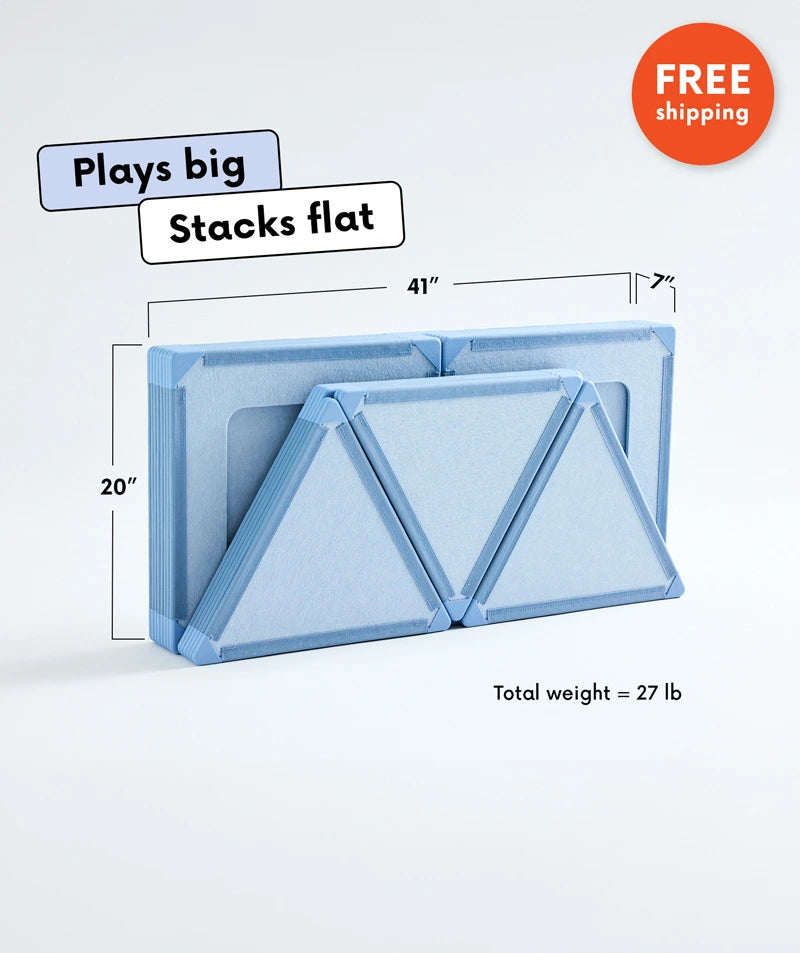
Superspace is designed as a multi-sensory building system that incorporates principles shown to be beneficial for children with ADHD.
This innovative magnetic construction system features modular panels that connect through satisfying magnetic "clicks," providing immediate tactile feedback that helps maintain engagement and focus.
The system's open-ended design allows for endless creative possibilities while offering the structure and sensory input that children with ADHD often need. While specific research on Superspace's effectiveness is limited, the general principles it employs are supported by research on multi-sensory interventions for ADHD.
The magnetic connection system provides immediate, satisfying feedback that reinforces positive behavior and maintains engagement.
This tactile reward system addresses the need for frequent positive reinforcement that children with ADHD require. The modular structure allows for both individual exploration and collaborative play, supporting social skills while respecting each child's unique pace and interests.
Superspace's design specifically addresses common ADHD challenges:
- Focus Enhancement: The colorful, magnetic pieces and endless creative possibilities keep children engaged and motivated, with tactile feedback helping maintain attention for longer periods
- Impulse Control: Open-ended play encourages patience and thoughtful decision-making as children must plan and execute their designs, practicing self-regulation
- Emotional Regulation: Building activities can be both calming and empowering, with therapists guiding children through problem-solving when structures don't work as planned
- Motor Skills: The system incorporates both gross and fine motor skills as children reach, stack, and connect pieces, providing sensory input that can have a calming effect
The satisfying "click" of magnetic pieces connecting offers immediate sensory feedback that helps regulate the nervous system and provides proprioceptive input.
This combination of structure and flexibility is ideal for supporting executive functioning development while allowing for creative exploration and problem-solving.
Superspace's open-ended design encourages creativity and problem-solving, two areas where children with ADHD often excel when given the right tools and environment.
The limitless building possibilities allow children to explore their interests and develop their unique strengths while practicing essential cognitive skills like planning, organization, and breaking down complex tasks into manageable steps.
How Superspace Enhances Executive Functioning in ADHD Children
Executive functioning skills are often the greatest challenge for children with ADHD, but structured play activities can provide opportunities to develop these essential cognitive abilities.
This demonstrates how play therapy helps ADHD by showing that children can improve executive functioning through structured, engaging activities that provide immediate feedback and clear goals.
Superspace building activities naturally strengthen working memory as children hold multiple pieces of information in mind while planning and executing their designs. The magnetic pieces provide visual and tactile cues that support memory retention, making complex building projects more manageable for children with ADHD.
The open-ended nature of Superspace encourages children to experiment with different approaches and adapt their strategies when initial plans don't work. This flexibility is crucial for children with ADHD, who often struggle with rigid thinking patterns and benefit from opportunities to practice adaptive problem-solving.
Collaborative Superspace play provides natural opportunities to practice inhibitory control through turn-taking and sharing materials. These social interactions help children with ADHD develop impulse control while building positive relationships with peers in a structured, supportive environment.

Practical Implementation: Using Superspace in Play Therapy Sessions
Integrating Superspace into ADHD play therapy sessions requires thoughtful planning and adaptation to each child's unique needs.
Research demonstrates that structured play therapy sessions with appropriate tools can produce substantial improvements in executive functioning and emotional regulation [5].
Create a dedicated space with minimal distractions where children can focus on Superspace activities. Organize magnetic pieces in accessible containers to support organization skills while maintaining easy access during play.
These ADHD therapy tools for parents help create an optimal environment for therapeutic success.
For attention difficulties, use goal-oriented building challenges with clear time limits.
For emotional regulation, incorporate breathing exercises between building phases.
For social skills, design collaborative projects that require communication and turn-taking.
These ADHD play activities can be adapted for different age groups and developmental levels.
Younger children benefit from simple building tasks with immediate rewards, while older children can handle complex projects that require planning and sustained effort.
Adjust complexity based on individual attention spans and developmental levels.
Try these specific Superspace activities for ADHD play therapy:
- Goal-Oriented Challenges: Set small, achievable tasks like building a tower or creating a specific shape to encourage focus, planning, and persistence
- Collaborative Play: Pair children together to work on shared projects, fostering teamwork, communication, and turn-taking skills
- Emotion-Focused Activities: Create "emotion towers" where each layer represents a different feeling, helping children explore and process emotions
- Impulse Control Exercises: Introduce timed activities where children must wait for their turn or follow step-by-step processes to complete structures
Real-World Results: Research Evidence for Multi-Sensory Play Therapy
The effectiveness of multi-sensory play therapy approaches for children with ADHD is well-documented in research literature.
Studies on serious games and tangible interfaces for ADHD treatment have revealed consistent gains across multiple domains, including visuospatial working memory, attention control, and cognitive flexibility.
Research has demonstrated executive functioning gains in children who participated in group-based play therapy sessions [6].
Studies show improvements in planning, organization, and impulse control following structured play therapy sessions using multi-sensory therapeutic tools.
Studies consistently show that children with ADHD benefit from activities that provide immediate sensory feedback and structured yet flexible play opportunities.
The research supports the use of tactile, visual, and kinesthetic elements in therapeutic interventions, which can help children maintain focus and develop self-regulation skills.
Parents and therapists report that children who regularly engage in structured multi-sensory play activities show sustained improvements in social skills, emotional regulation, and academic performance.
The open-ended nature of building and creative play allows for continued challenge and growth as children develop new skills and face increasingly complex projects.
The versatility of Superspace makes it a valuable tool for professionals working with children with ADHD.
Its engaging, multi-sensory nature allows for endless creativity while supporting therapeutic goals.
Therapists and educators report seeing improvements in children's ability to focus, regulate emotions, and work through frustration when incorporating Superspace into play therapy sessions.
Teachers notice better collaboration and problem-solving skills in group settings.

Your Child's Journey Starts Here
As a parent, you've probably spent countless hours searching for the "right" approach to help your child with ADHD.
You've tried different strategies, felt frustrated when nothing seemed to work, and maybe even questioned whether you're doing enough.
Here's what you need to know:
You are enough, and your child has incredible potential waiting to be unlocked.
The research supporting multi-sensory play therapy approaches is encouraging, and the tools are available. Multi-sensory play therapy with tools like Superspace offers a promising approach to helping your child discover their strengths, build confidence, and develop the skills they need to thrive.
Imagine watching your child's face light up as they successfully complete a complex building project they planned themselves.
Picture the pride in their eyes when they solve a problem that once would have led to frustration. Envision the confidence they'll carry into school, friendships, and life when they know they can tackle challenges and succeed.
This isn't about fixing your child—it's about giving them the tools to be their best selves. Every magnetic connection, every creative solution, every moment of focused play is building the foundation for their future success.
Your child's journey with ADHD doesn't have to be defined by struggles.
With the right approach, the right tools, and your unwavering support, they can build not just structures, but the confidence, skills, and resilience they need to navigate life's challenges with grace and determination.
The question isn't whether your child can succeed—it's whether you're ready to give them the tools they need to show you just how amazing they truly are.
References
- American Academy of Pediatrics. (2019). Clinical practice guideline for the diagnosis, evaluation, and treatment of attention-deficit/hyperactivity disorder in children and adolescents. Pediatrics, 144(4), e20192528.
- Katz, N., et al. (2023). Play therapy and storytelling intervention on children's social skills with ADHD. Journal of Educational Psychology, 115(4), 234-248.
- Pfeifer, J. H., & Allen, N. B. (2021). The embodied brain: Towards a neurodevelopmental model of mental health. Current Opinion in Psychology, 44, 101-108.
- Chen, H. Y., et al. (2018). Association between sensory modulation and daily activity function in children with ADHD. Developmental Medicine & Child Neurology, 60(8), 912-920.
- Shams, M., Kharamin, S., & Rezaei, S. (2017). The social play, social skills, and parent-child relationships of children with ADHD 12 months following a RCT of a play-based intervention. Children, 4(12), 15.
- Systematic Review. (2023). Sandplay therapy as a complementary treatment for children with ADHD: A scoping review. Brain Sciences, 13(9), 20.