Everything You Need to Know Before Buying Superspace (2026 Parent Guide)
Craig SpencerAnother Saturday morning, another living room buried in couch cushions. The blanket fort your four-year-old spent an hour building just collapsed again. Now you're hearing the familiar refrain: "There's nothing to do. Can I have the tablet?"
You love their imagination. You just wish keeping up with it didn't feel like rebuilding the same unstable fort three times a day.
Enter Superspace, the world's first giant magnetic tiles designed for full-body play.
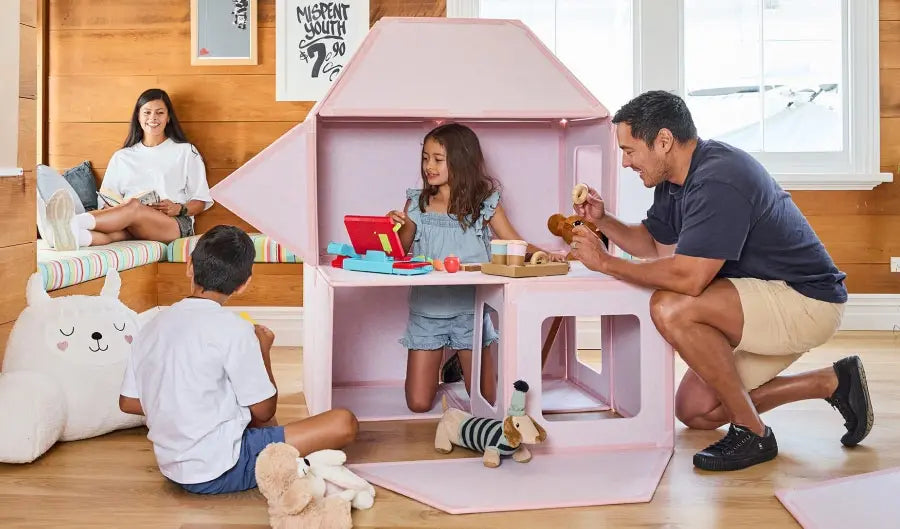
These life-sized felt-covered panels snap together magnetically to create stable forts, tunnels, and imaginative spaces kids can actually climb inside.
This guide helps you choose the right set, maximize playtime, and make the most of your investment.

Key Takeaways
- Superspace is the world's first giant magnetic tile system designed for whole-body play, replacing collapsing pillow forts with stable structures children can actually enter and customize for cooperative play and independent projects.
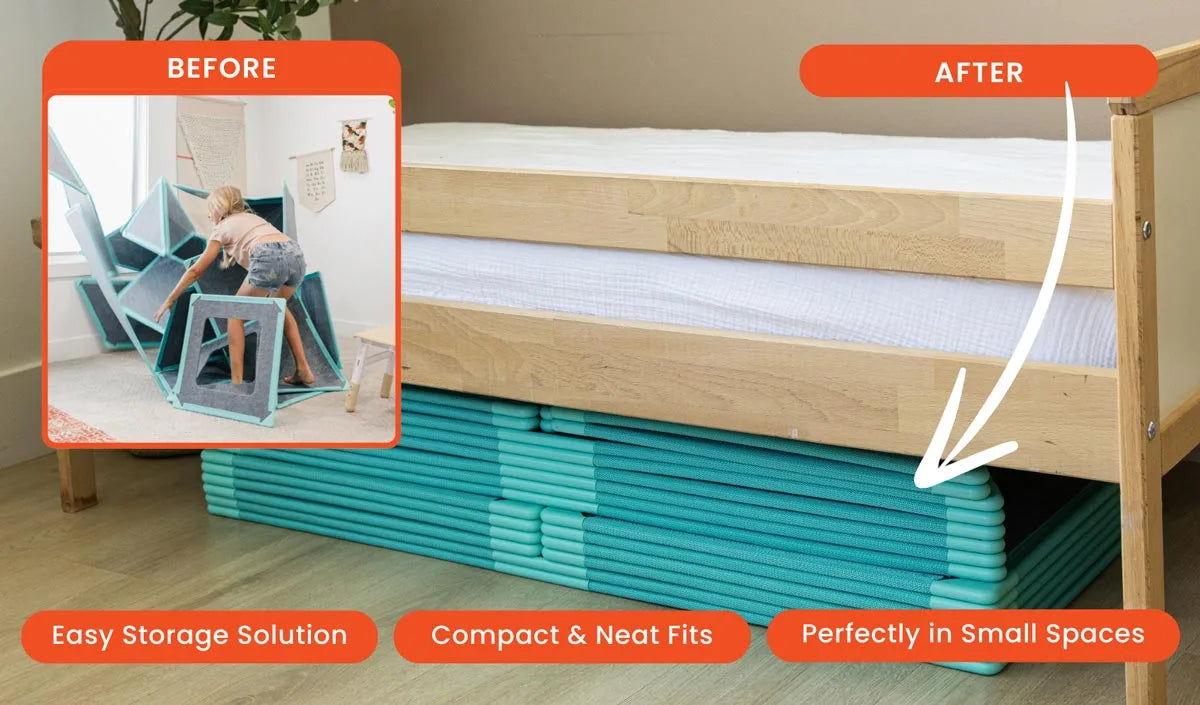
- The magnetic panels are designed to stack flat and can be stored in a closet, under a bed, behind a couch, or against a wall - making cleanup and storage simple even in apartments or smaller homes.
- Safety wins include embedded magnets, soft eco-felt made from recycled bottles, and compliance with major international toy standards.
- Stability improves dramatically when adults model magnet alignment, use triangles as braces, and build on smooth floors.
- Collapses become teachable moments backed by research on construction play.
- Superspace fosters spatial reasoning, math readiness, and imaginative storytelling when families guide builds with spatial language and pretend prompts.
- Free shipping within the contiguous US and a 30-day money-back guarantee; sets sell out before peak holidays, so order early for gift delivery.
Table of Contents
- What Exactly Is Superspace?
- What Superspace Solves (and What to Know Before You Buy)
- Superspace vs. Alternatives
- Safety, Materials & Magnet Strength
- Cost, Value & Financing
- Shipping & Returns
- How to Choose the Right Set & Add-Ons
- Research-Backed Benefits of Life-Sized Construction Play
- What Real Families Say: The Unfiltered Truth
- Expert Tips for Stable Builds & Engaging Play Ideas
- FAQs
- Choosing the Right Superspace Set for Your Family
- References
What Exactly Is Superspace?
Superspace is the world's first giant magnetic tile system designed for whole-body imaginative play. Think of it as life-sized Magna-Tiles your kids can actually climb inside and call their own.
Each eco-felt panel (2-by-3-foot rectangles, triangles, squares, trapezoids, and windows) features embedded auto-align magnets along every edge that click together to create stable, enclosed structures.
The magnetic technology that made tabletop tiles beloved by millions of families now scales up for forts, tunnels, reading dens, and elaborate multi-room creations.
Sets stack flat for storage and are designed for ages three to ten, though many families report teenagers and even adults joining in on the building fun.
Core Components
- Panels: The Big Set ships with 24 panels (6 rectangles, 6 trapezoids, 6 triangles, 4 squares, 2 window squares). The Little Set includes 16 panels (10 squares, 4 triangles, 2 square windows).
- Add-on packs: Rectangles, squares, farmyard themes, and imagination packs extend builds without replacing the original kit.
- Materials: Panels use eco-felt made from about 130 recycled plastic bottles per Big Set. Magnets are securely sealed inside the plastic corners.
Who It Suits Best
- Families with children who already love Magna-Tiles, LEGO, or dramatic play.
- Homes seeking a screen-free, large-muscle indoor activity when weather limits outdoor time.
- Multi-age siblings or therapy classrooms needing collaborative play tools.
- Parents ready to manage storage, periodic magnet alignment, and teach cleanup habits.

What Superspace Solves (and What to Know Before You Buy)
If you're tired of finding couch cushions in every room, cardboard boxes colonizing your hallway, and blanket forts that last exactly eleven minutes before someone cries, Superspace offers a game-changing solution.
One parent summed it up perfectly:
"Everyone in the house loves them. Especially me, since they are easy to pick up and we don't have the mess of blankets and chairs all over the living room for fort building."
The magnetic panels snap together in seconds and stack flat when playtime ends. No more tape. No more safety pins. No more "Mom, it fell down AGAIN!"
- The daily couch-cushion shuffle - cleanup takes two minutes, not twenty
- Collapsing cardboard forts that end in tears - magnetic panels stay connected during active play
- Screen time guilt - parents report kids choosing Superspace over tablets on rainy days
- Fort-building mess that takes over your living room for days - panels stack flat for quick storage
What to know for best results:
- Younger builders (ages 3 to 4) benefit from adult guidance at first to learn magnet alignment and building techniques. Once they master it, independent play takes off.
- One set works beautifully for 1 to 2 kids building together. Families with multiple kids often expand with add-on packs as play evolves.
- Storage requires planning - one set stacks to 9 inches tall and fits under beds, behind couches, or on rolling carts.
One grandmother commented: "I noticed how much they loved Magna-Tiles and building forts out of boxes. When I found these, I felt like I hit the jackpot for all they loved."
Superspace vs. Alternatives
Superspace shines brightest for immersive, climb-in play, yet other fort or play couch systems can meet different needs or budgets.
Superspace vs. Play Couches (Nugget, Play Fort)
- Superspace: Snap-together walls, windows, and tunnels for imaginative structures.
- Play couches: Better for lounging, jumping, and softer sensory play. They lack rigid walls but offer comfy reading corners.
- Decision tip: If your child treats the Nugget like a crash pad, keep it, and add Superspace only if they crave enclosed spaces or want to build bigger structures.
Superspace vs. Rod-and-Connector Kits (Fort Magic, Crazy Forts)
- Rod kits: Budget-friendly ($45 to $200), lightweight, and portable. Require blankets or sheets for walls.
- Superspace: Sturdier surfaces, much faster and easier to build with, quicker cleanup, higher upfront cost.
- Decision tip: Choose rod kits for quick setups in tight budgets; choose Superspace when you want a ready-made "room" without digging for linens.
Superspace vs. Tabletop Magnetic Tiles (Magna-Tiles, Connetix)
- Tabletop tiles build fine motor skills and small-scale architecture.
- Superspace extends the same magnetic language into gross-motor, full-body play. Many families use both, keeping the tiles for morning quiet time and Superspace for afternoon energy release.

Safety & Materials
Eco-felt panels with factory-sealed magnets. Conforms to UKCA and CE toy safety standards. Supervise kids aged 3-4.
Cleaning: Wipe with damp cloth and mild soap. Air dry fully. Use lint roller for pet hair.
Toddler Considerations
- Position builds away from staircases or other climb hazards.
- Encourage toddlers to sit rather than climb on roofs. Reinforce walls with triangles to limit tipping.
- Store panels upright or under furniture when not in use to discourage unsupervised pulls.
Cost, Value & Financing: Understanding the Investment
Superspace represents an investment in your child's play: $279 for The Little Set, $429 for The Big Set, with add-on packs ranging from $99 to $149.
As the world's first giant magnetic tile system designed for full-body play, the pricing reflects the innovation, quality materials (eco-felt made from recycled bottles), and embedded auto-align magnet technology.
The brand rarely runs sales, focusing instead on consistent quality and value. One parent who waited nearly a year for a discount finally ordered at full price and reported "zero regrets."
Here's how families evaluate whether Superspace delivers value for their investment:
The Parents Who Said "Worth Every Penny"
Over 50,000 families have shared in the magic and fun of Superspace, making it one of the most trusted giant magnetic tile systems for whole-body play.
Here's what parents are saying about the investment:
Chase B., parent of three kids (ages 6, 5, 3):
"Don't wait for a sale, order them. These are worth every cent and we have zero regrets. This is one of the few things my kids play with almost every day."
Jennifer S., mom whose son still plays at age 11:
"We got these when they first launched years ago and my son, now 11 still plays with them. They are the BEST toy I've ever bought, and I've bought a LOT."
Sheryl C., grandmother who kept buying more:
"People might think these items are expensive but the time and experience playing with both of them was worth every penny."
These aren't isolated stories. The reviews reveal a pattern: families who buy Superspace either become immediate repeat buyers (adding sets within months) or vocally regret the purchase. There's very little middle ground.
The Cost-Per-Year Reality Check
Let's do the math the way actual families use it:
Scenario: Big Set used 4 days/week for 7 years (ages 3 to 10)
- Total cost: $429
- Cost per play session: $0.29
- Compare to: $40 impulse toy played with twice = $20 per session
Real-world example from Andrea D.:
"My 5-year-old logged about 26 hours in the first weekend and woke up early wanting to build immediately!"
That's 26 hours of screen-free play in 48 hours. For some families, that alone justifies the cost.
Setting Realistic Expectations
A small number of families found their experience differed from expectations. Understanding these situations helps you make the best choice for your family:
Challenge: Interest faded quickly
Solution: Kids who weren't already passionate builders sometimes lost interest after the novelty wore off. The families with sustained engagement had children already showing strong construction play interests.
Challenge: Wanted bigger, more elaborate builds
Solution: As kids' skills grew, many families expanded with add-on packs (Rectangles, Squares, themed sets) to keep builds fresh and challenging. This is why the brand offers expansion options - play evolves over time.
Challenge: Panels showed wear over time
Solution: Felt can show wear with heavy daily use. Most families found this cosmetic rather than functional, and panels continued working for years.
The key difference: Families who understood Superspace as a collaborative, open-ended building system (like life-sized Magna-Tiles) had the most success. Those expecting instant independent play for toddlers needed more adult involvement initially before kids mastered the technique.
Making the Price Work for Your Budget
Shop Pay installments (US only):
Four payments, no interest when approved. Turns $429 into $107/month.
Split it with family:
Many grandparents buy the Little Set ($279) as the main gift, then parents add expansion packs for birthdays. One grandfather noted his grand-nephews "use them constantly for the last year and a half. One of the best investments in a toy that I've ever made."
Start small, expand later:
The Little Set (16 panels) lets you test the concept. If your kids obsess over it, add the Rectangles Pack next. If they don't, you've spent $279, not $600.
The Real Question Isn't "Is It Expensive?"
It's "Will my kids actually use this?"
Gary B.'s review captures it:
"Well worth the money and I can see the fun lasting for years to come."
The best indicator of success: If your child is already taping boxes together, building pillow forts daily, or maxing out their Magna-Tiles collection, Superspace is the natural next step in their building journey.
These are the kids who use Superspace for years, build daily, and inspire families to expand with multiple sets.
Shipping & Returns
Free shipping in contiguous US. Ships within 3 business days, arrives in 5 to 7 business days.
30-day money-back guarantee. See refund policy and shipping policy.
Sets sell out before holidays - order early for Christmas delivery.

How to Choose the Right Set & Add-Ons
| Scenario | Recommended Set | Why |
|---|---|---|
| Most families (1-2 kids, ages 3 to 10) | The Big Set | 24 panels provide enough variety for elaborate builds, multiple room types, and years of creative growth without needing immediate expansion |
| Apartment, one child (ages 3 to 5) | Little Set | Smaller footprint, easier storage, still allows for small forts and reading nooks |
| Multi-sibling family (ages 4 to 9) | Big Set + Rectangles Pack | Enough walls for shared builds, rectangles reinforce roofs |
| Therapy or a classroom setting | Big Set ×2 + Squares Pack | Supports group stations, sensory pathways, and large motor planning |
| Fort hobbyist or dedicated playroom | Big Set + Farmyard or Imagination Packs | Adds thematic prompts and windows for storytelling |
What the Research Says (And Why It Actually Matters)
You're not buying Superspace for better test scores. You want your kids off screens and creatively engaged.
But here's the bonus: while they're building "rocket ships" and "vet clinics," research-backed development happens naturally.[1-6]
What construction play develops:
- Math foundations: Spatial reasoning and geometry concepts that show up in third-grade math
- Problem-solving: When forts collapse, kids learn cause-and-effect and structural stability
- Executive function: Planning which panels go where builds focus and sequencing skills
- Creativity: Open-ended play enhances storytelling and emotional expression
- Motor skills: Aligning magnets requires precision that supports later writing and reading
Real parent observation (Taylor W.):
"The geometry/physics lessons that come with trying to build it are also pretty awesome."
Pediatric therapist (Michelle M.):
"We use it for problem solving, executive function, visual-spatial skills, planning, imaginative play, and attention. I can use them with my 2-year-olds and 12-year-olds."
The bottom line: Does your child already show building obsession? Do they tape boxes together, stack couch cushions, spend hours with Magna-Tiles? If yes, Superspace becomes development disguised as play. If not, even the most research-backed toy ends up in the closet.
What Real Families Say: The Unfiltered Truth
Before you spend $300+, here's what actually happens when Superspace arrives in real homes, told by the parents and grandparents who made the investment.
"The Cure for Addiction to Electronics"
David H., parent:
"My kids use this more than any other toy they have! The cure for addiction to electronics."
Jessica:
"This is the only thing we have purchased that gets them off of their tablets and into creative, imaginary play for hours!!"
Multi-Age Appeal
Katrina S., mom of 6 boys:
"Even big sis (16) got in on the fun. For several nights it became a cave to sleep in. An igloo for my penguin loving boy. A spaceship, they even used them to build rooms for a zoo. One of the best investments we have ever made!"
"I Hit the Jackpot"
Donna B., grandmother:
"Bought this for my grandsons when they were 3 and 5. On a visit to see them, I noticed how much they loved Magna-Tiles and also building forts out of cardboard boxes. When I found these I felt like I hit the jackpot for all they loved. It allows their imagination to soar! They are so well-made, and the fact that they could be broken down and stored is even better. They are now 4 and 6 and still continue to love them!"
The Repeat Buyers
Anonymous parent:
"I swore we wouldn't buy any more after 2 sets but I just feel like we want more."
Important Considerations
One set works for 1 to 2 kids building together. Families with 3+ kids often add expansion packs for simultaneous play.
Stability improves when magnets align edge to edge (listen for the click) and triangles brace corners. Most families found collapses decreased after the first week.
Superspace works best when kids already show building passion: taping boxes together, daily pillow forts, or Magna-Tile obsession.
Grandparents Love It Too
Sheryl C., grandmother who bought 4 sets:
"My grandchildren still been playing with this set every day for the past 2 years. People might think these items are expensive but the time and experience playing with both of them was worth every penny."
The Bottom Line
Sarah, mom of a 7-year-old:
"The neighbors actually flock to join him and it ends up being an event. It's been the easiest way to persuade him to play with friends off screens!"
For passionate builders - kids who tape boxes together, construct daily pillow forts, or obsess over Magna-Tiles - Superspace delivers years of engaged, creative play.

Expert Tips for Stable Builds
Quick stability checklist: Build on hardwood or low-pile carpet. Align magnets edge to edge. Add triangles at corners. Double-stack rectangles for roofs.
Play ideas: Tunnels for trucks (ages 3-4), vet clinics with windows (ages 5-7), mazes with secret doors (ages 8-10).
Storage: Stack on rolling cart, lean against closet wall, or slide under beds.
FAQs
Buying Decision FAQs
How many Superspace sets do I actually need?
Here's the honest answer most parents discover after buying:
One set works for 1 to 2 kids building together, but rarely satisfies multiple kids wanting to build separate structures simultaneously.
The pattern in reviews is striking. Parents buy one Big Set (24 panels), kids play obsessively for weeks, then start asking for "more pieces." Within 3 to 6 months, most families either:
- Buy 1 to 2 add-on packs (Rectangles, Squares) to expand building options
- Purchase a second full set for sibling builds
- Resign themselves to kids taking turns or building collaboratively
One dad captured the cycle perfectly:
"We were gifted a big set and ordered a second big set. I swore we wouldn't buy any more after buying 2 sets but I just feel like we need more, so our plan is to order the rectangles set next."
Realistic expectations:
- 1 Big Set: Perfect for 1 child or 2 kids who collaborate well
- 1 Big Set + Rectangles Pack: Allows for bigger, more elaborate single builds
- 2 Big Sets: Enough for 2 to 3 kids to build separate structures simultaneously
- 3+ Sets: Therapy clinics, classrooms, or families with 4+ kids
If budget is tight, start with one set and watch play patterns. If they're building daily and constantly asking for "more walls," you'll know it's worth expanding.
Big Set vs. Little Set: Which should I buy first?
The brand positions them clearly: Big Set (24 panels) for "families with one or more kids aged 3 to 10," Little Set (16 panels) as a "starter set for smaller families."
But here's what real customer data reveals:
Choose the Big Set ($429) if:
- You have 2+ kids who will use it
- Your child loves building and construction play
- You can afford the upfront cost without financial stress
- You want to avoid "we need more pieces" complaints within the first month
The Big Set is Superspace's top seller for good reason: 24 panels provide enough variety (rectangles, trapezoids, triangles, squares, windows) to build multiple room types, taller structures, and more complex designs. Most satisfied customers bought the Big Set first.
Choose the Little Set ($279) if:
- You have one child or want to test the concept before committing $400+
- Storage space is extremely limited
- You're unsure if your child will sustain interest beyond the first few weeks
- You plan to add expansion packs for holidays/birthdays if it's a hit
The honest caveat: Several reviewers mentioned the Little Set felt "limiting" within weeks and wished they'd started with the Big Set. One noted: "We started with the Little Set and within a month ordered the Big Set because they wanted bigger builds."
The safe middle ground: Buy the Big Set during a restock window. If you're truly on the fence, check Facebook Marketplace or toy libraries to test a set before investing. Both sets are compatible with all add-on packs, so you can expand either direction.
Will one set be enough to entertain multiple kids at the same time?
One set works beautifully for 1 to 2 kids building together, or 2 to 3 kids who collaborate on a single large structure.
For families wanting simultaneous independent play for 3+ children, most find that adding expansion packs or a second set opens up more creative possibilities.
What parents discovered:
"Having three children, one set can really only comfortably be used by one child at a time" - but many families solved this by treating Superspace as a collaborative building experience rather than separate simultaneous play.
Why expansion becomes appealing:
- 24 panels (Big Set) create amazing structures - a basic 4-walled room with a roof uses 10 to 12 panels, leaving extras for doors, windows, and creative additions
- As kids' imaginations expand, so do their building ambitions - many want to create multi-room designs or separate play spaces
- Add-on packs (Rectangles, Squares, themed sets) let families grow with their play patterns
What actually works for multiple kids:
Collaborative building (works for some families):
Parents who framed Superspace as a "together toy" had better success. Kids build one elaborate structure as a team (zoo with multiple animal rooms, spaceship with different sections, multi-room house).
Katrina S., mom of 6 boys:
"The minute it arrived they were transforming our house into one adventure after another. Their imaginations ran wild. Even big sis (16) got in on the fun."
Multiple sets (the expensive but effective solution):
Families with 3+ kids who wanted simultaneous independent play bought 2 to 3 full sets. One grandmother noted: "I first bought The Big Set and then I realized they wanted to make more designs" (she eventually bought 4 sets over 2 years).
Taking turns (works for patient kids):
Some families instituted "fort time" rotations. One child builds for 30 to 60 minutes, then the next gets a turn. This requires parental enforcement and doesn't work with highly competitive siblings.
Planning tip: Many families with multiple kids start with one Big Set for collaborative building, then add expansion packs for birthdays or holidays as kids' building skills grow. This spreads the investment while matching the panels to your family's evolving play style.
How long do kids typically play with Superspace before outgrowing it?
The reviews reveal something surprising: Superspace has remarkable longevity when kids match the "builder" profile.
Typical usage timeline from satisfied customers:
Ages 3 to 5 (Some parental involvement may be required):
Kids need help aligning magnets, stabilizing walls, and learning building techniques. Structures are simpler (basic houses, tunnels, reading nooks). Play sessions average 30 to 60 minutes with adult support.
Ages 6 to 8 (Independent building emerges):
This is the "sweet spot" reviewers mention most. Kids build independently, create elaborate multi-room designs, and play for 2+ hours without prompting. Many parents report daily use during this phase.
One therapist noted:
"I can use them with my 3-year-olds and 12-year-olds" (pediatric therapy clinic context).
Ages 9+ (Sustained interest for builders, decline for others):
The split becomes clear here. Kids who are natural builders continue using Superspace for complex engineering projects, escape rooms for friends, and creative challenges. Kids who aren't wired for building phase out around age 9 to 10.
Jennifer S., whose son is now 11:
"We got these when they first launched years ago and my son, now 11 still plays with them. They are the BEST toy I've ever bought, and I've bought a LOT."
Multiple reviews mentioned teenagers (14 to 16) joining younger siblings for fort building, treating it more like a family game night activity than solo play.
The 3+ year pattern:
The vast majority of satisfied customers report consistent use for 3 to 4 years minimum, with some extending to 6+ years.
Sheryl C., grandmother:
"My grandchildren ages 3 and 4 just love playing with Superspace. They still been playing with this set everyday for the past 2 years."
Keys to sustained engagement:
Families who report the longest play spans share these practices:
- Child already showed building interest before Superspace arrived
- Parents initially spent time teaching building techniques to younger kids (3 to 4 year olds), which led to confident independent play
- Families expanded with add-on packs as kids' skills grew, keeping builds fresh and challenging
- Screen time remained intentionally limited, making Superspace a go-to activity
Can I leave Superspace forts set up permanently or do I have to break them down daily?
You can do either, but each approach has trade-offs that reviewers learned the hard way.
OPTION 1: Leave Forts Standing (Semi-Permanent Setup)
Who this works for:
- Dedicated playrooms where the fort isn't in traffic flow
- Families with space to "lose" a corner of a room long-term
- Kids who use the same fort design for imaginative play over weeks (vet clinic, spaceship, reading den)
Real parent example:
"Two Mama Bears blog reported seven months of near-daily use with the panels stored beside the couch so the kids could rebuild after dinner."
Note: They stored panels nearby, not kept the fort standing 24/7.
Pros:
- Zero daily cleanup effort
- Kids can return to the same imaginative play scenario
- Becomes a cozy reading nook or calm-down space
Cons:
- Takes up significant floor space (a 4-wall fort = roughly 6x6 feet)
- Forts can still collapse from accidental bumps, pets, or rough play
- Panels collect dust, pet hair, and require vacuuming/lint rolling
- Kids may lose interest in the same structure after 1 to 2 weeks
- You sacrifice that space for other activities
OPTION 2: Build & Break Down Daily (Active Play Cycle)
Who this works for:
- Apartments or homes where living space is at a premium
- Families who need the floor clear for other activities
- Kids who love the building process as much as the playing-inside part
- Parents who value tidiness and don't mind 2-minute cleanup
Pros:
- Room stays functional for multiple uses (yoga, dance parties, floor play)
- Building becomes part of the play (not just the end result)
- Kids design new structures daily instead of same fort getting stale
- Panels stay cleaner when stacked away
Cons:
- Requires daily teardown (though reviewers consistently say "2 minutes")
- Younger kids (3 to 5) can't rebuild independently without adult help
- Interrupts imaginative play scenarios that span multiple days
OPTION 3: Hybrid Approach (Best of Both)
Many families found a middle ground:
- Weekdays: Build and break down daily (school nights, need the space)
- Weekends: Leave fort standing for 2 to 3 days of extended play
- School breaks: Semi-permanent setups that last 1 to 2 weeks
One mom shared:
"For several nights it became a cave to sleep in. An igloo for my penguin-loving boy. A spaceship..." (implying forts stayed up for days during specific play themes).
Storage solutions if you break down daily:
- Under bed (panels stack 9 inches tall)
- Behind couch or sofa
- Rolling wire cart (IKEA Trofast mentioned in reviews)
- Leaning against wall in closet
- Under crib or in large toy chest
Most families find a flexible approach works best: leave forts standing when space allows, break down when needed for other activities.
Product & Logistics FAQs
Is Superspace worth the price compared with other fort kits?
If you want durable, reusable walls kids can enter daily, Superspace delivers value across years; rod sets or play couches are cheaper short-term but offer different experiences.
How sturdy are the magnets, and will forts collapse?
Magnets hold well when edges align flush. Collapses usually signal misalignment or uneven floors; teach kids to add triangles and test walls before play.
Structural problem-solving strengthens design thinking.[3]
What ages can safely play with Superspace?
The brand rates panels for ages three and up. Toddlers should play with adult supervision, especially when siblings build taller than shoulder height.
How do you clean and store Superspace panels?
Spot clean with mild soap and water, air dry completely, and stack under a bed or behind furniture. Use a lint roller for pet hair and a flat cart to move stacks easily.
What happens if a panel arrives damaged or a magnet feels weak?
Document the issue within a week, email Superspace support with photos, and follow up if needed.
Can Superspace be used outdoors or in classrooms?
The panels are suitable for brief outdoor use on dry days but should be stored indoors. Many occupational therapists and preschool teachers use sets for gross motor planning, but plan for adult-led cleanup and inspection.
Choosing the Right Superspace Set for Your Family
You've discovered how Superspace - the world's first giant magnetic tile system - transforms everyday fort building into stable, creative, screen-free play. You've read from families who call it "the best investment ever" and learned what makes it work best.
Now comes the fun part: choosing which set matches your family's play style.
Find Your Perfect Match
Superspace thrives in families where:
- Kids already show building passion (taping boxes, daily pillow forts, Magna-Tile obsession)
- Parents enjoy collaborative play and can guide younger builders (ages 3 to 5) through initial learning
- You value multi-year investments in open-ended, screen-free play
- You have storage space (under beds, behind couches, or dedicated play areas)
- The investment fits comfortably in your budget, or you can split costs with grandparents/family
Important considerations before buying:
- Younger kids (under 3) benefit from adult guidance initially - independent play develops as they master technique
- One Big Set works beautifully for 1 to 2 kids; families with 3+ kids often expand with add-ons for more building options
- Superspace complements other toys rather than replacing them - kids rotate through play patterns
- Storage planning helps (panels stack 9 inches tall)
- Consider starting with the Big Set or testing through toy libraries if budget is a primary concern
What the Transformation Actually Looks Like
Before Superspace:
Couch cushions scattered. Blanket forts that collapse. Cardboard boxes taped together. Kids asking for tablets when they're "bored."
After Superspace (when it works):
Kids building before breakfast. Siblings cooperating on elaborate constructions. Neighbors asking where you got "that cool fort thing." Two-minute cleanup instead of a twenty-minute living room reconstruction.
But only if your child is already wired for building.
Choosing Your Starting Point
Start with the Big Set if:
Your child lives for construction - they're taping boxes, stacking cushions, and building constantly. You recognize them in the reviews from families who say "my kids play with this almost every day."
Why the Big Set:
24 panels provide enough variety for elaborate builds, multiple room types, and years of creative growth. As one dad shared: "I swore we wouldn't buy any more after 2 sets but I just feel like we need more" - the Big Set gives you a strong foundation before expanding.
Start with the Little Set if:
Your child enjoys building and you want to introduce them to giant magnetic tiles at a lower entry point ($279 vs. $429).
Why the Little Set:
16 panels create amazing starter structures while testing how your family uses Superspace. Many families begin here, then add the Rectangles Pack or upgrade to the Big Set once they see consistent daily play. Both sets work with all add-on packs, so you can grow your collection over time.
Smart Shopping Tips:
- Check toy libraries or Facebook Marketplace to experience Superspace before investing
- Coordinate with grandparents for birthday/holiday gift splitting
- Use Shop Pay installments (US only) to spread payments interest-free
- Order during restock windows - sets sell out before peak holidays
The Last Word from Real Parents
Chase B., parent of three:
"Don't wait for a sale, order them. These are worth every cent and we have zero regrets. This is one of the few things my kids (6,5,3) play with almost every day."
Jennifer S., whose 11-year-old still plays:
"We got these when they first launched years ago, and my son, now 11, still plays with them. They are the BEST toy I've ever bought, and I've bought a LOT."
Trust Your Instincts
The families who rave about Superspace recognized their child's building passion and knew the giant magnetic tiles would be a hit. As one dad put it: "Don't wait for a sale, order them. These are worth every cent, and we have zero regrets."
If you're reading this thinking, "This sounds exactly like my kid," you're probably right. The building obsession you're seeing now - the daily pillow forts, the cardboard box creations, the Magna-Tile marathons - is telling you something.
If you're still researching and want more time to decide, that's perfectly fine too. Bookmark this guide, watch your child's play patterns, and revisit when you feel ready.
The right choice is the one that matches your child's play style, your family's budget, and the kind of memories you want filling your living room.
For some families, that's Superspace panels transforming into rocket ships every Saturday morning.
For others, it's something else entirely.
Both are right.
Shop all Superspace magnetic tiles today.
References
- Verdine, B. N., Golinkoff, R. M., Hirsh-Pasek, K., Newcombe, N. S., Filipowicz, A. T., & Chang, A. (2014). Deconstructing building blocks: Preschoolers' spatial assembly performance relates to early mathematical skills. Child Development, 85(3), 1062-1076. https://doi.org/10.1111/cdev.12165
- Hawes, Z., Gilligan-Lee, K. A., & Mix, K. S. (2022). Effects of spatial training on mathematics performance: A meta-analysis. Child Development, 58(1), 112-137. https://doi.org/10.1037/dev0001281
- Weber, A. M., Reuter, T., & Leuchter, M. (2020). The impact of a construction play on 5- to 6-year-old children's reasoning about stability. Frontiers in Psychology, 11, 1737. https://doi.org/10.3389/fpsyg.2020.01737
- Zhang, X., Chen, C., Yang, T., & Xu, X. (2020). Spatial skills associated with block-building complexity in preschoolers. Frontiers in Psychology, 11, 563493. https://doi.org/10.3389/fpsyg.2020.563493
- Cameron, C. E., Brock, L. L., Murrah, W. M., Bell, L. H., Worzalla, S. L., Grissmer, D., & Morrison, F. J. (2012). Fine motor skills and executive function both contribute to kindergarten achievement. Child Development, 83(4), 1229-1244. https://doi.org/10.1111/j.1467-8624.2012.01768.x
- Russ, S. W., & Wallace, C. E. (2013). Pretend play and creative processes. American Journal of Play, 6(1), 136-148. https://www.museumofplay.org/app/uploads/2021/02/AJP-Volume-6-Number-1.pdf