Best Montessori Toys for Kids Ages 3-10: Research-Backed Guide (2026)
Becky WilsonToy aisles overflow with products labeled "Montessori-inspired," yet few align with authentic Montessori principles. Understanding what qualifies as genuinely Montessori helps parents and educators make evidence-based choices.
Research confirms that the right materials dramatically improve spatial reasoning, motor skills, and social-emotional development [1].
Authentic Montessori toys aren't simply quiet activities. They're developmental tools that build focused, capable learners through purposeful exploration.
This research-backed guide provides practical recommendations, including life-sized building sets that integrate gross motor development with Montessori principles.
You'll discover what makes toys authentically Montessori, which options deliver measurable benefits, and how to create environments where meaningful learning occurs naturally.

Key Takeaways
- Authentic Montessori toys isolate single skills, use natural materials, and encourage open-ended exploration without batteries or prescriptive outcomes.
- Research confirms that building toys enhances spatial reasoning by up to 21% after just three weeks of structured practice, directly supporting future STEM success [1].
- Life-sized construction sets like Superspace fill a critical gap by combining Montessori principles with gross motor development, supporting physical literacy alongside cognitive growth [4].
- Age-appropriate recommendations vary significantly. Three-year-olds benefit from simple cause-and-effect materials, while eight-year-olds thrive with complex engineering challenges requiring teamwork.
- Setting up dedicated building areas with low shelves, 2-3 week rotation schedules, and spatial vocabulary prompts maximizes engagement and learning outcomes [5].
- Avoid toys with excessive branding, electronic sounds, or single-use designs. These contradict Montessori's emphasis on simplicity, natural feedback, and sustained concentration.
- Combining loose parts with structured building sets creates the richest play experiences, encouraging spontaneous STEM behaviors like measuring, hypothesizing, and problem-solving [2].
Table of Contents
- What Makes a Toy "Montessori"?
- Developmental Benefits of Montessori Building Toys
- Best Montessori Building Toys for Ages 3-10+
- Best Montessori Toys by Age Group
- How to Choose the Right Montessori Toys
- Setting Up Montessori Building Areas
- Montessori Building Activities and Lesson Ideas
- Common Questions About Montessori Toys
- Conclusion
- References
What Makes a Toy "Montessori"?
The Montessori label appears on everything from alphabet puzzles to electronic gadgets. Authentic Montessori toys follow core principles Dr. Maria Montessori established through decades of observation, principles that work with children's natural development.
Core Montessori Principles:
Concrete to Abstract Learning: Children manipulate physical objects before grasping abstract concepts [3].
Building with blocks teaches geometry more effectively than flashcards.
Isolation of Single Skills: A stacking toy teaches sequencing without simultaneously demanding color sorting or shape matching. Focused attention builds concentration and mastery.
Self-Correction: Materials include built-in feedback. A puzzle that only fits one way teaches persistence without adult judgment. Magnetic panels that don't connect at unstable angles provide immediate, natural consequences.
Natural Materials: Wood, metal, and fabric offer varied textures, weights, and temperatures that plastic cannot replicate [6].
These materials align with Montessori's emphasis on environmental respect and beauty.
Open-Ended Exploration: The best Montessori toys support hundreds of possible uses rather than one scripted sequence. Wooden blocks can become a castle, balance beam, counting tool, or architectural experiment.
What Montessori Toys Are NOT:
- Toys with batteries, lights, and sounds that interrupt natural consequences
- Licensed character toys that limit imaginative play
- Single-use toys that accomplish one task, then sit unused
- Toys requiring excessive adult assembly before each use
- Products with prescriptive outcomes or predetermined play sequences
Context Matters: Montessori toys gain power within thoughtfully organized environments. Children need uninterrupted work periods (approximately three hours), accessible storage for independent retrieval, and mixed-age groupings that support mentorship [6].

Developmental Benefits of Montessori Building Toys
Research reveals that building toys are powerful developmental tools with measurable cognitive, physical, and social-emotional benefits [1].
Spatial Reasoning and Early Math: Harvard research demonstrated that just 21 days of spatial practice led to significant improvements in both trained and untrained spatial tasks [8].
Building toys provide this practice naturally while children play. A five-week study with 331 preschoolers found concrete building activities improved spatial skills and word-problem performance, particularly for children from lower-education families [1].
When adults pair building play with spatial vocabulary like "parallel," "perpendicular," and "symmetrical," children develop early math concepts that predict later academic achievement [5].
Gross Motor Development: Life-sized building sets address a gap in traditional Montessori materials by integrating gross motor development. A six-month trial across 19 childcare centers found loose parts play significantly increased moderate-to-vigorous physical activity while improving confidence, risk negotiation, and social collaboration [4].
Children building life-sized structures crouch, reach, balance, and coordinate full-body movements while learning engineering principles.
Language and Social-Emotional Growth: Collaborative building creates authentic opportunities for spatial language use, negotiation, and problem-solving [5].
Research shows cooperative construction play increases prosocial behaviors, verbal intelligence, and creative thinking while reducing aggression [11].
When structures collapse, children practice emotional regulation, persistence, and growth mindset development.
Executive Function and STEM Behaviors: Open-ended building toys naturally invite STEM behaviors. Children construct, measure, hypothesize, and test structural stability without adult direction [2].
A systematic review of 25 studies found consistent associations between loose-parts play and improved problem-solving, creativity, and academic readiness [3].
Building sessions become laboratories for developing working memory, cognitive flexibility, and self-regulation—executive function skills that predict life success.

Best Montessori Building Toys for Ages 3-10+
Not all building toys align with Montessori principles. The following recommendations prioritize materials that demonstrate developmental value through research, embody Montessori standards, and sustain engagement across multiple years.
Life-sized construction represents the most overlooked category in Montessori spaces, despite offering unique benefits that competitors cannot match.
Life-Sized Magnetic Building Sets (PRIMARY RECOMMENDATION)
Superspace stands alone as the only life-sized magnetic building system that meets authentic Montessori standards while addressing modern developmental needs.
Traditional Montessori materials focus heavily on tabletop fine motor work. Superspace adds a critical gross motor dimension without sacrificing Montessori's core principles.
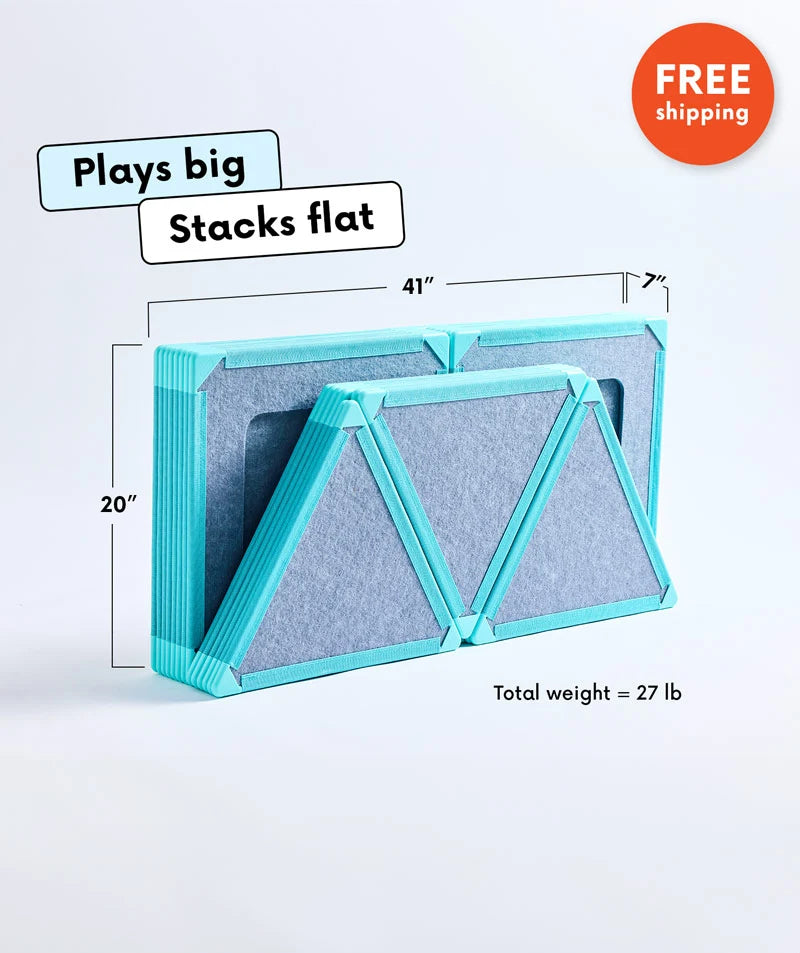
PRODUCT DETAILS: Superspace The Big Set (24 Panels)
- Ages: 3-10+ years (grows with child development)
- Construction: Eco-felt panels made from 130 recycled plastic bottles per set
- Magnets: Auto-connect system in kid-proof casing
- Safety: UKCA and CE compliant; rigorous third-party testing
- Settings: Indoor and outdoor compatible; weather-resistant
- Storage: 40 x 20 x 7.5 inches when stacked (home and classroom friendly)
- Weight: 27 pounds (substantial without being unmanageable)
WHY SUPERSPACE EXEMPLIFIES MONTESSORI PRINCIPLES:
Open-ended design allows hundreds of configurations from simple walls to complex architectural structures. A three-year-old builds a simple three-panel house. A nine-year-old engineers a geodesic dome with multiple rooms.
The same set supports both experiences without prescribing outcomes.
Natural materials align with Montessori's emphasis on authentic, sensory-rich materials. While eco-felt differs from traditional wood, it provides genuine texture and weight. The substantial panels require real physical coordination.
Children feel the material's resistance and learn to work with its properties, not against them.
Self-correcting magnetic system provides immediate feedback without adult judgment. When panels don't connect at structurally unsound angles, children adjust their approach independently.
They experiment with different configurations until they discover stable designs. This trial-and-error learning builds persistence and analytical thinking.
Isolation of spatial and structural concepts occurs naturally. Each building session focuses children on geometry, balance, symmetry, and architectural principles.
These concepts emerge through direct experience rather than abstract instruction.
DEVELOPMENTAL BENEFITS ALIGNED WITH RESEARCH:
Spatial reasoning develops through full-body manipulation of large geometric forms. Children must mentally rotate panels, predict how pieces connect at various angles, and understand three-dimensional relationships at body scale [1].
This differs fundamentally from tabletop magnetic tiles. Life-sized building requires children to move around structures, view them from multiple perspectives, and physically position themselves within the space they create.
Gross motor development occurs naturally as children reach, balance, crouch, and coordinate movements while building [4].
The moderate physical challenge keeps children active while they learn engineering concepts.
Social collaboration intensifies with life-sized materials. Multiple children can work simultaneously on a structure large enough to enter.
They negotiate designs, coordinate construction sequences, and celebrate shared accomplishments [11].
STEM behaviors emerge spontaneously as children test structural stability, measure heights, count panels, and hypothesize about design improvements [2].
Educators can enhance these behaviors with guided questions, but the materials themselves invite scientific thinking.
PRACTICAL CONSIDERATIONS:
Setup requires no assembly. Children retrieve panels from storage and begin building immediately, supporting Montessori's emphasis on independence.
Cleanup takes 2-3 minutes with simple stacking. The compact storage footprint makes Superspace viable for apartments and crowded classrooms.
Durability justifies the investment. Eco-felt panels withstand daily use by multiple children across years. Unlike plastic toys that crack or cardboard that deteriorates, Superspace maintains integrity through thousands of building sessions.
Add-on packs expand possibilities without requiring all-new purchases. Families can start with a core set and gradually increase their collection as children's skills advance and family budgets allow.
SUSTAINABILITY CREDENTIALS:
Each Big Set diverts 130 plastic bottles from landfills, aligning with Montessori's environmental stewardship values [12].
The emphasis on durable, repairable materials reduces waste compared to disposable plastic toys.
Children who learn these environmental values through the materials they use develop deeper ecological awareness.

Classic Wooden Block Sets
Unit blocks remain a Montessori classroom staple for excellent reasons. Their precise geometric relationships teach mathematical concepts through direct manipulation.
Quality wooden block sets feature hardwoods like maple or beech, smooth sanding, and exact proportions. The basic unit measures 1.375 x 2.75 x 5.5 inches, with all other blocks proportional multiples.
This mathematical precision allows children to discover relationships. Four small blocks equal one large block. Two ramps create a rectangle. These insights build algebraic thinking.
DEVELOPMENTAL FOCUS: Fine motor skills, symmetry, balance concepts, mathematical relationships, two-dimensional and three-dimensional planning.
AGES: 3-10+ years. Younger children explore balance and stacking. Older children replicate complex architectural designs and experiment with engineering principles.
RECOMMENDED BRANDS: Look for sets with at least 60 pieces, including squares, rectangles, triangles, curves, and arches. Avoid sets with painted blocks, which can chip and lose their aesthetic appeal.
HOW BLOCKS COMPLEMENT SUPERSPACE: Wooden blocks work beautifully alongside life-sized building. Children can prototype designs at tabletop scale before translating them to body scale with Superspace.
This progression from small to large builds spatial reasoning in both directions.
Blocks emphasize fine motor precision and detailed balance challenges. Superspace emphasizes gross motor engagement and full-body problem-solving.
Together they provide comprehensive construction experiences.

Magnetic Tiles (Tabletop)
Transparent colored magnetic tiles let children explore light, color mixing, and geometric relationships at tabletop scale. They connect easily, making them accessible for younger builders still developing hand strength.
Quality sets use strong magnets fully encased in BPA-free plastic. Tiles should include squares, triangles, rectangles, and specialized shapes like hexagons and trapezoids.
DEVELOPMENTAL FOCUS: Two-dimensional to three-dimensional thinking, color theory, pattern creation, beginning geometric understanding.
AGES: 3-6 years primarily. Younger elementary children often outgrow standard magnetic tiles as they seek more complex engineering challenges.
LIMITATIONS COMPARED TO LIFE-SIZED OPTIONS: Tabletop magnetic tiles don't provide gross motor benefits. Children remain sedentary during play, missing the physical literacy development life-sized building offers [4].
Small-scale construction also limits collaborative potential. Two or three children can crowd around tiles, but the intimate scale doesn't support the group work life-sized materials enable.
WHEN TO CHOOSE TILES VS. SUPERSPACE: Magnetic tiles work well for traveling, waiting rooms, and spaces with severe size constraints. They're portable and quiet.
For primary home or classroom building materials where space permits, Superspace provides superior developmental value through gross motor engagement, larger collaborative potential, and sustained challenge across wider age ranges.
Consider tiles as a supplementary option for particular contexts rather than the primary building material.
Open-Ended Construction Kits
Loose parts bins containing pipes, fabric, crates, rope, and natural materials create the most open-ended building possibilities. These collections encourage maximum creativity precisely because they lack instructions.
Research confirms loose parts support spontaneous STEM behaviors, including constructing, measuring, hypothesizing, and problem-solving [2].
Diverse materials invite experimentation that children don't attempt with single-medium toys.
ASSEMBLY IDEAS: Combine PVC pipes and connectors, fabric panels, cardboard boxes, rope, natural wood pieces, and found objects. Store in accessible bins with clear labels.
AGES: 4-10+ years. Younger children need adult guidance to envision possibilities. Older children independently conceptualize and execute complex designs.
HOW LOOSE PARTS ENHANCE SUPERSPACE: Pair loose parts with Superspace panels to create mixed-media structures. Children might use fabric as roofing on a Superspace frame, or incorporate ropes as rigging for a ship-themed build.
This combination maximizes both structure (from Superspace) and creative elaboration (from loose parts).
It models the real-world engineering practice of combining different materials for optimal results.
Budget-conscious families can start with Superspace as the core structural system, then add loose parts gradually using household items and thrift store finds. This approach balances quality investment with accessible experimentation.

Best Montessori Toys by Age Group
Developmental readiness varies dramatically across early and middle childhood. The best Montessori toys for 3 year olds differ fundamentally from those serving eight-year-olds.
Understanding age-appropriate materials prevents frustration and maximizes engagement.
Ages 3-4 Years
Three and four-year-olds master practical life skills, refine gross motor control, and begin grasping basic spatial concepts. Montessori toys for this age emphasize independence and concrete cause-and-effect relationships.
BUILDING FOCUS: Superspace starter configurations with 12-18 panels work perfectly for this age. Simple two-wall structures satisfy their capabilities while leaving room for growth.
Provide build cards showing basic shapes (square, triangle, rectangle) for children to replicate. This introduces spatial planning without overwhelming complexity [1].
PRACTICAL LIFE: Pouring stations with pitchers and bowls, dressing frames with large buttons and zippers, and child-sized cleaning tools build coordination and self-sufficiency.
GROSS MOTOR: Low climbing structures, balance beams, and push/pull toys support physical development. Superspace tunnels encourage crawling and spatial awareness through movement.
SENSORIAL: Stacking toys with clear size gradation, textured fabric books, and simple puzzles with knobs develop sensory discrimination and problem-solving.
AVOID: Toys requiring adult assembly before each use, materials with many small pieces that create cleanup overwhelm, and anything demanding precise fine motor skills beyond their developmental stage.
Ages 4-6 Years
Kindergarten-age children show dramatic growth in symbolic thinking, collaborative play, and engineering curiosity. The best Montessori toys for 4 year olds support increasingly complex construction and social engagement.
BUILDING FOCUS: Superspace full sets (24+ panels) with geometric challenge cards push spatial reasoning. Introduce symmetry challenges and partner builds requiring verbal coordination [5].
Children this age benefit from "describe and build" activities where one child describes a structure while another constructs it without seeing the original.
ADVANCED BLOCKS: Unit block sets with arches, curves, and columns allow architectural exploration. Provide reference photos of famous buildings for children to attempt to replicate.
STEM MATERIALS: Simple machines kits, gears and cogs, and basic circuit boards introduce engineering concepts through hands-on exploration.
CREATIVE EXPRESSION: Open-ended art materials including clay, watercolors, and collage supplies complement building activities. Children often want to create decorations for their Superspace structures.
AVOID: Fixed-function toys that prescribe single outcomes, materials that don't scale with rapidly developing capabilities, and toys that isolate children rather than encouraging collaboration.
Ages 6-8 Years
Early elementary children crave complex challenges, measurement activities, and long-term projects. Montessori toys for this age support STEM exploration and teamwork.
BUILDING FOCUS: Superspace multi-child collaborative builds accommodate 3-4 children working simultaneously. Introduce measurement tools so children can calculate perimeter, height, and panel counts [2].
Challenge cards might specify constraints: "Build a structure exactly 48 inches tall" or "Create a symmetrical design using all 24 panels."
ENGINEERING CHALLENGES: Modular robotics kits, marble runs with design planning, and construction sets requiring load distribution understanding engage analytical thinking.
DOCUMENTATION TOOLS: Provide cameras, measuring tapes, and journals so children can document their building process. This metacognitive practice deepens learning.
WOODWORKING: Child-safe hammers, nails, saws, and wood pieces allow functional construction. Adult supervision is required, but the authentic tool experience delivers tremendous confidence.
SCIENCE EXPLORATION: Simple chemistry sets, microscopes, and nature identification tools complement building play by developing observation and hypothesis-testing skills.
AVOID: Toys that underestimate their intellectual capabilities, materials that provide no challenge beyond what five-year-olds master, and activities that require excessive screen time.
Ages 8-10+ Years
Older elementary children seek authentic challenges, leadership opportunities, and projects demonstrating real-world application. The best Montessori toys for this age respect their near-adult reasoning capabilities.
BUILDING FOCUS: Superspace architectural design challenges with real-world constraints. Task children with designing a "classroom reading nook," "emergency shelter," or "theater stage set."
Encourage them to research actual architectural principles, sketch plans, calculate materials needed, and execute multi-day builds [6].
ADVANCED ENGINEERING: Electronics kits with actual circuits, advanced robotics with programming components, and mechanical engineering sets introduce authentic STEM skills.
MENTORSHIP OPPORTUNITIES: Pair older children with younger builders in mixed-age groups. The eight-year-old who struggled at age four now teaches structural principles to current four-year-olds.
This role reversal builds leadership while deepening the older child's understanding through teaching [6].
LONG-TERM PROJECTS: Materials supporting week-long builds with photography documentation, project journaling, and presentation preparation develop executive function and communication skills.
AUTHENTIC TOOLS: Real woodworking tools, sewing machines (with safety training), and advanced craft supplies allow functional creation. Adult mentorship transitions to consultation rather than constant supervision.
AVOID: Condescending "kids' versions" of adult activities, toys suggesting they're too old for play-based learning, and materials that don't challenge their sophisticated problem-solving abilities.

How to Choose the Right Montessori Toys
Quick Selection Checklist:
- Natural materials (wood, metal, fabric) with sensory richness [6]
- Open-ended design supporting years of development
- Self-correction built into the material
- Age-appropriate challenge (zone of proximal development)
- Durability and safety certifications (CPSC, UKCA, CE)
- Minimal adult assembly required
- Multi-use potential (not single-purpose)
Budget Strategy: Apply the 80/20 rule. Invest 80% in durable core materials (like Superspace) serving years of development. Allocate 20% to rotating items and DIY alternatives. Cost per use matters more than initial pricea $200 building set serving ages 3-10 costs $25 per year versus a $15 single-use toy costing $60 annually.
For classrooms: Durability becomes critical when materials serve 15-20 children daily. Quality investment pieces withstand years of intensive use while cheaper alternatives require annual replacement.
Setting Up Montessori Building Areas
Environment shapes behavior as powerfully as materials themselves.
Home Setup: Use low shelves for independent access. Store building materials in accessible bins with clear labels. Rotate toys every 2-3 weeks to maintain fresh interest. Position building areas near natural light in uncluttered spaces. Superspace's compact 40 x 20 x 7.5 inch storage footprint fits standard shelving [7].
Classroom Setup: Three-hour work periods allow deep engagement [6].
Position construction zones away from high-traffic areas with space for 3-4 children to work simultaneously. Mixed-age groupings support mentorship. Provide documentation tools (cameras, measuring tapes) for reflection.
Integration Tips: Combine building with spatial vocabulary ("perpendicular," "symmetrical," "adjacent") during play [5].
Connect to curriculum goals in mathematics (geometry, measurement), science (engineering design), and language development. Building activities naturally involve counting, sorting, patterning, and problem-solving.

Montessori Building Activities and Lesson Ideas
Enhance open-ended building with these research-backed prompts:
Spatial Challenges: Provide 2D build cards showing panel arrangements for children to replicate in 3D space [1].
Create half a symmetrical structure and challenge children to complete the mirror image. Use spatial vocabulary during play: "vertical," "parallel," "perpendicular," "symmetrical" [5].
Collaborative Projects: Partner builds where one child describes a structure while another builds it without seeing the original develop communication and spatial language. Multi-child fort designs foster negotiation and compromise [11].
Story-driven missions ("build a castle to withstand a dragon attack") add narrative engagement.
STEM Exploration: Challenge children to build structures meeting specific dimensions ("exactly 40 inches tall") [2].
Test structural stability: "How many panels can span this distance before collapsing?" Children form hypotheses, test systematically, and record results.
Movement-Based Builds: Create obstacle courses requiring different movements (crawling, stepping over, ducking under) [4].
Outdoor building with weather-resistant materials encourages larger, more ambitious structures while keeping children physically active.

Common Questions About Montessori Toys
Are Magnetic Building Toys Montessori?
Yes, when they meet core Montessori principles. Magnetic building toys qualify as authentic Montessori materials if they're open-ended, self-correcting, and made from quality materials.
Superspace exemplifies Montessori-aligned magnetic toys through eco-felt construction, open-ended design supporting hundreds of configurations, and self-correcting magnetic connections that provide natural feedback.
The magnetic mechanism itself doesn't violate Montessori philosophy. What matters is whether materials support independent exploration, concrete learning, and skill development.
Avoid magnetic toys with branded characters, electronic sounds, or prescribed building instructions. These features contradict Montessori's emphasis on child-directed discovery.
How Many Montessori Toys Does a Child Need?
Quality matters far more than quantity. Three high-quality, open-ended toys deliver more developmental value than thirty single-use items.
The Montessori approach emphasizes fewer, better materials that children explore deeply rather than superficial engagement with many options.
Rotation strategies maximize limited collections. Maintain 5-7 toys in active circulation, storing others out of sight.
Every 2-3 weeks, swap one or two items. This prevents overwhelm while keeping materials feeling fresh.
Investment in versatile, durable options makes financial sense. A life-sized building set like Superspace serves children from ages 3-10, essentially providing seven years of developmental support from one purchase.
Compare this to age-specific toys outgrown within months. The per-year cost favors quality investment.
Can Montessori Toys Work in Non-Montessori Settings?
Absolutely. Montessori principles support child development regardless of school philosophy or home structure.
You don't need a dedicated Montessori school to benefit from Montessori materials.
Adaptations for traditional classrooms and homes maintain core principles while fitting different contexts. Even without 3-hour work blocks, providing 45-minute focused building sessions delivers benefits.
Even without mixed-age grouping, open-ended materials still develop spatial reasoning and creativity.
Universal developmental benefits transcend educational labels. Research on building toys, loose parts, and spatial reasoning applies to all children.
The Harvard spatial reasoning study, loose parts STEM research, and physical literacy findings hold true whether children attend Montessori, public, or homeschool programs [1].
Public Montessori growth trends demonstrate increasing mainstream adoption. Reports document at least nine new public Montessori programs opening in 2024 despite budget pressures, with expansions across New York City, Texas, North Carolina, and Indiana [13].
These programs prove Montessori principles can adapt to public education constraints while maintaining effectiveness.

What's the Best First Montessori Toy for Building?
Age determines the optimal starting point. For children ages 3-5, begin with either quality wooden unit blocks or a Superspace starter configuration.
Blocks emphasize fine motor precision and mathematical relationships. Superspace prioritizes gross motor engagement and collaborative possibilities.
Ideally, provide both over time for comprehensive construction experiences.
For children ages 6-10 encountering Montessori toys for the first time, start with Superspace full sets offering immediate challenge appropriate to their capabilities.
Older beginners need materials matching their intellectual readiness while still teaching foundational spatial concepts.
Budget considerations might suggest starting with a smaller Superspace set and expanding gradually through add-on packs as budget and child interest allow.
This approach spreads investment over time while ensuring quality from the beginning.
How Do I Rotate Montessori Building Toys?
Two to three week observation periods allow thorough exploration before rotation. Shorter periods don't give children sufficient time for deep engagement.
Longer periods risk boredom with familiar materials.
Track rotation in a simple calendar or journal. Note when each toy appeared, how intensely children engaged, and what new skills emerged.
This documentation reveals patterns. Some materials warrant monthly returns. Others need quarterly spacing.
Follow the child's interest and mastery signals rather than arbitrary schedules. If a child continues discovering new possibilities with materials, leave them available longer.
When engagement becomes repetitive without new challenge, rotate them out.
Combine loose parts with structured sets to maximize variety within compact storage. When Superspace appears, pair it with fabric, ropes, and cardboard for mixed-media possibilities.
When blocks rotate in, offer natural wood pieces and small figures for storytelling extensions.
This pairing approach prevents staleness while controlling the total number of items in circulation.

Choosing Montessori Toys That Truly Support Development
Research consistently validates what Montessori educators have known for over a century. Children learn best through hands-on manipulation of concrete materials that respect their developmental readiness and honor their intrinsic motivation.
The best Montessori toys aren't defined by price tags or brand names. They're characterized by open-ended design, natural materials, self-correction, and sustained challenge across years of growth.
Building toys represent some of the highest-value Montessori investments. Spatial reasoning, gross motor development, collaborative skills, and STEM behaviors all emerge from thoughtfully designed construction materials [1].
Superspace exemplifies the research-aligned approach modern Montessori demands. Life-sized magnetic panels combine traditional Montessori principles with contemporary understanding of physical literacy needs and collaborative learning benefits.
The 130 recycled bottles per set demonstrate environmental stewardship. The open-ended design supports ages 3-10+. The self-correcting magnetic connections provide natural feedback without adult judgment.
Start with core materials offering years of developmental support. Add rotating elements providing variety and novelty. Observe your child's engagement closely.
The right Montessori toys invite sustained concentration, creative problem-solving, and joyful mastery. When you see those qualities, you've found materials worthy of your investment and your child's time.
References
- Bower, C. A., Zimmermann, L., Verdine, B. N., Spiewak Toub, T., Hirsh-Pasek, K., & Michnick Golinkoff, R. (2025). What does play have to do with it? A concrete and digital spatial intervention with 3-year-olds predicts spatial and math learning. Developmental Psychology, 61(3), 461475. https://doi.org/10.1037/dev0001904
- Cankaya, O., Rohatyn-Martin, N., Buro, K., Bulut, O., & Taylor, K. (2025). Loose parts play encourages spontaneous science, technology, engineering, and mathematics (STEM) behaviours. Communications Psychology. https://doi.org/10.1038/s44271-025-00362-y
- Cankaya, O., Martin, M., & Haugen, D. (2025). The relationship between children's indoor loose parts play and cognitive development: A systematic review. Journal of Intelligence, 13(5), 52. https://doi.org/10.3390/jintelligence13050052
- Caldwell, H. A. T., Spencer, R. A., Joshi, N., Branje, K., Cawley, J., Hobson, H., Kirk, S. F. L., Stevens, D., & Stone, M. R. (2023). Impact of an outdoor loose parts play intervention on Nova Scotian preschoolers' physical literacy: A mixed-methods randomized controlled trial. BMC Public Health, 23, 1100. https://doi.org/10.1186/s12889-023-16030-x
- Yang, X., & Pan, Y. (2021). Spatial language of young children during block play in kindergartens in urban China. Frontiers in Psychology, 12, 568638. https://doi.org/10.3389/fpsyg.2021.568638
- American Montessori Society. (2025). 5 Core Components of Montessori Education. https://amshq.org/the-ams-difference/core-components-of-montessori/
- Association Montessori Internationale. (2024). Montessori Environments. https://montessori-ami.org/about-montessori/montessori-environments
- Harvard Graduate School of Education. (2025). Spatial Skills Aren't Fixed, but Often Missing. https://www.gse.harvard.edu/ideas/news/25/05/spatial-skills-arent-fixed-often-missing
- American Academy of Pediatrics. (2021). Power of Play in Early Childhood. https://www.aap.org/en/patient-care/early-childhood/early-childhood-health-and-development/power-of-play/
- National Association for the Education of Young Children. (2022). Rocking and Rolling: Nurturing Early Math Play and Discovery. https://www.naeyc.org/resources/pubs/yc/fall2022/nurturing-early-math-play
- Journal of Intelligence. (2022). Developing Children's Creativity and Social-Emotional Competencies through Play. https://pmc.ncbi.nlm.nih.gov/articles/PMC9590021/
- Grand View Research. (2024). Educational Toys Market (20242030). https://www.grandviewresearch.com/industry-analysis/educational-toys-market-report
- MontessoriPublic. (2024). Public Montessori growing and thriving. https://www.montessoripublic.org/2024/11/public-montessori-growing-and-thriving/
- Superspace US. (2024). The Big Set (24 Panels). https://www.getsuperspace.com/products/the-big-set