Best Indoor Playhouse Alternatives: Space-Saving Fort Building Solutions
Craig SpencerYour kids crave a play space that sparks imagination without taking over the living room. Every traditional indoor playhouse feels like a permanent piece of furniture.
Parents tell us those bulky kids playhouse options monopolize 15 to 30 square feet and rarely evolve with growing interests.
The American Academy of Pediatrics links sustained, self-directed play to stronger brain architecture and executive function skills [1].
Indoor playhouse alternatives keep that payoff without locking you into one setup.
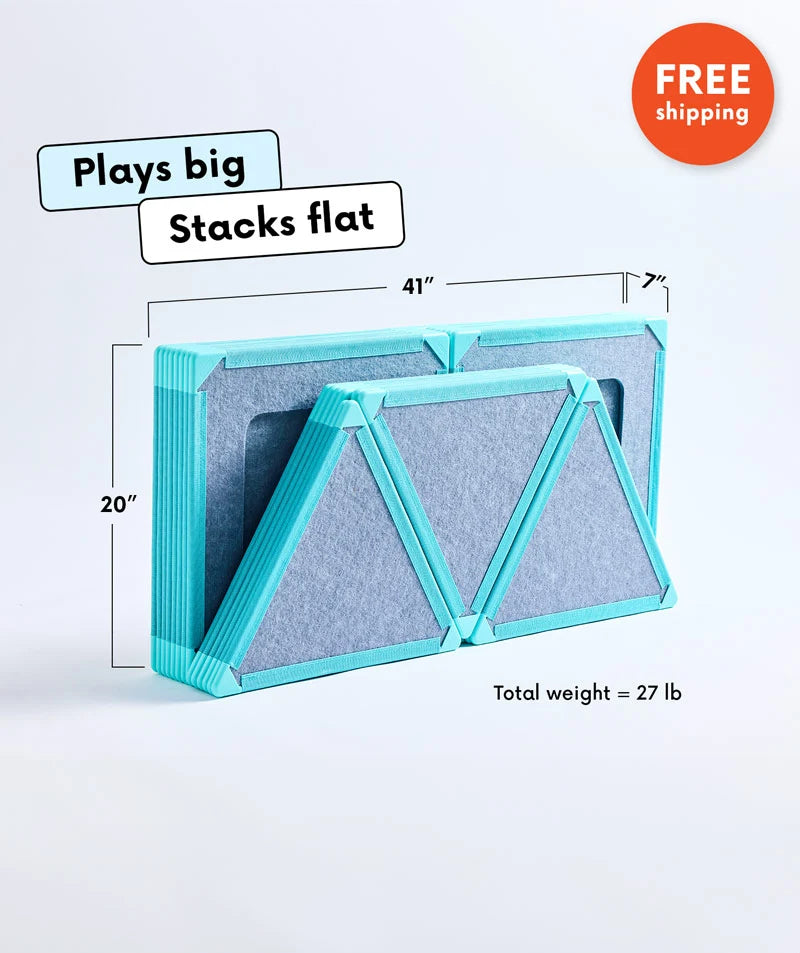
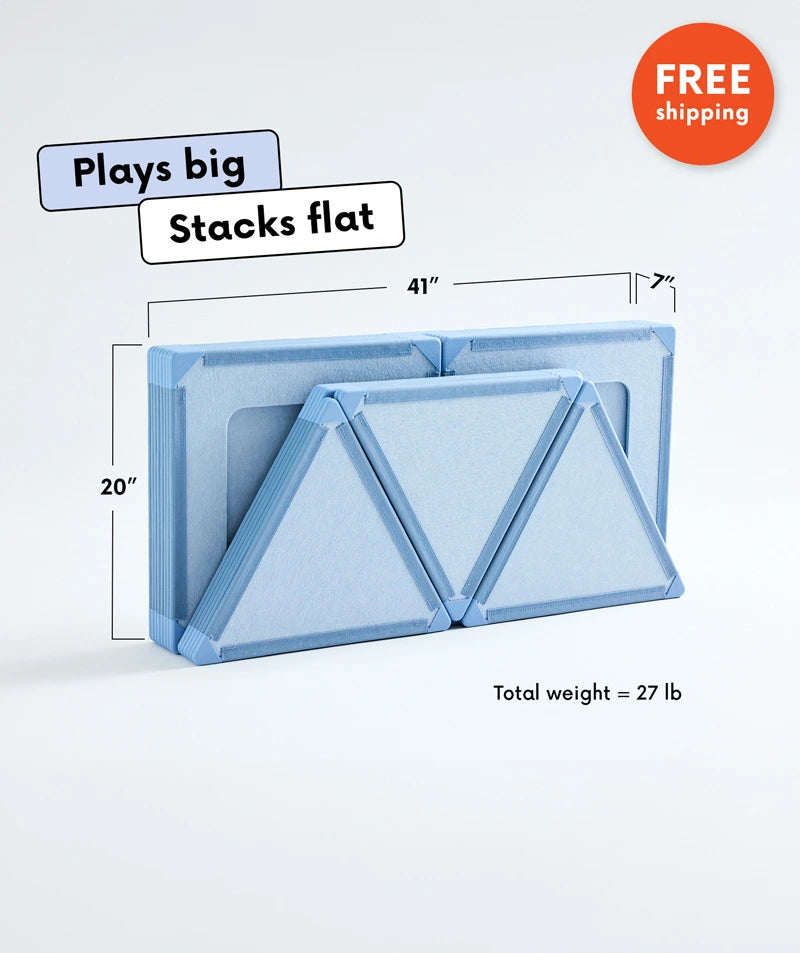
Superspace magnetic building panels turn forts into obstacle courses or reading nooks, then hide in 2 square feet when playtime ends.

Key Takeaways
- Space-saving indoor playhouse alternatives replace a bulky kids playhouse with just 2 sq ft of storage
- Fort building systems offer unlimited configurations versus fixed playhouse designs that kids outgrow in 2-4 years
- Magnetic building panels develop STEM skills, spatial reasoning, and problem-solving through active construction play
- Open-ended construction toys provide 5-8+ years of engagement compared to 2-4 years for traditional playhouses
- Best playhouse alternatives include magnetic panels ($279-$429), fort building kits ($30-$150), and collapsible options starting at $30
- Space-saving solutions eliminate 3-8 hours of assembly time required for traditional wooden playhouses
- Construction-based play enhances executive function and self-regulation better than passive fixed structures
Table of Contents
- Why Traditional Indoor Playhouses Fall Short
- What Are Indoor Playhouse Alternatives?
- The Benefits of Open-Ended Construction Play
- Space-Saving Solutions for Small Homes and Apartments
- Cost-Per-Year Analysis: True Value Comparison
- Age Range and Developmental Stages
- Real Parent Scenarios: Which Alternative Is Right for You?
- How to Maximize Small Space Play
- Making the Switch: Transitioning from Traditional Playhouse
- Conclusion: Rethinking Play Space in Modern Homes
- References
Why Traditional Indoor Playhouses Fall Short
Traditional indoor playhouses promise magical play experiences. But the reality for most families tells a different story. Once assembled and placed in your living room or bedroom, that charming cottage becomes a permanent fixture you navigate around every single day.
The Space Problem: 15-30 Square Feet of Permanent Real Estate
The Little Tikes Cape Cottage measures 42.8 inches by 35 inches at its base. That's 10.4 square feet of floor space. The Step2 Neat & Tidy Cottage II takes up 38.5 inches by 54.5 inches, nearly 15 square feet. Larger wooden playhouses claim 30 to 63 square feet, roughly the size of a small bedroom. Even a small indoor playhouse still claims a chunk of your floor plan.
Unlike regular furniture, you can't rearrange an indoor playhouse. It sits exactly where you placed it on day one. For families in apartments or homes under 1,200 square feet, that permanent footprint creates a painful trade-off between your child's play space and your family's living space.

The High Cost of Limited Play Value
Traditional playhouses range from $150 for basic plastic models to $1,129 for premium wooden structures.
That's a significant investment for most families buying a playhouse for kids. Yet parent testimonials reveal a concerning pattern: children play intensely for the first two weeks, then interest gradually fades over the next 2 to 4 years.
The fixed cottage or house design offers only one way to play. Your child pretends it's a home, a store, or maybe a castle.
But after discovering all possible configurations of the same four walls and windows, the novelty wears off. That $400 investment delivered less than two years of engaged play.
Assembly Complexity and Maintenance Requirements
Plastic playhouses require 20 minutes to 2 hours of assembly time.
Wooden structures demand 3 to 8 hours of careful construction. You'll need Phillips screwdrivers, potentially power drills, and the patience to follow 30 to 50-page instruction manuals.
Many parents report frustration with missing hardware or unclear assembly diagrams.
Wooden playhouses require annual maintenance, including sealant reapplication and regular cleaning.
Plastic models collect dust in crevices and fade from sun exposure over time. The maintenance burden adds hidden costs beyond the initial purchase price.
Limited Developmental Benefits
A fixed playhouse structure provides one primary benefit: imaginative role-play.
Your child pretends to cook, clean, or run a store. These activities support social development and language skills.
But traditional playhouses miss opportunities for STEM learning, engineering challenges, and problem-solving that construction-based alternatives naturally provide.
Research shows that 68% of children's self-regulation ability can be predicted by the quality of their play experiences [2].
Fixed structures with predetermined play scripts offer less cognitive challenge than open-ended construction systems where children must plan, build, and problem-solve independently.

What Are Indoor Playhouse Alternatives?
Indoor playhouse alternatives share a common advantage: they deliver imaginative play value without permanently consuming your living space.
These solutions range from simple fabric tents to sophisticated magnetic building systems. Each option offers distinct benefits for different family situations.
Fabric Pop-Up Tents and Teepees
Fabric play tents create cozy hideaways that children transform into homes, castles, or secret bases.
Most measure 3 to 4 feet in diameter and stand 4 to 5 feet tall. The fabric construction weighs just 2 to 4 pounds, allowing kids to move the portable playhouse for kids between rooms or store it in a closet when not in use.
Pop-up tents fold flat to approximately 2 feet in diameter and 2 inches thick.
That compact storage represents a 95% reduction in floor space compared to traditional playhouses. Canvas teepees with wooden pole frames require slightly more storage space but still collapse to a manageable bundle.
These alternatives cost $30 to $150, significantly less than traditional playhouses.
The trade-off: fabric structures offer predetermined shapes with limited customization.
Your child can't rebuild the tent into different configurations or combine multiple units into larger structures.
Cardboard Playhouses
Cardboard playhouses provide an affordable entry point into indoor play structures.
These flat-pack designs ship as printed cardboard sheets that children help assemble. The assembly process itself becomes a creative activity, with many models including markers for customization. They're an easy playhouse for small spaces when you need a temporary option.
Melissa & Doug cardboard playhouses cost $30 to $60. After assembly, they provide 2 to 6 months of play value before cardboard deterioration requires recycling.
This short lifespan makes cardboard ideal for temporary solutions or families testing whether their child enjoys enclosed play spaces before investing in permanent options.
The environmental impact deserves consideration. Cardboard production and disposal create waste, though the material is recyclable.
For families seeking longer-term solutions, cardboard's brief lifespan makes it less cost-effective than more durable alternatives.
Inflatable Play Structures
Inflatable playhouses combine the portability of fabric tents with more substantial structures resembling traditional cottages.
These vinyl constructions inflate in 2 to 5 minutes using the included electric pumps. When deflated, this collapsible playhouse format rolls up for storage in standard closets or under beds.
Most inflatable playhouses cost $50 to $150 and measure 4 to 6 feet when inflated.
The vinyl construction resists wear better than fabric tents but requires careful attention to prevent punctures. Inflatable structures work best for supervised play in homes without sharp objects or pet claws.
Storage convenience represents the primary advantage. A 5-foot inflatable playhouse compresses to approximately 1 square foot of storage space.
However, the inflation and deflation process adds setup time compared to instant-play alternatives like pop-up tents or permanent structures.
Fort Building Kits with Rods and Connectors
Fort building kits transform bed sheets and blankets into custom structures using plastic rods and connectors.
Children insert rods into ball-shaped connectors, creating frameworks for tunnels, castles, spaceships, or houses. Families who want fort building instead of playhouse monotony get open-ended builds that stay fresh.
Fort Magic and Crazy Forts dominate this category with kits ranging from $30 to $150.
A basic 25-piece kit creates small structures 3 to 4 feet tall. Larger 69-piece sets build elaborate multi-room fortresses spanning 6 to 8 feet in multiple directions.
The educational value extends beyond imaginative play.
Children develop spatial reasoning by visualizing three-dimensional structures from two-dimensional plans. They problem-solve when structures wobble or collapse, learning engineering principles through trial and error.
Research confirms that early spatial skills predict later mathematics performance [3].
Storage requirements remain minimal. A 44-piece fort building kit fits in a storage bin measuring 12 inches by 8 inches by 4 inches. That's approximately 0.3 square feet, representing a 98% reduction compared to traditional playhouses occupying 15 to 30 square feet permanently.
For a comprehensive comparison of different fort building kit systems, including detailed reviews of Fort Magic, Crazy Forts, and other leading brands, see our complete guide to the best fort building kits.

Magnetic Building Panel Systems
Magnetic building panels represent the newest category of indoor playhouse alternatives.
Large-scale panels with embedded magnets connect edge-to-edge, creating stable walls, tunnels, and multi-story structures.
Unlike small magnetic tiles designed for tabletop play, life-sized panels accommodate children climbing inside their creations. They function like a space saving playhouse that stores flat.
Superspace pioneered this category with 24-inch square panels that children can walk through and play inside.
The patented magnetic connection system allows 3-year-olds to successfully build without adult assistance, yet offers sufficient complexity to engage 8-year-olds in engineering challenges.
The Little Set with 16 panels creates simple houses, tunnels, and multi-room structures with doorways and windows.
The Big Set with 24 panels enables advanced builders to construct elaborate castles with towers, maze systems, or two-story forts. Each configuration takes 5 to 15 minutes to build and stores flat against a wall or in a closet.
The magnetic system delivers three advantages that other alternatives can't match.
First, instant stability.
Unlike rod systems that require careful balancing, magnetic panels lock together securely enough for active play.
Second, true modularity.
Children rebuild the same panels into completely different structures daily.
Third, longevity.
The durable panels withstand years of repeated building, climbing, and play.
Research shows that construction play with three-dimensional materials enhances spatial skills critical for STEAM subjects [4].
When children physically manipulate large panels to create structures, they develop spatial visualization abilities that transfer to mathematics, science, and engineering tasks.
To explore how life-sized magnetic building panels compare to traditional tabletop magnetic tiles and other construction toys, read our complete guide to magnetic building toys.

The Benefits of Open-Ended Construction Play
Traditional playhouses provide a predetermined play experience. You assemble the structure once, and children play with that fixed design until they outgrow it.
Construction-based alternatives flip this model entirely. The building process itself becomes the primary play activity, with imaginative role-play following afterward.
Unlimited Configurations vs. Fixed Designs
A traditional playhouse offers one configuration: the cottage or house design you assembled on day one.
Your child might rearrange toy furniture inside or hang decorations, but the fundamental structure never changes. After exploring every window, door, and corner, familiarity breeds boredom.
Construction alternatives like magnetic building panels or fort building kits offer truly unlimited possibilities.
Today's house becomes tomorrow's spaceship, next week's castle, and next month's maze system. Children who built the same structure five times discover that repositioning a single panel creates an entirely different play experience.
This variety directly impacts engagement duration.
Parent testimonials suggest traditional playhouses maintain strong interest for 6 months to 2 years before becoming background furniture.
Construction systems sustain active engagement for 5 to 8 years because the building process presents new challenges each time.
This principle reflects the core benefits of open-ended play, which research shows significantly enhances creativity, problem-solving, and long-term engagement.

Active Building vs. Passive Play
Traditional playhouses require 20 minutes to 8 hours of parent assembly, then provide a finished structure for passive play.
Children walk through the door, pretend to cook in the kitchen, and engage in role-play activities. The playhouse itself remains static throughout this process.
Construction alternatives transform children from consumers into creators. They plan which structure to build, select the necessary panels or rods, execute the construction, and then play inside their creation.
This active building process engages different cognitive skills than passive play inside finished structures.
Research confirms that children show 49% to 114% improvements in gross motor skills when engaged in construction play that requires large muscle movements [5].
Building life-sized structures develops spatial awareness, hand-eye coordination, and motor planning as children position panels, connect pieces, and test structural stability.
These benefits reflect the broader research on why hands-on learning is essential for child development, creating stronger neural pathways than passive learning approaches.

STEM Learning Through Engineering Challenges
Every construction project teaches engineering principles through hands-on experience.
Children discover that triangle configurations create more stable structures than rectangles. They learn that panels placed at angles can form tunnels and ramps. When structures wobble or collapse, they troubleshoot by repositioning supports or adding reinforcement panels.
These engineering challenges develop critical thinking skills that traditional playhouses can't provide.
A fixed cottage structure teaches your child how to open doors and pretend to cook. A construction system teaches them how forces, balance, and geometry determine whether structures stand or fall.
The American Academy of Pediatrics emphasizes that play enhances brain structure in the frontal cortex, supporting executive function development [1].
Construction play particularly strengthens planning, problem-solving, and flexible thinking as children must visualize structures, execute building plans, and adapt when initial designs don't work as expected.
Beyond construction play, discover 40+ hands-on STEM activities that extend engineering and problem-solving learning across science, technology, and mathematics.
Developing Executive Function and Self-Regulation
Open-ended construction play requires sustained attention, planning, and self-regulation.
Children must resist impulsive building to consider which panel placement creates their desired structure. They manage frustration when builds collapse, developing emotional regulation skills through trial and error.
Research involving 127 children found that 68% of self-regulation ability could be predicted by play quality measures [2].
Construction play that requires planning and problem-solving builds stronger self-regulation skills than predetermined play scripts in fixed structures.
When children build with magnetic panels or fort building kits, they practice the same executive function skills that support later academic success. They plan multi-step projects, monitor progress toward goals, adjust strategies when approaches fail, and persist through challenges.
These cognitive skills transfer directly to classroom tasks like multi-step math problems or science experiments.
For parents of children with ADHD or executive function challenges, learn how construction play specifically supports executive functioning development through structured, multi-sensory engagement.

Space-Saving Solutions for Small Homes and Apartments
Space constraints create the primary obstacle preventing families from providing adequate play areas.
If you're hunting for the best indoor playhouse for small apartment living, footprint is the obstacle. In apartments or small homes where every square foot matters, that footprint forces impossible choices between play space and living space.
Storage Footprint Comparison
The Little Tikes Cape Cottage occupies 10.4 square feet on your floor every single day. The Step2 Neat & Tidy Cottage claims 15 square feet permanently.
Wooden playhouses consume 30 to 63 square feet, essentially eliminating an entire room or corner for any other purpose. You need a playhouse that doesn't take up space once kids are done.
Playhouse alternatives offer dramatic storage improvements.
The Superspace Little Set with 16 panels stores flat against a wall in 2 square feet.
That represents a 93% reduction in space requirements compared to a 30-square-foot playhouse.
Fort building kits compress into storage bins, occupying less than 1 square foot. Pop-up tents fold to 2-foot diameter circles just 2 inches thick.
This storage efficiency transforms how families use their living space.
When children finish playing, magnetic panels slide behind the couch or into a closet. The living room returns to full adult functionality within 2 minutes.
Traditional playhouses never disappear.
They dominate your space 24 hours per day, 365 days per year. This minimalist approach aligns with research showing that fewer, more versatile toys enhance creativity and focus better than rooms filled with single-purpose items.
Multi-Room Flexibility
Traditional playhouses cannot move between rooms. Once assembled, they stay in the designated space.
If your child wants to play in their bedroom today and the playroom tomorrow, the fixed structure prevents that flexibility.
Portable alternatives like magnetic panels or fort building kits travel wherever children want to play.
Morning construction happens in the living room where sunlight streams through windows.
Afternoon play moves to bedrooms for quiet fort reading time. Evening builds take over the playroom for active climbing adventures.
This flexibility particularly benefits families with multiple children sharing bedrooms.
When siblings need separate spaces, a magnetic panel wall temporarily divides the room.
When they want to play together, the panels reconfigure into a shared castle or house. The same building materials serve completely different purposes throughout the day.
Rental-Friendly Solutions
Rental agreements often restrict permanent structures or require property modifications.
Large wooden playhouses may violate lease terms about furniture size or weight limits. Even plastic playhouses create damage risks if children scratch floors or walls during play.
Magnetic building panels and fort building kits leave zero permanent impact on rental properties. No installation required. No wall mounting. No floor anchoring. These solutions simply sit on existing floors, then store away when the lease ends or family moves.
For families who relocate frequently due to work or military service, portable play structures travel to new homes without specialized packing or shipping arrangements.
The rental-friendly nature extends value beyond the current home. When you purchase a traditional playhouse, you're investing in a structure that may not fit your next apartment or house.
When you purchase magnetic panels or fort building kits, you're investing in a system that adapts to any future living space, regardless of size or layout.

Cost-Per-Year Analysis: True Value Comparison
Upfront price tags tell only part of the value story.
The true cost of any play equipment depends on the purchase price divided by the years of active engagement. This cost-per-year calculation reveals which solutions deliver the best long-term value for families.
Traditional Playhouse Costs
Traditional plastic playhouses cost $150 to $400 for standard models.
Premium wooden structures range from $500 to $1,129.
Parent testimonials and product reviews indicate children maintain a strong interest for approximately 2 to 4 years before outgrowing the structure or losing interest in the fixed design.
A $300 plastic playhouse used actively for 3 years costs $100 per year.
A $600 wooden playhouse with 4 years of engagement costs $150 per year. T
hese calculations assume no resale value because local pickup requirements and assembly complexity make used playhouses difficult to sell.
Assembly time adds hidden costs.
If parents value their time at even $20 per hour, the 3 to 8 hours required for wooden playhouse assembly adds $60 to $160 in labor costs. Maintenance supplies, including wood sealant and cleaning products, add another $20 to $40 over the structure's lifespan.
Alternative Solution Costs
Fort building kits range from $30 for basic 25-piece sets to $150 for elaborate 69-piece systems.
These kits maintain engagement from ages 3 to 10 as children progress from simple tunnels to complex multi-room structures. With 7 years of active use, a $100 fort building kit costs approximately $14 per year.
Pop-up fabric tents cost $30 to $100 and typically engage children for 2 to 5 years, depending on quality. A $60 tent with 3 years of use costs $20 per year. Inflatable playhouses at $75 to $150 deliver similar longevity, averaging $25 to $40 per year.
Magnetic building panels represent the highest upfront investment at $279 to $429 for complete sets.
However, the durability and expanding complexity support 5 to 8+ years of engagement as children grow from simple structures at age 3 to elaborate engineering projects at age 8 and beyond.
The Little Set at $279, used for 6 years, costs approximately $47 per year.
Long-Term Value Assessment
The cost-per-year analysis reveals a counterintuitive truth: the least expensive option (cardboard playhouses at $30-60) delivers the worst value because the 3 to 6-month lifespan creates costs of $60 to $240 per year.
The mid-priced options (fort building kits and magnetic panels at $100-429) deliver the best value through extended engagement periods.
Educational value adds another dimension beyond pure entertainment cost.
Traditional playhouses support imaginative role-play but limited STEM learning.
Construction alternatives teach engineering, spatial reasoning, and problem-solving throughout their extended lifespans.
If you value these educational benefits, construction systems deliver significantly more developmental impact per dollar invested.
Magnetic building panels maintain structural integrity through years of play, making them ideal for passing down to younger siblings when older children outgrow them.
Fort building kit rods and connectors rarely break, creating lasting value that serves multiple children in the family over many years.

Age Range and Developmental Stages
Different playhouse alternatives suit different developmental stages. U
Understanding which options match your child's current abilities and future growth helps you select solutions that deliver maximum value throughout childhood, including the right indoor playhouse for toddlers.
Ages 2-3: Simple Enclosed Spaces
Toddlers ages 2 to 3 seek cozy enclosed spaces that provide sensory security. They enjoy crawling through tunnels, hiding in small areas, and peeking out from behind walls.
Complex construction challenges exceed their developmental abilities at this stage.
Pop-up fabric tents excel for this age group.
The instant setup provides immediate gratification without frustrating toddlers who lack patience for extended building processes. The enclosed fabric walls create the cozy hideaway feeling that helps young children develop spatial awareness and body boundaries.
Simple magnetic building panels work well for advanced 3-year-olds with adult support.
Parents can demonstrate basic construction while toddlers help place panels, developing early understanding of cause and effect as magnetic edges snap together.
The building process should take less than 5 minutes to maintain toddler attention spans. For more age-appropriate play options for toddlers, explore our guide to best sensory play toys that support tactile development and body awareness.
Ages 4-5: Beginning Construction Skills
Preschoolers ages 4 to 5 develop the fine motor skills and cognitive planning abilities to engage in simple construction projects.
They can follow basic visual instructions, understand geometric shapes, and persist through 10 to 15-minute building sessions.
Fort building kits with large connectors suit this developmental stage.
Children successfully insert rods into ball connectors, creating simple rectangular frames they drape with sheets. The trial-and-error process teaches spatial concepts like "above," "beside," and "between" while building frustration tolerance.
Magnetic building panels at this age support more elaborate projects. Four- and 5-year-olds build simple houses with four walls and a doorway, then progress to tunnels and multi-room structures.
Research confirms that construction play with three-dimensional materials develops spatial skills essential for later STEAM learning [4].

Ages 6-8: Complex Engineering Projects
School-age children ages 6 to 8 demonstrate the cognitive complexity to plan multi-step projects, troubleshoot structural problems, and pursue extended building sessions lasting 30 to 60 minutes.
They begin understanding abstract concepts like symmetry, balance, and structural reinforcement.
This age group exhausts the learning potential of fixed playhouses.
After years of pretend play in the same cottage structure, 7 and 8-year-olds seek more challenging activities.
Traditional playhouses languish unused while children pursue screen time or other engaging options.
Construction alternatives maintain strong engagement throughout this stage.
Six-year-olds build simple structures. Seven-year-olds add complexity with multiple rooms, levels, and architectural features. Eight-year-olds tackle engineering challenges like building the tallest stable tower or creating maze systems with multiple pathways.
The educational research supports this extended engagement. Studies show that spatial skills developed during construction play correlate with mathematics performance [3].
As children tackle increasingly complex building projects, they develop the spatial reasoning abilities that support geometry, algebra, and advanced math concepts in later grades.
Ages 9+: Advanced Creative Projects
Children ages 9 and older rarely play with traditional playhouses.
The fixed structures designed for preschool pretend play don't offer sufficient complexity for pre-teens seeking genuine creative challenges.
Most playhouses get relegated to storage, donated, or discarded by this age.
Advanced construction systems continue to engage older children through increasingly sophisticated projects.
Pre-teens build elaborate multi-level structures, experiment with architectural designs, and create challenge courses combining multiple building elements.
The open-ended nature supports creative expression without the "babyish" associations of predetermined play structures.
Superspace magnetic panels serve this extended age range particularly well.
The same panels that thrilled your 3-year-old with simple four-wall houses challenge your 10-year-old to engineer stable two-story structures or complex maze systems.
This longevity makes magnetic panels a true "lifetime toy" that grows with your family rather than getting outgrown and discarded.

Real Parent Scenarios: Which Alternative Is Right for You?
Every family faces unique space constraints, budget limitations, and child preferences.
Understanding how different alternatives suit specific situations helps you select the best solution for your household.
Scenario 1: Apartment Living with 800 Square Feet
Sarah lives in an 800-square-foot, two-bedroom apartment with her 4-year-old daughter. She wanted to provide her child with a special play space but couldn't sacrifice 20 square feet for a traditional playhouse. After researching alternatives, she invested in the Superspace Little Set with 16 panels for $279. These playhouse alternatives for small homes let her reclaim shared space.
The magnetic panels store flat behind the living room couch when not in use. Each morning, Sarah's daughter builds a new structure:
Monday's house becomes Tuesday's castle, Wednesday's tunnel, and Friday's store.
The building process itself entertains her for 30 to 45 minutes, followed by hours of imaginative play inside her creation. When bedtime arrives, the panels slide back into storage in under 5 minutes.
Cost-per-year analysis: With projected 6+ years of use from age 4 to 10+, the $279 investment costs approximately $47 per year. Sarah avoided the $300 to $500 she would have spent on a traditional playhouse that would dominate her living room permanently.
If you're considering Superspace for your family, our comprehensive parent buying guide covers set sizing, safety features, age recommendations, and storage strategies in detail.
Scenario 2: Rental Home with Annual Moves
Marcus and Jennifer relocate annually for military service. They have two children, ages 3 and 6, who need engaging play equipment that travels easily between assignments. Traditional playhouses proved impractical because disassembly and reassembly with each move created significant hassle.
They chose the Superspace Little Set, which packs flat with their luggage. At each new rental house, the kids immediately rebuild favorite fort configurations while parents unpack. The portable system works equally well in small apartments or larger houses.
The consistent builds supported both children through each move. Familiar structures in unfamiliar rooms helped them feel at home faster after relocation. As they grow, the same panels keep offering new engineering challenges without adding bulk to their household goods.
Scenario 3: Multiple Children with Different Ages
Rebecca has three children ages 2, 5, and 8. She needed a play solution that engaged all three simultaneously despite their different developmental stages. A traditional playhouse suited the 5-year-old but didn't challenge the 8-year-old and overwhelmed the 2-year-old.
She selected a combination approach: pop-up fabric tent ($45) for the 2-year-old's sensory needs, plus the Superspace Big Set with 24 panels ($429) for the older children's construction projects. The tent provided the cozy hideaway the toddler craved, while magnetic panels challenged the 5 and 8-year-olds to collaborate on elaborate structures.
The siblings often combined both systems. The 5-year-old built magnetic panel rooms, then dragged the fabric tent inside as a "bedroom" within the larger house structure. The 8-year-old designed maze systems with the tent as the reward at the center. The 2-year-old enjoyed playing in both the tent and the magnetic structures his siblings built.
Total investment: $474 for equipment serving three children across a 6-year span (ages 2-8). Cost per child per year: approximately $26.

Scenario 4: Budget-Conscious Family Testing Options
David and Michelle wanted to provide their 4-year-old son with fort-building experiences but hesitated to invest $279+ before confirming his interest. They started with a basic Crazy Forts 25-piece kit for $30.
Their son immediately loved building tunnels and simple structures. After three months of daily fort building, David and Michelle felt confident investing in a more robust system. They purchased the Superspace Little Set with 16 panels for $279, which complemented the existing rod-and-connector kit. The combined systems let their son create hybrid structures using both magnetic panels and rod frameworks.
This staged investment approach cost $309 total while managing financial risk. If their son hadn't enjoyed construction play, they would have lost only $30 rather than $279+. The testing period confirmed that fort building matched his play preferences, making the larger investment worthwhile.
Scenario 5: Grandparents Seeking Special Play Space
Janet and Robert wanted to create a special play experience for grandchildren ages 3 to 9 who visit every weekend. A traditional playhouse seemed excessive for part-time use, but they wanted something more substantial than simple toys.
They installed the Superspace Little Set with 16 panels in their spare bedroom. The panels store flat against the wall during the week when grandchildren aren't present. On Friday afternoons before visits, Janet sets up a basic structure that grandchildren immediately modify into their preferred designs.
The magnetic panels serve children across the entire age range. The 3-year-old plays inside structures his older cousins build. The 6-year-old constructs simple houses and tunnels. The 9-year-old challenges himself with elaborate engineering projects. The same equipment engages the entire group simultaneously despite six years of age difference.
Janet reports that fort building became the primary activity during visits, replacing previous screen time habits. The grandchildren plan their weekend building projects throughout the week, arriving with design ideas ready to execute. This natural replacement of screen time with active construction play reflects strategies outlined in our guide on reducing screen time while boosting child development.
How to Maximize Small Space Play
Space constraints don't have to limit play value. Strategic approaches help families create rich play experiences even in apartments or small homes under 1,000 square feet.

Vertical Space Utilization
Most families focus on floor space when assessing play areas. Vertical space offers untapped potential for construction play that doesn't consume precious floor real estate. Magnetic building panels can stack vertically against walls, creating tall towers and castles that occupy minimal floor footprint while maximizing visual impact.
Fort building kits excel at vertical construction. Children build upward rather than outward, creating tall structures 5 to 6 feet high that occupy just 4 to 6 square feet of floor space. The vertical emphasis satisfies children's desire for substantial structures without spreading across entire rooms.
Rotation Systems for Play Equipment
Instead of providing constant access to all toys, implement rotation systems where certain play equipment appears for two-week periods before storing away. This approach maintains novelty while preventing toy overwhelm in small spaces.
Magnetic building panels work exceptionally well in rotation systems. Store panels for two weeks while children play with other toys. When you reintroduce the panels, children approach building with renewed enthusiasm and fresh design ideas. The break prevents both toy fatigue and parent frustration with ongoing construction projects cluttering living spaces.
Multi-Functional Furniture Integration
Strategic furniture selection supports play without dedicated playroom space. Coffee tables with storage underneath house building kits. Ottomans with hidden compartments store magnetic panels. Bookshelves with deep shelves accommodate structures children build and want to preserve overnight.
This integration allows living rooms to serve dual purposes: adult living space most of the day, temporary play space during designated building times. The furniture itself facilitates this transition rather than creating obstacles to overcome.
Designated Building Times
Establish consistent building times when construction play takes over shared spaces. For example, 4 PM to 6 PM becomes "fort building time" when living rooms transform into construction zones. After 6 PM, structures get dismantled and equipment stores away for family dinner and evening activities.
These designated times teach children to respect shared family space while guaranteeing their construction play remains a priority. The time limits also encourage children to complete projects efficiently rather than leaving half-finished structures scattered indefinitely.
Research on play quality confirms that consistency and routine support deeper engagement [2].
Children who know building time occurs daily at 4 PM arrive prepared with design plans, leading to more sophisticated projects than sporadic building sessions without clear timeframes.

Making the Switch: Transitioning from Traditional Indoor Playhouse to Superspace
Some families already own traditional playhouses but recognize their limitations. Transitioning to alternatives requires thoughtful approaches that honor children's attachments while introducing new play possibilities.
Gradual Introduction Approach
Don't immediately discard the traditional playhouse. Instead, introduce construction alternatives alongside the existing structure. Let children discover through experience that building their own structures offers more engagement than playing in the predetermined cottage.
Purchase a small starter set like a 6-panel magnetic building kit or basic fort building system. Place it near the traditional playhouse without commentary. Many children naturally gravitate toward the construction alternative because the building process itself provides novelty the fixed structure can't match.
After two to four weeks, most children spend more time with construction alternatives than traditional playhouses. At this point, suggest donating or storing the old playhouse to "make room for bigger fort building projects." Children who participated in the decision feel empowered rather than having their toy confiscated.
Repurposing Existing Equipment
Traditional playhouses can integrate into fort building systems rather than getting discarded entirely. Use the playhouse as the "castle keep" within a larger magnetic panel castle structure. Drape fort building kit frameworks over and around the playhouse, creating hybrid mega-structures that combine both systems.
This repurposing extends the playhouse's engagement while introducing construction play concepts. Children learn that combining different building elements creates more possibilities than any single system alone. The creativity this approach fosters transfers to other areas as children discover that existing resources can be reimagined rather than replaced.
Reframing Play Priorities
The transition from traditional playhouses to construction alternatives represents a philosophical shift in how families approach play. Fixed structures emphasize imaginative role-play within predetermined parameters. Construction systems prioritize creativity, engineering, and problem-solving alongside imaginative play.
Help children understand this expanded play definition. "Instead of one house you play inside, you'll be able to build different structures every single day. Yesterday's spaceship becomes today's castle and tomorrow's maze." This reframing builds excitement about new possibilities rather than sadness about losing the old playhouse.
The American Academy of Pediatrics emphasizes that play creates brain architecture supporting executive function development [1].
Construction play particularly strengthens these skills through planning, problem-solving, and flexible thinking. Framing the transition as upgrading to "big kid building toys" helps children embrace the change with enthusiasm.

Conclusion: Rethinking Play Space in Modern Homes
Traditional indoor playhouses served families well for decades. But modern living demands more flexible solutions than a fixed kids playhouse.
The 1,200-square-foot homes and studio apartments where today's families live can't accommodate 30 square feet of permanent play structures without significant sacrifices.
Indoor playhouse alternatives solve the space problem without compromising developmental benefits. Magnetic building panels, fort building kits, and collapsible play structures deliver the same imaginative play value in fractions of the space.
These alternatives add educational benefits through construction challenges that develop STEM skills, spatial reasoning, and executive function.
The cost-per-year analysis reveals that mid-priced construction systems ($100-400) deliver superior long-term value compared to traditional playhouses through extended engagement periods spanning 5 to 8+ years.
Children don't outgrow building systems because the complexity grows with their abilities. The same panels that thrilled them as preschoolers challenge them as elementary students.
Your child deserves rich play experiences regardless of your home size.
Space constraints don't limit development when you select play equipment that stores efficiently and offers genuine educational value.
Fort building instead of traditional playhouses represents not a compromise but an upgrade: more configurations, more learning, more years of engagement, and more family living space preserved.
Superspace magnetic building panels exemplify this new generation of play equipment designed for modern families.
The panels transform any room into a creative construction zone, then disappear into 2 square feet of storage. From ages 3 to 10+, children build increasingly sophisticated structures that support their developmental growth while respecting your family's space needs.
Ready to reclaim your living space while enhancing your child's play experiences?
Explore Superspace magnetic building panels and discover how construction play creates more value than traditional playhouses ever could.
References
- Yogman, M., Garner, A., Hutchinson, J., Hirsh-Pasek, K., Golinkoff, R. M., & American Academy of Pediatrics Committee on Psychosocial Aspects of Child and Family Health & Council on Communications and Media. (2018). The power of play: A pediatric role in enhancing development in young children. Pediatrics, 142(3), e20182058. https://doi.org/10.1542/peds.2018-2058
- Bredikyte, M., & Brandisauskiene, A. (2023). The links between play quality and self-regulation in 3- to 6-year-old children. Early Years: An International Research Journal, 43(2), 179-194. https://doi.org/10.1080/09575146.2021.1912910
- Verdine, B. N., Golinkoff, R. M., Hirsh-Pasek, K., Newcombe, N. S., Filipowicz, A. T., & Chang, A. (2013). Deconstructing building blocks: Preschoolers' spatial assembly performance relates to early mathematical skills. Child Development, 85(3), 1062-1076. https://doi.org/10.1111/cdev.12165
- İleri, Z., Topaloglu, M. Y., Karaman, B. A., & Kazak, G. (2023). The relationship between early spatial thinking ability and STEAM activities in preschool. Participatory Educational Research, 10(2), 148-168. https://doi.org/10.17275/per.23.23.10.2
- Sutapa, P., Pratama, K. W., Rosly, M. M., Ali, S. K. S., & Karakauki, M. (2021). Improving motor skills in early childhood through goal-oriented play activity. Children, 8(11), 994. https://doi.org/10.3390/children8110994