Is Dramatic Play Still Taken Seriously? Why It Deserves the Spotlight
Becky WilsonWhen schedules get tight, dramatic play is often the first thing to go. It feels easy to cut. After all, it looks like children are "just playing."
But research tells a different story. Decades of studies show that dramatic play builds the very skills educators value most: self-regulation, language, empathy, and kindergarten readiness.
This is not a case for nostalgia or wishful thinking. It is a case backed by science.
Dramatic play deserves to be treated as essential in early childhood education, not as filler between "real" lessons.
In this guide, you will learn what the research actually shows, why novelty matters for sustained engagement, and how flexible environments like Superspace make rotating dramatic play themes practical and sustainable.

Key Takeaways
- Dramatic play develops executive function, self-regulation, and impulse control in young children.
- Research spanning over two decades links sociodramatic play directly to kindergarten readiness.
- Novelty matters: rotating themes keep children engaged and introduce fresh learning opportunities.
- Pretend play builds empathy by letting children practice perspective-taking in safe scenarios.
- The quality of play environments directly impacts developmental outcomes.
- Flexible, modular spaces make dramatic play sustainable for busy classrooms.
- Treating dramatic play as essential, not optional, leads to measurably better outcomes.
Table of Contents
- The Science Behind Dramatic Play
- What Dramatic Play Develops (And Why It Matters)
- The Power of Novelty: Why Rotating Themes Keep Kids Engaged
- Creating Inclusive Dramatic Play Experiences
- Why Dramatic Play Gets Pushed Aside
- Making Dramatic Play Sustainable: A Flexible Environment Approach
- A Month of Dramatic Play: Theme Rotation Ideas
- Treating Dramatic Play Like It Matters
- References
The Science Behind Dramatic Play
When children don costumes, take on roles, and navigate imaginary scenarios, something significant is happening in their brains. They are not just playing. They are building executive function.
Executive function refers to the mental processes that allow us to plan, focus attention, remember instructions, and juggle multiple tasks. These skills are the foundation of academic success and social competence.
A landmark study by Elias and Berk published in Early Childhood Research Quarterly found that sociodramatic play serves as a critical context for developing self-regulation skills [1].
Children who engaged in more complex pretend play showed stronger impulse control and better ability to follow multi-step directions.
More recent research confirms these findings. Veresov et al. in a 2021 study published in Frontiers in Psychology demonstrated that the quality of sociodramatic play significantly impacts executive function development [2].
The type of play matters. The environment matters. And the opportunities for extended, immersive role-play matter.
Slot et al. found that higher quality pretend play environments produce measurably better cognitive outcomes [3].
This is not about simply having a dress-up corner. It is about creating conditions where dramatic play can flourish.

What the Studies Actually Show
The benefits of dramatic play extend beyond cognitive development. Research by Qu et al. shows that sociodramatic play enhances theory of mind, which is the ability to understand that others have thoughts and feelings different from our own [4].
This is empathy in action. Children practicing being a doctor must consider how a "patient" feels. Children playing restaurant must anticipate what a "customer" needs.
Gioia and Tobin documented that self-regulation skills developed through sociodramatic play directly support classroom adaptation and school success [5].
Matthews found that sociodramatic play is a key contributor to kindergarten readiness, addressing the very academic outcomes that often pressure schools to cut play time [6].
And in 2024, Özcan and İvrendi confirmed that complexity in sociodramatic play correlates positively with children's self-regulation abilities [7].
This is not opinion. It is decades of consistent findings across multiple research teams and methodologies. For more on how play supports executive functioning development, see our related guide.

What Dramatic Play Develops (And Why It Matters)
Understanding the research is important. But educators also need to see how these benefits show up in daily classroom life.
Language and Communication
Dramatic play is one of the richest contexts for language development. When children take on roles, they practice dialogue, expand vocabulary, and experiment with narrative structure.
A child playing "veterinarian" learns words like "stethoscope," "symptoms," and "patient." A child running a pretend restaurant learns "menu," "order," and "change."
These are not isolated vocabulary lessons. They are words learned in meaningful context, which research shows leads to better retention.
Children also practice the pragmatics of language: turn-taking in conversation, adjusting speech for different roles, and expressing needs clearly.
Social-Emotional Skills
Dramatic play provides a safe space to practice emotions and relationships. Children can explore fear by pretending to be brave firefighters. They can process family dynamics by playing house.
Theory of mind develops naturally through role-play. When a child must act as someone else, they must consider what that person thinks, feels, and needs [4].
Conflict resolution happens in real time. When two children both want to be doctors, they must negotiate. When the "story" takes an unexpected turn, they must cooperate to continue.
These are not skills that can be taught through worksheets. They emerge through interaction. Learn more about the therapeutic benefits of play in our guide to play therapy.
Self-Regulation and Executive Function
Staying in character requires impulse control. A child playing a patient must wait their turn. A child playing a store clerk must remember prices and follow the "rules" of the scenario.
Research by Özcan and İvrendi found that more complex dramatic play scenarios correlate with stronger self-regulation abilities [7].
Planning and sequencing develop naturally. Children decide what the story is, who plays which role, and what happens next. They hold multiple pieces of information in working memory while navigating social dynamics.
These are the same executive function skills that predict academic success.
Cognitive Development
Dramatic play requires abstract thinking. A block becomes a phone. A scarf becomes a superhero cape. This symbolic representation is a cognitive milestone.
Problem-solving happens constantly. What do we do when we run out of pretend food? How do we fix the spaceship that "crashed"?
Creativity flourishes when children have open-ended scenarios and the freedom to take play in unexpected directions. This is why open-ended play is so valuable for child development.
Academic Readiness
Here is the irony. Dramatic play is often cut to make room for academic instruction. But research shows dramatic play builds the very skills that support academic learning.
Matthews identified sociodramatic play as a key contributor to kindergarten readiness [6].
Math concepts emerge through pretend commerce: counting money, making change, and measuring ingredients. Literacy develops through functional print: reading menus, writing orders, and making signs.
Dramatic play is not opposed to academics. It is a foundation for them. See our research on hands-on learning benefits for more evidence.

The Power of Novelty: Why Rotating Themes Keep Kids Engaged
Children's brains are wired for novelty. A dramatic play center that stays the same week after week loses its pull. Children need fresh scenarios to stay engaged.
Rotating themes does more than prevent boredom. Each new theme introduces new vocabulary, new roles, and new learning opportunities.
A veterinary clinic theme teaches science concepts and empathy. A restaurant theme reinforces math and social skills. A post office theme builds literacy and sequencing.
The key is making rotation practical. This is where many classrooms struggle. Setting up a new theme takes time. Storing materials takes space. Buying new props takes budget.
Cross-Curricular Connections
Themed dramatic play naturally integrates multiple learning domains.
A community helpers theme (fire station, hospital) develops vocabulary like "emergency," "patient," and "rescue" while practicing cooperation and empathy.
A retail theme (grocery store, restaurant) reinforces counting, pricing, and literacy through menus and signs.
A nature theme (veterinarian, garden center) introduces science vocabulary and concepts like habitat, species, and life cycles.
An adventure theme (spaceship, pirate ship) builds narrative skills, creativity, and collaborative storytelling. These are the same benefits you see with creative play activities.
When dramatic play themes connect to broader curriculum, the learning compounds.

Creating Inclusive Dramatic Play Experiences
Dramatic play is naturally inclusive. Children with different abilities can participate at their own level. Non-verbal children can communicate through action. Children who struggle with structured tasks can thrive in open-ended scenarios.
The National Association for the Education of Young Children (NAEYC) emphasizes the importance of responsive environments that accommodate diverse learners.
Representation matters in dramatic play themes. When themes reflect children's backgrounds and communities, all children see themselves in the play.
Flexible environments support inclusion by allowing children to configure spaces that work for their needs. A child who needs more space can spread out. A child who needs a quieter corner can create one.
Dramatic play should not require specific skills to participate. It should meet children where they are.
Why Dramatic Play Gets Pushed Aside
Despite the research, dramatic play often gets sidelined. Why?
Academic pressure from standards and testing pushes educators toward measurable outcomes. It is harder to point to a dramatic play session and say, "Here is what they learned" than to show a completed worksheet.
Limited time in structured schedules squeezes out play. When there are only so many hours in the day, play feels like the "extra" that can be cut.
Perception matters. To administrators and parents, dramatic play can look like children "just playing." The cognitive work happening underneath is invisible.
The setup burden is real. Creating engaging, dramatic play centers takes time and energy that exhausted educators may not have.
Space constraints limit what is possible. Not every classroom has room for a dedicated dramatic play area, let alone rotating themes.
Budget for materials adds up. New costumes, props, and themed items cost money that many programs do not have.
Reframing Dramatic Play as Essential
These barriers are real. But so is the research.
Dramatic play is academic learning. It builds cognitive, language, and social skills that support everything else children do in school.
Research supports treating dramatic play as a foundation, not a frill. The studies are consistent across decades and methodologies.
Investment in flexible play infrastructure pays dividends. When the environment supports easy rotation and sustained play, the learning follows. See the research in our case study on Superspace in early childhood education.
The question is not whether to include dramatic play. It is how to make it sustainable.

Making Dramatic Play Sustainable: A Flexible Environment Approach
The traditional approach to dramatic play involves buying themed props, storing what is not in use, and spending time setting up each new theme. It works, but it is expensive and labor-intensive.
A more sustainable approach focuses on the environment itself. Instead of themed props, invest in modular, reconfigurable structures that can transform for any scenario.
How Superspace Supports Dynamic Dramatic Play
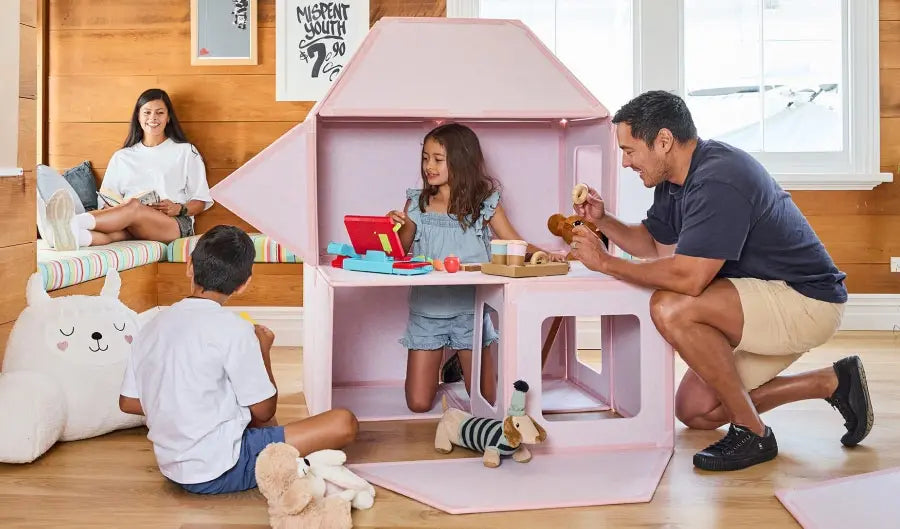
Superspace panels create a blank canvas for dramatic play. The same panels that form a veterinary clinic one week become a spaceship the next.
Quick reconfiguration means weekly theme rotations are actually practical. Teachers spend less time on setup and more time facilitating play.
One investment replaces ongoing prop purchases. Instead of buying new themed items each month, the structure adapts to whatever theme children explore.
Child-sized structures immerse children in the scenario. When children can step inside their imaginary world, the play becomes more sustained and complex.
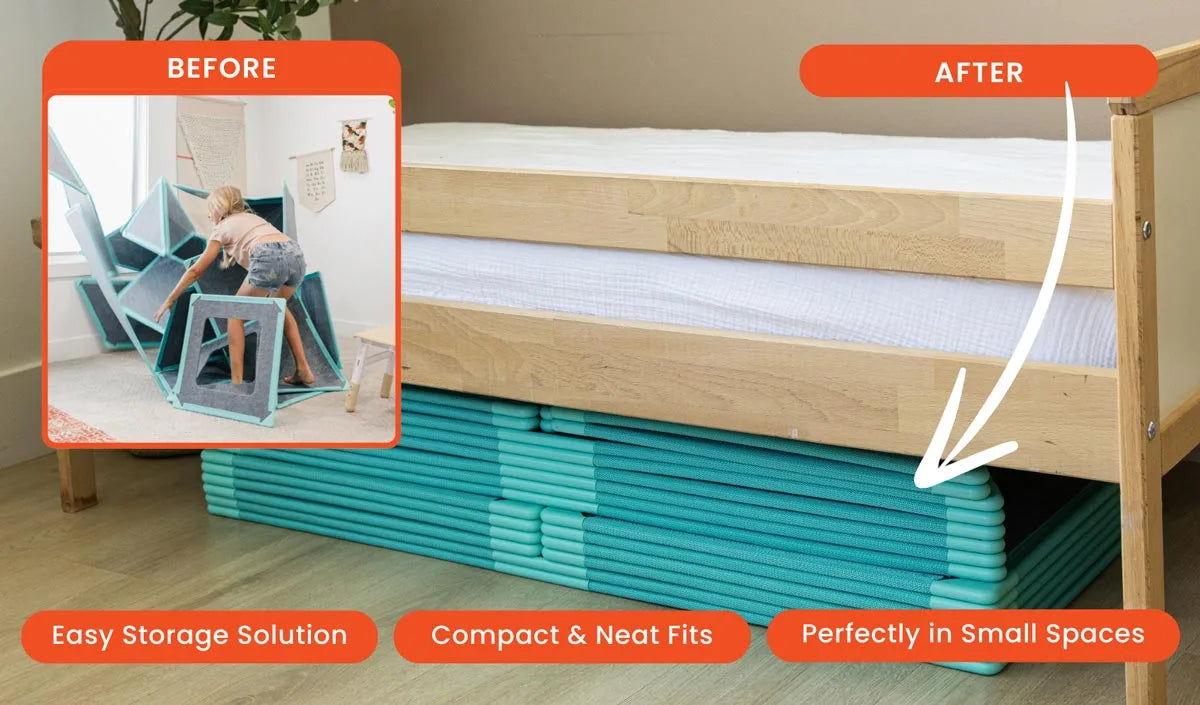
Easy storage and space efficiency matter for real classrooms with limited square footage. Superspace breaks down for storage and reconfigures quickly.
Durability for daily classroom use means the investment lasts. These are not flimsy props that break after a few uses. The physical activity involved also supports gross motor development.
Example Transformations
Week 1: Veterinary Clinic. Panels form exam tables, a waiting area, and a reception desk. Add simple props like stuffed animals and a toy stethoscope.
Week 2: Restaurant. The same panels become a counter, kitchen area, and dining space. Add paper menus and a notepad for orders.
Week 3: Spaceship. Panels reconfigure into a control room and observation deck. Add buttons made from stickers and a "window" to space.
Week 4: Post Office. Panels create a counter and sorting area. Add envelopes, stamps, and mailboxes made from shoeboxes.
The structure stays constant. The theme changes. The learning continues.

A Month of Dramatic Play: Theme Rotation Ideas
Here is a practical starting point for rotating dramatic play themes across a month.
Week 1: Community Helpers
- Theme: Fire Station or Hospital
- Vocabulary: emergency, patient, firefighter, rescue, stethoscope, siren
- Skills: Empathy, cooperation, sequencing, following procedures
Week 2: Retail and Commerce
- Theme: Grocery Store or Restaurant
- Vocabulary: customer, menu, price, change, receipt, order
- Skills: Math (counting, making change), social interaction, literacy (reading menus and signs)
Week 3: Nature and Science
- Theme: Veterinarian or Garden Center
- Vocabulary: species, habitat, seedling, symptoms, growth, care
- Skills: Science inquiry, caring for living things, observation
Week 4: Adventure and Imagination
- Theme: Spaceship or Pirate Ship
- Vocabulary: orbit, treasure, captain, navigation, planet, crew
- Skills: Creativity, narrative building, cooperation, problem-solving
Each week introduces fresh vocabulary, new roles, and different learning opportunities. Children stay engaged because the play stays novel.

Treating Dramatic Play Like It Matters
The research is clear: dramatic play builds executive function, self-regulation, language, empathy, and academic readiness. It is not a break from learning. It is learning.
The benefits span cognitive, social-emotional, language, and academic domains. No other single activity addresses so many developmental areas simultaneously.
Novelty through rotating themes maximizes engagement and compounds learning opportunities. Flexible environments make rotation practical and sustainable.
Dramatic play deserves the spotlight in early childhood education. It deserves protected time, dedicated space, and investment in infrastructure that supports rich, sustained play.
Give dramatic play the attention the research says it warrants. Explore how Superspace can transform your classroom into a dynamic, dramatic play environment that keeps children engaged week after week.
References
- Elias, C.L. & Berk, L.E. (2002). Self-regulation in young children: Is there a role for sociodramatic play? Early Childhood Research Quarterly, 17(2), 216-238. https://doi.org/10.1016/S0885-2006(02)00146-1
- Veresov, N., Veraksa, A., Gavrilova, M., et al. (2021). Do children need adult support during sociodramatic play to develop executive functions? Experimental evidence. Frontiers in Psychology, 12, 779023. https://doi.org/10.3389/fpsyg.2021.779023
- Slot, P.L., Mulder, H., Verhagen, J., & Leseman, P.P.M. (2017). Preschoolers' cognitive and emotional self-regulation in pretend play: Relations with executive functions and quality of play. Infant and Child Development, 26(6), e2038. https://doi.org/10.1002/icd.2038
- Qu, L., Shen, P., Chee, Y.Y., & Chen, L. (2015). Teachers' theory-of-mind coaching and children's executive function predict the training effect of sociodramatic play on children's theory of mind. Social Development, 24(4), 716-733. https://doi.org/10.1111/sode.12116
- Gioia, K.A. & Tobin, R.M. (2010). Role of sociodramatic play in promoting self-regulation. In C.E. Schaefer (Ed.), Play therapy for preschool children (pp. 181-198). American Psychological Association. https://psycnet.apa.org/record/2009-08925-009
- Matthews, S.B. (2008). The relationship among self-regulation, sociodramatic play, and preschoolers' readiness for kindergarten [Doctoral dissertation]. ProQuest Dissertations & Theses Global.
- Özcan, Ö. & İvrendi, A. (2024). Relationship between socio-dramatic play and self-regulation skills in early childhood. Kastamonu Education Journal, 32(1), 1-15. https://doi.org/10.24106/kefdergi.1426465