Gross Motor Development Through Fort Building: The Benefits of Life-Sized Play
Craig SpencerYour child is reaching overhead, lifting a large panel, and clicking it into place. They're bending, squatting, and crawling through the opening of their creation. This isn't just play.
It's their brain and body working together in ways that shape their physical development for years to come.
Fort building has been a childhood staple for generations. But what most parents don't realize is that life-sized fort building is one of the most effective gross motor activities you can offer your child.
Research shows that physical play directly supports cognitive development, balance, coordination, and even academic success [1].
The good news?
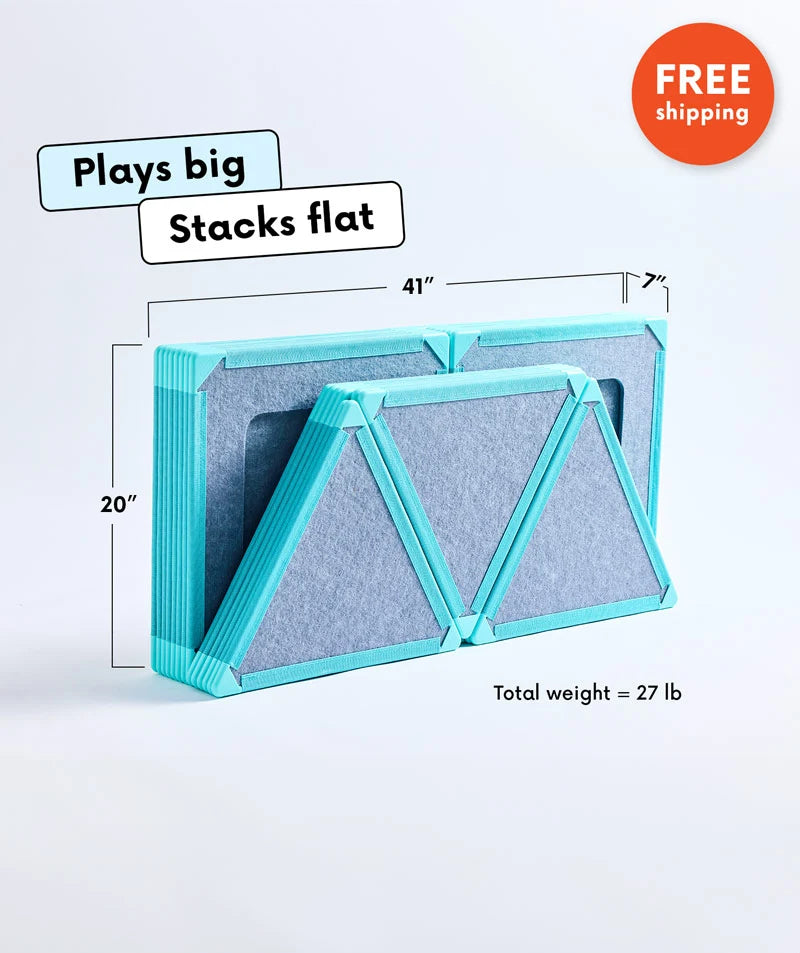
You don't need expensive equipment or a backyard obstacle course. Tools like Superspace panels transform any living room into a developmental playground where gross motor skills flourish naturally through creative play.

Key Takeaways
- Gross motor development involves large muscle groups and forms the foundation for all physical skills
- Fort building engages the whole body through reaching, lifting, carrying, climbing, and crawling
- Research confirms that physical play supports both motor and cognitive development in children
- Life-sized building differs from tabletop toys by requiring full-body movement and engagement
- Vestibular and proprioceptive systems are activated during fort building, supporting balance and body awareness
- Age-appropriate fort building activities can be tailored for children from ages 2 through 10
- Parents can maximize developmental benefits by creating space for movement and allowing productive struggle
Table of Contents
- What Is Gross Motor Development and Why Does It Matter?
- Why Today's Kids Need More Physical Play Than Ever
- The Physical Benefits of Life-Sized Fort Building
- How Building Forts Builds Brains Too
- Building Together: Social Skills Through Collaborative Play
- Fort Building Activities by Age: From Toddlers to Big Kids
- Why Life-Sized Building Kits Make the Difference
- Getting Started: Tips for Maximizing Developmental Benefits
- Building Bodies and Minds, One Fort at a Time
- References
What Is Gross Motor Development and Why Does It Matter?
Gross motor skills involve the large muscle groups of the body. These include the arms, legs, and core muscles that control major movements like walking, running, jumping, climbing, and throwing.
Unlike fine motor skills that focus on small hand movements, gross motor development creates the foundation for nearly every physical activity your child will ever do. It's the ability to coordinate large muscle movements with balance, strength, and body awareness.
Children develop gross motor skills in a predictable sequence. Infants learn to roll and sit. Toddlers master walking and climbing. Preschoolers develop the coordination for hopping, skipping, and catching. By elementary school, children can perform complex movements that require multiple muscle groups working together.
This developmental progression matters far beyond sports and playground activities. Research by Zeng and colleagues found that physical activity programs positively affect both motor skills and cognitive development in preschool children [1].
The relationship between movement and brain development is profound.
When children use their large muscles, they're not just building strength. They're creating neural pathways that support learning, attention, and problem-solving. This is why hands-on learning is so effective for children.
Gross motor activities help children understand where their body is in space, how to control their movements, and how to respond to their environment.
Strong gross motor skills also predict academic success. Children who struggle with balance and coordination often face challenges with sitting still, writing, and focusing in classroom settings. Physical development is not separate from cognitive development. They are deeply interconnected.

Why Today's Kids Need More Physical Play Than Ever
Modern childhood looks different than it did a generation ago.
The Centers for Disease Control and Prevention recommends that children get at least 60 minutes of moderate-to-vigorous physical activity every day. Many children are not meeting this goal.
Several factors contribute to this physical activity gap.
Screen time has increased dramatically, with many children spending hours each day on tablets, phones, and computers.
Outdoor play opportunities have decreased due to safety concerns, urban living, and overscheduled calendars.
Free play has been replaced by structured activities that often involve sitting.
The consequences are measurable.
Pediatric occupational therapists and physical therapists report seeing more children with delayed motor development, reduced core strength, and coordination difficulties. These challenges affect everything from handwriting to playground participation.
Physical play for children is not optional. It's essential for healthy development.
The American Academy of Pediatrics emphasizes that play is critical to children's health and development, supporting physical, cognitive, social, and emotional growth. For parents looking to reduce screen time, active play offers a compelling alternative.
Fort building offers a compelling solution to the indoor physical play challenge.
Unlike passive screen activities, building a life-sized structure requires constant movement. Children can engage in active, full-body play without needing good weather or a backyard.
Fort building transforms any space into an opportunity for gross motor development.

The Physical Benefits of Life-Sized Fort Building
Fort building is a comprehensive gross motor activity that engages multiple muscle groups and movement patterns.
When children build structures they can enter and explore, they naturally perform the movements that develop strength, coordination, and body awareness.
Full-Body Engagement
Building a life-sized fort requires the entire body.
Children reach overhead to place panels at height, engaging their shoulders, arms, and core. They bend and squat to connect pieces at floor level, strengthening their legs and lower back. They carry materials from one location to another, building endurance and coordination.
This full-body engagement is what separates life-sized building from tabletop activities.
Traditional building toys like blocks and small magnetic tiles primarily develop fine motor skills. While valuable, these activities don't provide the large muscle activation that fort building delivers.

Balance and Coordination Development
Fort building naturally activates the vestibular system, which controls balance and spatial orientation.
When children move around their structure, reach across their body midline, and navigate through openings, they're strengthening their sense of balance.
Research on vestibular development shows that the balance system continues to mature until approximately 4-6 years of age [2].
Activities that challenge balance during this critical period support healthy development. Fort building provides this challenge in a motivating, self-directed context.
Bilateral coordination develops when children use both sides of their body together. Carrying a large panel, climbing through a tunnel, or stabilizing a structure all require the left and right sides to work as a team.
Strength Building Through Play
Fort building provides resistance-based exercise without the structure of traditional exercise.
When children lift and carry panels, they're building upper body and core strength. When they squat to build low sections and stand to build high sections, they're strengthening their legs.
The beauty of fort building is that strength building happens naturally. Children don't perceive it as exercise. They're playing. Yet their muscles are working against resistance, growing stronger with each building session.
As structures become more complex, the physical challenge increases. Larger forts require more movement, more lifting, and more problem-solving with the body. The activity naturally progresses to meet a child's growing abilities.
Spatial Awareness and Body Mapping
Proprioception is the body's sense of where it is in space.
When children build and navigate forts, they receive rich proprioceptive input. They learn how much force to use when clicking pieces together. They discover how to fit their body through an opening. They understand the relationship between their size and the structure's dimensions.
This body mapping is fundamental to physical coordination.
Children who have strong proprioceptive awareness move more confidently and bump into things less often. They can judge distances and navigate spaces with greater skill.
Fort building provides continuous proprioceptive feedback. The weight of panels, the resistance of magnetic connections, and the physical experience of being inside a self-built structure all contribute to body awareness development.

How Building Forts Builds Brains Too
The physical benefits of fort building are impressive. But the cognitive benefits are equally significant. Movement and thinking are not separate processes. They develop together.
Executive Function Development
Executive function includes the mental skills of planning, sequencing, problem-solving, and impulse control. Fort building requires all of these skills.
Children must plan what they want to build. They must sequence the steps to make it happen. They must solve problems when structures don't work as expected.
Research by Pesce and colleagues found that programs centered on deliberate play benefit both motor skills and executive function [3].
Fort building is deliberate play. Children have a goal, make decisions, and adapt their approach based on results.
Spatial Reasoning
Spatial reasoning is the ability to understand and mentally manipulate objects in three-dimensional space. This skill predicts success in STEM fields and is essential for everyday tasks like packing a suitcase or reading a map.
Fort building develops spatial reasoning naturally. Children must visualize how panels will fit together. They must understand angles, stability, and structure. They must translate their mental image into a physical creation.
Creativity and Imaginative Play
Open-ended building encourages creative thinking.
There is no single correct way to build a fort. Children experiment, innovate, and create original designs. This creative process strengthens divergent thinking, the ability to generate multiple solutions to a problem.
Once built, forts become stages for imaginative play. The structure transforms into a castle, a spaceship, a veterinarian's office, or a secret hideout.
The physical creation supports extended dramatic play that develops language, social skills, and emotional understanding.
Risk Assessment and Confidence
Fort building provides opportunities for safe risk-taking.
Children learn to assess whether a structure is stable. They decide whether to make it taller or wider. They experience what happens when designs fail and learn to try again.
This productive struggle builds self-efficacy. When children successfully complete a challenging build, they develop confidence in their abilities. They learn that effort leads to accomplishment.

Building Together: Social Skills Through Collaborative Play
Fort building naturally invites collaboration. When two or more children work together on a structure, they practice essential social skills.
Communication becomes necessary. Children must share their ideas, explain their vision, and listen to their building partners. They negotiate which designs to pursue and how to divide tasks.
Cooperation emerges as children work toward a shared goal. They learn to take turns, share materials, and coordinate their efforts. The structure won't succeed unless they work together.
Conflict resolution skills develop when designs differ or disagreements arise. Children practice problem-solving within relationships, learning to compromise and find solutions that work for everyone.
Research confirms that motor interventions delivered in early childhood benefit not only motor and cognitive development but also social-emotional development [4].
Fort building provides this multi-dimensional benefit.
Building forts also creates spaces for emotional regulation.
The enclosed space of a fort can serve as a calming retreat. Children create "owned" spaces where they feel safe and in control. For children with ADHD, these benefits are particularly significant, as explored in our guide to ADHD and play therapy.

Fort Building Activities by Age: From Toddlers to Big Kids
Fort building adapts to children's developmental stages. Activities can be tailored to match a child's physical abilities, cognitive skills, and interests.
Ages 2-4: The Foundation Years
Young builders benefit from simple structures and large pieces. At this age, the focus is on basic movements: crawling through tunnels, climbing over low walls, and hiding inside enclosed spaces.
Adult scaffolding is important. Parents can help with the initial structure while children participate in placing pieces, crawling through, and adding decorations. The goal is joyful movement, not complex engineering.
Key skills developed at this age include body awareness, spatial understanding, and basic coordination. Toddlers learn where their body fits and how to navigate around obstacles. For age-appropriate toy recommendations, explore our guide to Montessori toys for kids.

Ages 5-7: The Builder Phase
Children in this age range can create more complex designs. They begin following their own plans, experimenting with different configurations, and building collaboratively with peers.
The focus shifts to coordination, strength, and problem-solving. Children can build taller structures that require reaching. They can work on multi-room designs that challenge spatial planning.
Collaborative building becomes especially valuable at this age. Children practice social skills while engaging in active physical play.
Ages 8-10: The Engineer Stage
Older children approach fort building as an engineering challenge. They can create complex, multi-level structures. They can incorporate design constraints and goals.
The focus includes advanced spatial reasoning, project management, and leadership. Children at this age can plan elaborate builds, delegate tasks to younger siblings, and problem-solve structural challenges.
Fort building remains physically engaging even as cognitive complexity increases. The reaching, lifting, and navigating continue to provide gross motor benefits. If you're looking for more options for older children, see our guide to the best fort building kits.

Why Life-Sized Building Kits Make the Difference
The difference between tabletop building and life-sized building is the difference between fine motor and gross motor engagement. Both are valuable. But they serve different developmental needs.
Traditional building toys like small magnetic tiles develop hand-eye coordination and finger dexterity. Children sit at a table and manipulate small pieces with their fingers. This is excellent for fine motor development.
Life-sized building requires whole-body movement. Children stand, squat, reach, carry, and climb. They enter their creations and experience them from the inside. This is gross motor development in action.
How Fort Building Compares to Other Gross Motor Activities
| Activity | Gross Motor Benefits | Creativity | Indoor/Outdoor | Typical Engagement |
|---|---|---|---|---|
| Fort Building (Superspace) | Excellent | Excellent | Both | Hours |
| Playground Equipment | Very Good | Limited | Outdoor Only | 30-60 minutes |
| Sports | Very Good | Minimal | Depends | Varies |
| Obstacle Courses | Very Good | Moderate | Both | 20-40 minutes |
| Dance/Movement | Good | Good | Indoor | 30 minutes |
| Traditional Building Toys | Fine Motor Only | Very Good | Indoor | Hours |
Fort building stands out because it combines sustained physical activity with open-ended creativity.
Unlike playground equipment or sports, children direct their own movement patterns. Unlike traditional building toys, every action involves gross motor engagement. And unlike most physical activities, kids willingly engage for hours at a time.
Superspace panels are designed with developmental benefits in mind.
The panels are large enough to require full-body engagement. The magnetic system is strong enough for stable structures. The materials are durable enough for repeated building, climbing through, and modification.
Life-sized building also provides immersive play.
Children don't just build a structure and look at it. They go inside. This immersion extends play duration and increases physical engagement. Kids who might play with tabletop toys for thirty minutes will often build and play in forts for hours.
The proprioceptive input from handling large, weighted panels provides sensory benefits that small pieces cannot match. Occupational therapists recognize this type of heavy work as beneficial for sensory integration and self-regulation.

Getting Started: Tips for Maximizing Developmental Benefits
Parents can enhance the developmental value of fort building with a few simple strategies.
Create space for movement. Clear enough floor space for building and for moving around the structure. Indoor or outdoor spaces both work well.
Resist the urge to help too much. Productive struggle builds skills. When children work through challenges independently, they develop problem-solving abilities and confidence.
Follow their lead. Let children direct the building process. Their ideas may differ from yours, and that's exactly the point. Self-directed play provides greater developmental benefits than adult-directed activities.
Add challenges progressively. As children master basic structures, introduce height, complexity, or collaboration. Suggest building something they can stand up inside or create a tunnel they can crawl through.
Incorporate physical challenges. Encourage climbing through openings, crawling under sections, and carrying materials. The more movement, the greater the gross motor benefit.
Make it social. Invite friends, siblings, or cousins to build together. Collaborative fort building multiplies the social-emotional benefits.
Connect to imaginative play. Once built, forts become settings for pretend play. Ask what the fort will become. This extends play duration and adds cognitive complexity.

Building Bodies and Minds, One Fort at a Time
Fort building is more than a rainy-day activity. It's a comprehensive developmental experience that builds gross motor skills, cognitive abilities, and social-emotional competence.
Research consistently shows that physical play supports healthy development across multiple domains [1][3][4].
Fort building delivers this physical play in a format that children find genuinely engaging. They're not exercising. They're building castles, spaceships, and secret bases. Yet their bodies are strengthening, their balance is improving, and their coordination is developing.
Life-sized fort building stands apart from other activities because it combines physical engagement with creativity.
Children don't just move their bodies. They design, construct, and inhabit their creations. This combination of movement and imagination creates extended, deeply engaged play sessions.
The next time you see your child reaching overhead to click a panel into place, squatting to build a tunnel, or crawling through an opening, know that you're witnessing gross motor development in action.
They're building strength, coordination, balance, and body awareness. They're building forts. And they're building the foundation for a lifetime of physical capability.
Ready to get started? Explore the Superspace Big Set or the Little Set to bring life-sized fort building into your home. For more guidance on choosing the right set, read our comprehensive Superspace buying guide.
References
- Zeng, N., Ayyub, M., Sun, H., Wen, X., Xiang, P., & Gao, Z. (2017). Effects of physical activity on motor skills and cognitive development in early childhood: A systematic review. BioMed Research International. https://doi.org/10.1155/2017/2760716
- Tufatulin, G. S., et al. (2025). Balance disorders in hearing impaired children: Prevalence, current possibilities of diagnostics and rehabilitation (scoping review). Vestnik Otorinolaringologii, 90(5), 177. https://pubmed.ncbi.nlm.nih.gov/41211906/
- Pesce, C., Masci, I., Marchetti, R., Vazou, S., Sääkslahti, A., & Tomporowski, P. D. (2016). Deliberate play and preparation jointly benefit motor and cognitive development: Mediated and moderated effects. Frontiers in Psychology, 7, 349. https://doi.org/10.3389/fpsyg.2016.00349
- Florit, E., Bastianello, T., Andalò, B., & Majorano, M. (2024). I-MovE. An intervention to promote movement at childcare centers: Benefits for motor cognitive and socio-emotional development. PLoS ONE, 19(1), e0297645. https://doi.org/10.1371/journal.pone.0297645
- Kuzik, N., Naylor, P. J., Spence, J. C., & Carson, V. (2020). Movement behaviours and physical, cognitive, and social-emotional development in preschool-aged children: Cross-sectional associations using compositional analyses. PLoS ONE, 15(8), e0237945. https://doi.org/10.1371/journal.pone.0237945
- Carson, V., Hunter, S., Kuzik, N., Wiebe, S. A., Spence, J. C., Friedman, A., Tremblay, M. S., Slater, L., & Hinkley, T. (2016). Systematic review of physical activity and cognitive development in early childhood. Journal of Science and Medicine in Sport, 19(7), 573-578. https://doi.org/10.1016/j.jsams.2015.07.011