Autism Awareness and Play: How Sensory Building Toys Support Neurodivergent Children
Craig SpencerFinding the best sensory toys for autism can feel overwhelming. You want something that holds your child's attention, meets their sensory needs, and actually supports their development.
With 1 in 31 children in the United States now identified with autism spectrum disorder [1], the need for purposeful, sensory-rich play has never been greater.
The good news?
Research consistently shows that the right kind of play can make a meaningful difference.
Sensory building toys, like Superspace giant magnetic building sets, offer a unique combination of proprioceptive input, open-ended creativity, and full-body engagement that many neurodivergent children naturally gravitate toward.

Key Takeaways
- One in 31 U.S. children is identified with autism spectrum disorder, making awareness and supportive play tools more critical than ever.
- Sensory processing differences affect how autistic children engage with play, and the right toys can bridge developmental gaps.
- Building play provides proprioceptive and vestibular input that helps regulate the nervous system and reduce anxiety.
- Open-ended, constructive play strengthens executive functioning skills like planning, sequencing, and flexible thinking.
- Life-sized building toys engage the whole body, supporting gross motor development while creating calming sensory experiences.
- Research-backed sensory integration approaches show measurable improvements in motor skills, social participation, and daily functioning.
- Choosing toys that match your child's specific sensory profile is more important than following age labels on the box.
Table of Contents
- Understanding Autism Spectrum Disorder: Beyond the Diagnosis
- How Sensory Processing Shapes Play for Autistic Children
- Why Building Play Is Uniquely Powerful for Kids on the Spectrum
- The Sensory Benefits of Life-Sized Building Toys
- How Open-Ended Play Supports Neurodivergent Minds
- Building Executive Functioning Skills Through Constructive Play
- Social Play and Communication Through Building Together
- Choosing the Right Sensory Toys for Your Autistic Child
- Practical Tips for Parents: Making Play Therapeutic at Home
- Building a World That Includes Every Child
- References
Understanding Autism Spectrum Disorder: Beyond the Diagnosis
What Is Autism Spectrum Disorder?
Autism spectrum disorder (ASD) is a neurodevelopmental condition that affects how a person communicates, interacts with others, and processes sensory information.
The word "spectrum" is important because no two autistic children experience the world in exactly the same way.
Some children may be highly verbal and socially engaged but struggle with sensory overload. Others may communicate differently or need more support with daily routines.
Many autistic children have remarkable strengths, including intense focus, exceptional pattern recognition, creative thinking, and deep expertise in areas they care about.
Understanding autism means recognizing that these children are not broken or in need of fixing.
They experience the world differently, and the right tools and environments can help them thrive on their own terms.
The Growing Prevalence of Autism in America
According to the CDC's Autism and Developmental Disabilities Monitoring (ADDM) Network, 1 in 31 children, or 3.2% of eight-year-olds in the United States, are now identified with autism spectrum disorder [1].
This represents a continued increase from previous years.
In 2020, the rate was 1 in 36. A decade earlier, it was 1 in 68. The reasons behind this trend include improved screening tools, broader diagnostic criteria, and greater awareness among parents and healthcare providers.
What this means in practical terms is that millions of families are navigating the unique joys and challenges that come with raising a child on the spectrum.
And one of the most accessible, impactful interventions available to every family is something deceptively simple: play.
But not just any play. Research increasingly shows that specific types of sensory-rich, structured play can support the developmental areas where autistic children need it most [2].

How Sensory Processing Shapes Play for Autistic Children
The Seven Sensory Systems
When most people think about senses, they think about the familiar five: sight, sound, touch, taste, and smell. But our bodies actually rely on seven sensory systems to navigate the world.
The two "hidden" senses that play a critical role in autism are proprioception and the vestibular system.
Proprioception is your body's sense of where it is in space. It comes from receptors in your muscles and joints and tells your brain how much force to use, how to position your body, and where your limbs are without looking at them. Think of it as your internal GPS.
The vestibular system is centered in your inner ear and governs balance, spatial orientation, and movement. It tells you whether you are upright, tilting, spinning, or accelerating.
For many autistic children, one or more of these sensory systems processes information differently.
Research has established a clear association between proprioceptive function and communicative traits in children with developmental disorders [5].

When Sensory Differences Affect Everyday Play
Sensory processing differences show up in play in ways that can puzzle parents who are not familiar with the underlying mechanisms.
A child who crashes into furniture may be seeking proprioceptive input. A child who spins in circles may be craving vestibular stimulation. A child who avoids certain textures may have tactile sensitivities that make some toys uncomfortable.
These are not behavioral problems. They are the nervous system communicating its needs.
Studies have shown that occupational therapy using Ayres Sensory Integration, which is grounded in providing targeted sensory experiences through play, produces measurable improvements in daily functioning for autistic children [2].
Understanding your child's sensory profile is the first step toward choosing toys and activities that meet them where they are, rather than where a developmental chart says they should be.
If you are looking for toys that engage the full range of sensory systems, building toys offer one of the most comprehensive options available.

Why Building Play Is Uniquely Powerful for Kids on the Spectrum
Proprioceptive Input: The Calming Power of Heavy Work
Occupational therapists call it "heavy work," and it is one of the most effective strategies for helping autistic children regulate their nervous systems. Heavy work includes any activity that involves pushing, pulling, lifting, or carrying.
Building with large-scale toys is a natural form of heavy work. When a child lifts a magnetic panel, carries it across the room, and positions it on a growing structure, they are flooding their proprioceptive system with organizing input.
A 2025 randomized controlled trial found that vestibular and proprioceptive exercises significantly reduced hyperactivity in children with autism spectrum disorder [4].
This is why many autistic children appear calmer and more focused after physical activity.
Building play provides this regulatory input in a way that feels like fun, not therapy. The connection between gross motor development and fort building is well documented in child development research.
Vestibular Input: Balance, Movement, and Body Awareness
The vestibular system helps children understand where their body is in relation to the space around them.
For autistic children with vestibular processing differences, everyday movements can feel unpredictable or disorienting.
Building structures that children can climb into, crawl through, and navigate around provides controlled vestibular input. The child moves their body in space, adjusts their balance, and develops spatial awareness, all within a predictable environment they have created themselves.
This kind of self-directed movement is particularly valuable because it allows the child to control the intensity of input. They choose how fast to move, how high to climb, and when to stop.
That sense of control is deeply regulating for a nervous system that often feels overwhelmed.

Fine and Gross Motor Development Through Construction
A systematic review of treatments for children with autism spectrum disorder highlighted the importance of sensory integration in improving motor skills and promoting social participation [3].
Building play develops both fine and gross motor skills simultaneously.
Gross motor development comes from the full-body engagement of lifting, carrying, and positioning large building components.
Fine motor skills develop through the precision required to align pieces, connect magnetic edges, and adjust structures.
For autistic children who may have motor planning challenges, building offers repeated practice in a low-pressure, self-paced environment. There is no time limit, no performance standard, and no one watching with a clipboard.

The Sensory Benefits of Life-Sized Building Toys
Multi-Sensory Engagement Without Overstimulation
One of the biggest challenges in choosing sensory toys for autism is finding something that provides enough input without tipping into overstimulation. Flashing lights, loud sounds, and chaotic textures can overwhelm the very children they are supposed to help.
Life-sized building toys offer a different approach. The sensory input comes from the building process itself, not from electronic features. The tactile experience of soft materials, the satisfying click of magnets connecting, and the physical effort of construction create a rich sensory environment that is simultaneously calming and engaging.
Research consistently shows that multi-sensory approaches produce the strongest developmental outcomes for children with autism [3]. The key is that the input comes through active participation rather than passive reception.
How Superspace Supports Sensory Integration
Superspace giant magnetic building sets are designed in a way that naturally aligns with the sensory needs of neurodivergent children, even though they were not specifically created as a therapy tool.
Each panel is two feet by three feet, which means building with them is a full-body activity. Children lift, carry, and position panels that require genuine physical effort, providing the proprioceptive input that helps organize the nervous system.
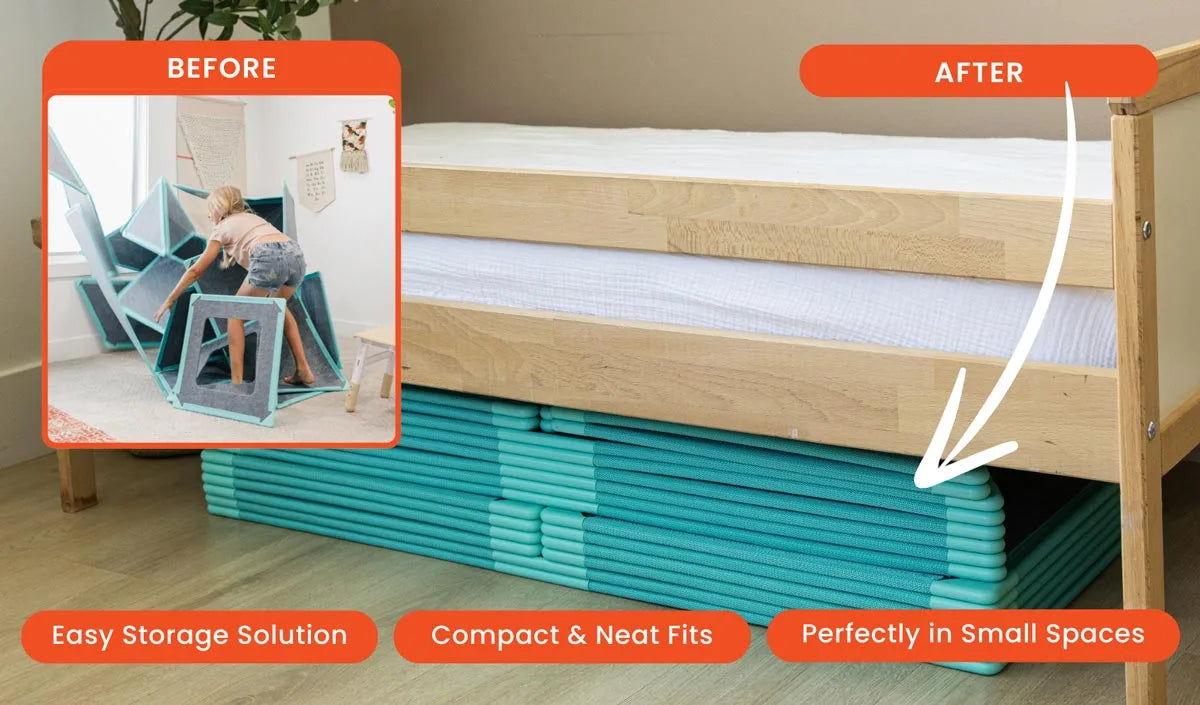
The panels are made of soft eco-felt, which offers a calming tactile experience. Unlike hard plastic or wood, the texture is gentle and consistent. There are no sharp edges, no surprising textures, and no overstimulating visual patterns.
The patented auto-aligning magnetic system means there is no wrong way to connect pieces. For a child who experiences anxiety around making mistakes, this design choice removes a significant barrier to engagement. Every attempt works. Every connection succeeds.
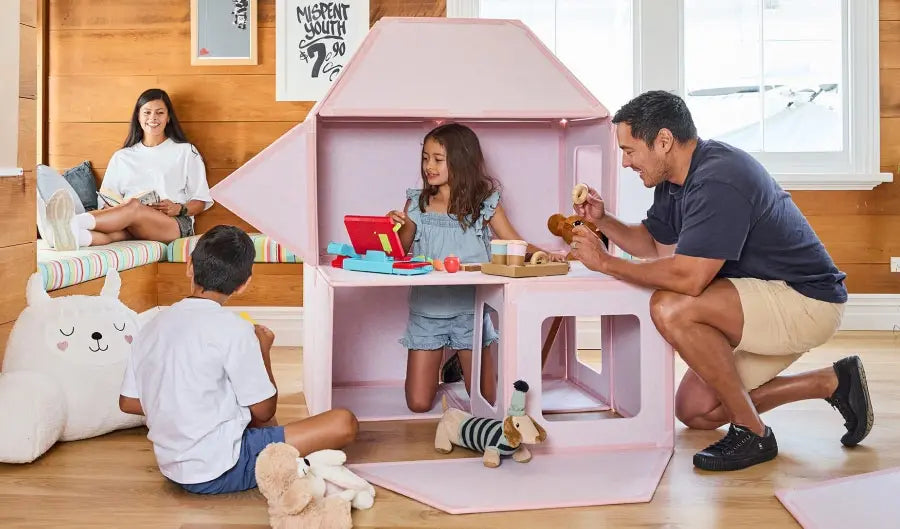
Once built, children can climb inside their creations. This transitions the play from construction into imaginative exploration, providing vestibular input as they move through enclosed spaces and proprioceptive feedback as they navigate doorways and walls they built themselves.
The multi-sensory nature of Superspace makes it particularly well-suited for children who benefit from simultaneous engagement across multiple sensory channels.

How Open-Ended Play Supports Neurodivergent Minds
No Wrong Answers: Reducing Anxiety Through Unstructured Play
Many autistic children experience significant anxiety around tasks that have a "right" answer.
Board games with fixed rules, puzzles with one solution, and structured activities with expected outcomes can trigger stress rather than enjoyment.
Open-ended play removes this pressure entirely.
When a child builds with toys that have no instructions, there is no failure state. Every creation is valid. Every modification is progress.
A 2024 systematic review evaluating play-based occupational therapy interventions found moderate to strong effects on playfulness and social play in children with autism spectrum disorder [6].
This kind of unstructured play also gives autistic children something they often lack in structured environments: autonomy. They decide what to build, when to modify it, and when they are finished.
For children who frequently feel managed or directed throughout their day, this autonomy can be profoundly calming.
Creativity and Cognitive Flexibility
Autism sometimes involves patterns of rigid thinking, where a child may prefer routines, resist changes, and struggle to adapt when plans shift.
While these patterns serve an important function, they can also limit a child's ability to navigate unpredictable situations.
Open-ended building play provides a gentle, low-stakes environment for stretching cognitive flexibility.
When a structure falls, the child adapts. When they run out of a particular panel shape, they improvise. When a sibling suggests a modification, they negotiate.
None of this feels like therapy because it is happening in the context of play. But the cognitive skills being exercised, including flexibility, adaptation, and creative problem-solving, are the same ones that support everyday functioning.

Building Executive Functioning Skills Through Constructive Play
Planning, Sequencing, and Problem-Solving
Executive functioning refers to the set of cognitive skills that allow us to plan, organize, sequence actions, and manage our behavior.
These skills develop gradually in all children, but autistic children often experience delays or differences in executive functioning development.
Building play naturally engages every component of executive functioning.
A child who decides to build a rocket must plan the structure, sequence the steps (base first, then walls, then roof), and solve problems when pieces do not fit as expected.
Research on occupational therapy using Ayres Sensory Integration has demonstrated its effectiveness in supporting goal attainment and occupational performance in children with sensory integration differences [8].
The beauty of construction play is that these cognitive demands are embedded in an inherently motivating activity. The child is not completing a worksheet or following instructions. They are building something they want to exist in the world.
Learn more about executive functioning through play and how building activities strengthen these critical skills.
Task Initiation and Flexible Thinking
One specific executive functioning challenge common in autism is task initiation, the ability to start a task independently without external prompting.
Building toys with no predetermined outcome lower the barrier to task initiation. There is no "right" first step, which means any starting point is valid. A child can begin by stacking two panels, and that action naturally leads to the next step.
Over time, this repeated experience of successful initiation builds confidence and transfers to other areas.
A child who learns to start a building project independently may gradually find it easier to start homework, begin a morning routine, or initiate play with a peer.

Social Play and Communication Through Building Together
Cooperative Play and Shared Goals
Social interaction can be challenging for autistic children, particularly when it requires reading social cues, managing turn-taking, or navigating unstructured group dynamics.
Building together creates a structured framework for social play. When two children are constructing a fort, the goal is clear, the roles are defined (one holds, one connects), and the communication is functional and concrete.
This kind of parallel and cooperative building allows autistic children to engage socially at their own comfort level.
A child can build alongside a sibling without direct interaction, gradually participating more as they feel safe.
Or they can dive into a collaborative project with a family-sized building set where communication happens naturally through the shared task.
For siblings with different neurotypes, building together creates common ground. The activity does not require the autistic child to adapt to a neurotypical play style. Instead, both children engage on equal terms within a shared creative space.
Language Development Through Joint Attention
Joint attention, the ability to share focus on an object or activity with another person, is a foundational communication skill that many autistic children develop at their own pace.
Building play creates natural joint attention opportunities.
When a child and parent are building together, they are both focused on the same structure.
This shared focus provides a natural context for language, including labeling ("the big one"), requesting ("pass me that"), directing ("put it here"), and describing ("it is getting tall").
Research on sensory integration approaches for autistic children has documented improvements in play outcomes, including increased engagement and interaction during play-based activities [9].
These language-building opportunities arise organically from the activity, making them less pressured than direct language instruction and more likely to generalize to other contexts.

Choosing the Right Sensory Toys for Your Autistic Child
Matching Toys to Your Child's Sensory Profile
Every autistic child has a unique sensory profile, and choosing the best sensory toys starts with understanding what your child's nervous system needs.
Children who are sensory seekers often crave deep pressure, heavy work, and intense movement. These children benefit from toys that involve lifting, carrying, pushing, and full-body engagement.
Life-sized building toys are particularly well-suited because they naturally provide the proprioceptive and vestibular input that sensory seekers crave.
Children who are sensory avoiders tend to prefer calm, predictable environments with gentle textures and controlled stimulation.
For these children, building toys with soft materials, consistent magnetic feedback, and no electronic components offers engagement without overwhelm.
Many autistic children have mixed sensory profiles, seeking input in some areas while avoiding it in others.
Versatile toys that allow children to control the intensity of their experience, building gently or energetically, are ideal for these children.
Explore our guide to Montessori-style toys for more developmentally appropriate play options.
Age-Appropriate vs. Developmentally Appropriate
One of the most common frustrations parents of autistic children face is the mismatch between their child's chronological age and their developmental stage.
A seven-year-old with autism might engage with toys designed for younger children, and there is nothing wrong with that.
Developmental readiness, not the age label on the box, should guide toy selection.
Building toys are particularly forgiving in this regard.
A three-year-old can stack two Superspace panels into a simple wall.
A ten-year-old can engineer a multi-room fort with windows and a crawl-through tunnel.
The same toy grows with the child, meeting them wherever they are on their developmental journey.
This scalability also means families do not need to constantly replace outgrown toys. One set of building panels serves a child for years, adapting to their changing abilities and interests.

Practical Tips for Parents: Making Play Therapeutic at Home
You do not need to be a therapist to make play meaningful.
Here are practical strategies any parent can use to turn building time into a developmentally supportive experience:
- Follow your child's lead. Let them decide what to build, how to build it, and when to stop. Autonomy is regulating.
- Start with parallel play. Sit nearby and build your own structure. Your presence matters more than your direction.
- Use simple, consistent language. Label what you see: "up," "big," "more," "together." Keep language functional and pressure-free.
- Create a dedicated building space. A predictable, calm area reduces sensory distractions and helps your child focus.
- Allow repetitive building. If your child builds the same structure every day, that is their nervous system finding regulation. Honor it.
- Celebrate the process, not the product. "You worked so hard on that" matters more than "What a beautiful fort."
- Use building as a transition tool. Predictable routines around play time (starting ritual, building time, cleanup) help children who struggle with transitions.
- Make it screen-free. Protect building time from competing stimuli. This dedicated time becomes a sensory sanctuary.

Building a World That Includes Every Child
Autism awareness is not just about wearing a ribbon in April or sharing a statistic on social media. Real awareness means understanding how neurodivergent children experience the world and meeting them where they are, especially in how they play.
The research is clear:
Sensory-rich, open-ended play supports autistic children's development across motor, cognitive, social, and emotional domains [2][3][6].
Building play, in particular, offers a unique combination of proprioceptive input, vestibular stimulation, executive functioning practice, and social opportunity that few other activities can match.
Life-sized building toys like Superspace create a play experience that is calming and stimulating, structured and creative, independent and social, all at the same time. They meet children where they are and grow with them as they develop.
Every child deserves toys that see their strengths, respect their differences, and support their growth.
When we choose play experiences designed with neurodivergent minds in mind, we are not just buying toys. We are building a world that truly includes every child.
Explore Superspace giant magnetic building sets and discover how life-sized building play can support your child's unique development journey.
References
- Centers for Disease Control and Prevention. (2025). Community Report on Autism 2025. ADDM Network. CDC. https://www.cdc.gov/autism/data-research/index.html
- Schaaf, R. C., et al. (2018). Efficacy of Occupational Therapy Using Ayres Sensory Integration: A Systematic Review. American Journal of Occupational Therapy, 72(1). https://www.autismspeaks.org/science-news/study-finds-sensory-integration-therapy-benefits-children-autism
- Camino-Alarcon, J., et al. (2024). A Systematic Review of Treatment for Children with Autism Spectrum Disorder. PMC. https://pmc.ncbi.nlm.nih.gov/articles/PMC11506176/
- Samad, A., et al. (2025). Effectiveness of vestibular and proprioceptive exercises in reducing hyperactivity in children with autism spectrum disorder: A randomized controlled trial. ScienceDirect. https://www.sciencedirect.com/science/article/abs/pii/S205065652500015X
- Proprioception, Emotion and Social Responsiveness in Children with Developmental Disorders: An Exploratory Study. (2024). PMC. https://pmc.ncbi.nlm.nih.gov/articles/PMC11202221/
- The Effect of Play-Based Occupational Therapy on Playfulness and Social Play of Learners with ASD. (2024). Taylor & Francis. https://www.tandfonline.com/doi/full/10.1080/19411243.2024.2360414
- Pfeiffer, B. A., et al. (2011). Effectiveness of Sensory Integration Interventions in Children with Autism Spectrum Disorders: A Pilot Study. American Journal of Occupational Therapy, 65(1), 76-85. https://pmc.ncbi.nlm.nih.gov/articles/PMC3708964/
- American Occupational Therapy Association. (2025). Occupational Therapy Interventions Using Ayres Sensory Integration. American Journal of Occupational Therapy, 79(Supplement 1). https://research.aota.org/ajot/article/79/Supplement%201/7910393010
- Ayres Sensory Integration for Addressing Play in Autistic Children. (2023). American Journal of Occupational Therapy, 77(2). https://research.aota.org/ajot/article/77/2/7702205080
- The Effect of Sensory Integration Therapy on Occupational Performance in Children with Autism. ASAT Online. https://asatonline.org/research-treatment/research-synopses/effect-of-sensory-integration-therapy/