5 Boredom Busters for Kids: Screen-Free Play That Beats 'I'm Bored'
Craig SpencerQuick answer: The best boredom busters for kids combine open-ended, screen-free play with a little freedom to figure things out. Research shows short bouts of boredom actually boost creativity and problem-solving. Give children hands-on materials, unstructured time, movement, and creative projects, then step back and let their imagination take over.
"Mooooom, I'm bored." If you have heard that more times than you can count this month, you are not alone.
Boredom tends to peak in the long, unstructured stretch of summer, on rainy days, and in that restless hour between dinner and bedtime.
Here's the good news.
A little boredom is not a problem to solve. It's a launchpad for creativity, and you do not have to be your child's full-time entertainer.
With a few simple shifts and the right open-ended, screen-free toys like Superspace, "I'm bored" can turn into hours of imaginative play.

Key Takeaways
- Short periods of boredom can boost creativity and problem-solving by pushing an under-stimulated mind to seek something new.
- Boredom is a normal, functional emotion, not misbehavior. It signals that the current situation is no longer stimulating.
- Children who spend more time in unstructured, self-directed activities show stronger self-directed executive function.
- The most effective boredom busters for kids are open-ended and screen-free, so a single activity can go in a hundred directions.
- Giving kids ownership over what to do next works better than handing them a fully planned activity.
- Open-ended building play with toys like Superspace turns idle time into hours of creative, full-body, screen-free fun.
Table of Contents
- Why Is My Child Always Bored?
- Is Boredom Actually Good for Kids?
- What Are the 5 Best Boredom Busters for Kids?
- What Are the Best Screen-Free Boredom Busters by Age?
- How Does Superspace Turn "I'm Bored" Into Hours of Creative Play?
- How Should Parents Respond When a Child Says "I'm Bored"?
- Turning "I'm Bored" Into Creativity
- Frequently Asked Questions
- References
Why Is My Child Always Bored?
Boredom feels like a complaint, but it is really a signal. Researchers describe boredom as a functional emotion that shows up when the current situation is no longer stimulating enough to hold attention [1].
In other words, when your child says "I'm bored," their brain is telling them it is time for something new. That is a normal and healthy part of being human, not a sign that something is wrong.
Two everyday patterns tend to make kids bored faster than usual.
The first is over-structured time. When a child's day is filled with adult-led activities and constant entertainment, they get little practice deciding what to do on their own. The moment the schedule has a gap, they do not know how to fill it.
The second is single-use toys. A toy that does only one thing is fun for a few minutes, but once the novelty wears off, there is nothing left to explore. Kids move on quickly and reach for the next thing, often a screen.
Understanding this changes how you respond. Boredom is not a failure of your parenting or your child's imagination. It is an invitation, and the way you answer it makes all the difference.

Is Boredom Actually Good for Kids?
Yes, in moderation. A growing body of research suggests that short periods of boredom can actually make children more creative and more resourceful.
In one well-known study, participants who first completed a dull, repetitive task produced more creative ideas on a later problem-solving task than those who skipped the boring warm-up [2].
Boredom seems to prompt the mind to wander and search for stimulation, which fuels fresh thinking.
Other research points to why this happens. Boredom is an approach-oriented state, meaning it pushes people to go looking for something new, and that mental reaching promotes associative, creative thought [3].
The benefits are not just about creativity. When children have to sit with a little boredom and decide what to do next, they practice self-direction.
A study of six- and seven-year-olds found that the more time children spent in less-structured activities, the stronger their self-directed executive functioning, including skills like setting goals and following through without adult prompting [4].
More structured time was linked to weaker self-direction.
None of this means boredom is magic, or that more is always better. It means unstructured moments are not wasted. They are where imagination and independence grow.
Play itself is the engine. The American Academy of Pediatrics calls play essential, noting that it builds brain structure, strengthens executive function, and supports emotional and social development [5].
Boredom is often just the doorway that leads children back to play.

What Are the 5 Best Boredom Busters for Kids?
The most effective boredom busters for kids are not a giant list of activities to march through. They are simple habits that hand creativity back to your child. Here are five that work across ages and seasons.
1. Build a Boredom Buster Jar and Let Kids Choose
The best time to plan for boredom is before it happens. Once a child is already whining, no one feels very creative, including you.
Sit down together and brainstorm ten to twenty screen-free ideas. Write each one on a slip of paper and drop them into a jar. Mix creative projects, active play, quiet activities, and simple helping-out tasks.
When "I'm bored" arrives, you do not have to be the activities director. You just point to the jar and let your child draw a slip. Because they helped build the list, the ideas feel like theirs, and motivation comes from inside rather than from you.
This small shift matters. It moves your child from waiting to be entertained toward taking ownership of their own free time, which is exactly the muscle that builds independence.

2. Offer Open-Ended, Screen-Free Toys
Open-ended toys are the secret weapon against boredom. Unlike a toy that does one thing, an open-ended toy can become anything, so the play changes every single time.
Blocks, art supplies, a big cardboard box, magnetic tiles, and building sets all invite kids to invent rather than follow instructions. There is no single right way to play, which means there is no point where the fun runs out.
Life-sized building sets like Superspace take this even further. Children build forts, tunnels, shops, and spaceships they can actually climb inside, so one set turns into hundreds of different creations.
Keeping these toys within easy reach makes screen-free play the path of least resistance. For more ideas, our guide to open-ended play breaks down why this kind of toy holds attention for so long.

3. Take Play Outside and Get Moving
Physical activity is one of the fastest ways to reset a bored, restless child. Movement changes the scenery, burns off pent-up energy, and opens the door to imaginative play.
You do not need elaborate plans. A backyard scavenger hunt, a chalk obstacle course on the driveway, a bike ride, or building a fort outside can fill an afternoon.
Nature adds its own novelty. Hunting for bugs, collecting leaves, splashing in water, or watching clouds gives kids new things to notice and wonder about.
Active, outdoor play also supports gross motor development, the large-muscle movement that underpins coordination and balance. Our guide to gross motor development through fort building shows how big, physical play builds strong bodies and busy minds at the same time.
4. Turn Everyday Moments Into Creative Projects
Some of the best creative activities for kids are hiding inside ordinary moments. The trick is to hand your child a small project and let them run with it.
Baking becomes a science experiment. Setting the table becomes a pretend restaurant. A stack of paper becomes a comic book, a mini magazine, or the blueprint for a fort.
Older kids love projects that stretch over several days, such as writing and illustrating a story, filming a stop-motion video with their toys, or inventing a board game with real rules. Our guide to creative play is full of ideas that grow with your child.
These projects work because they give children a sense of purpose and ownership. They are not just passing time, they are making something, which is far more satisfying than being handed another quick fix.
5. Protect Free Time With a Loose Routine
It sounds backward, but a little structure protects unstructured play. A loose daily rhythm gives the day a shape while still leaving big pockets of free time for your child to fill.
Something as simple as morning outside time, a quiet hour after lunch, and free play before dinner means kids always know a next thing is coming. That alone cuts down on a lot of aimless "I'm bored."
Inside those free-play pockets, resist the urge to fill every minute. This is where the research on unstructured time pays off, since self-directed play is linked to stronger self-regulation and goal-setting [4].
Think of it as building a fence, not a maze. The routine sets gentle boundaries, and inside them your child gets the freedom to explore, invent, and yes, sometimes be a little bored.

What Are the Best Screen-Free Boredom Busters by Age?
The same idea works differently depending on your child's age. Here is how to match boredom busters to where your child is developmentally.
| Age band | Why they get bored | Best screen-free boredom busters |
|---|---|---|
| Toddlers (1 to 3) | They cannot say "I'm bored," so it shows up as clinginess or crankiness. They need sensory and physical input. | Bins of rice or water with scoops, stacking and knocking down blocks, a pile of pillows to climb, a short walk, simple magnetic panels to push together. |
| Preschool (3 to 5) | "I'm bored" often means "play with me." They are learning to entertain themselves. | A rotating busy box, pretend play like kitchen or store, drawing, building forts, and open-ended tiles they can stack into simple walls. |
| Early elementary (6 to 8) | They crave challenge and mastery, and get bored when tasks feel too easy or too repetitive. | Boredom buster jar, scavenger hunts, building bigger and more complex structures, crafts, science experiments, and simple jobs to "own." |
| Tweens (9 to 12) | They are outgrowing simple toys and will roll their eyes at "the list." | Multi-day projects, building challenges (make the biggest fort possible), stop-motion videos, inventing games, and learning a new skill. |
Across every age, the winning formula is the same. Give kids something open-ended, add a dash of freedom, and let them lead. If your home has too many single-use toys competing for attention, our guide on how too many toys can stunt creativity is worth a read.

How Does Superspace Turn "I'm Bored" Into Hours of Creative Play?
If you want a single toy that checks every box on this list, open-ended building play is hard to beat. It is screen-free, physical, endlessly creative, and it grows with your child.
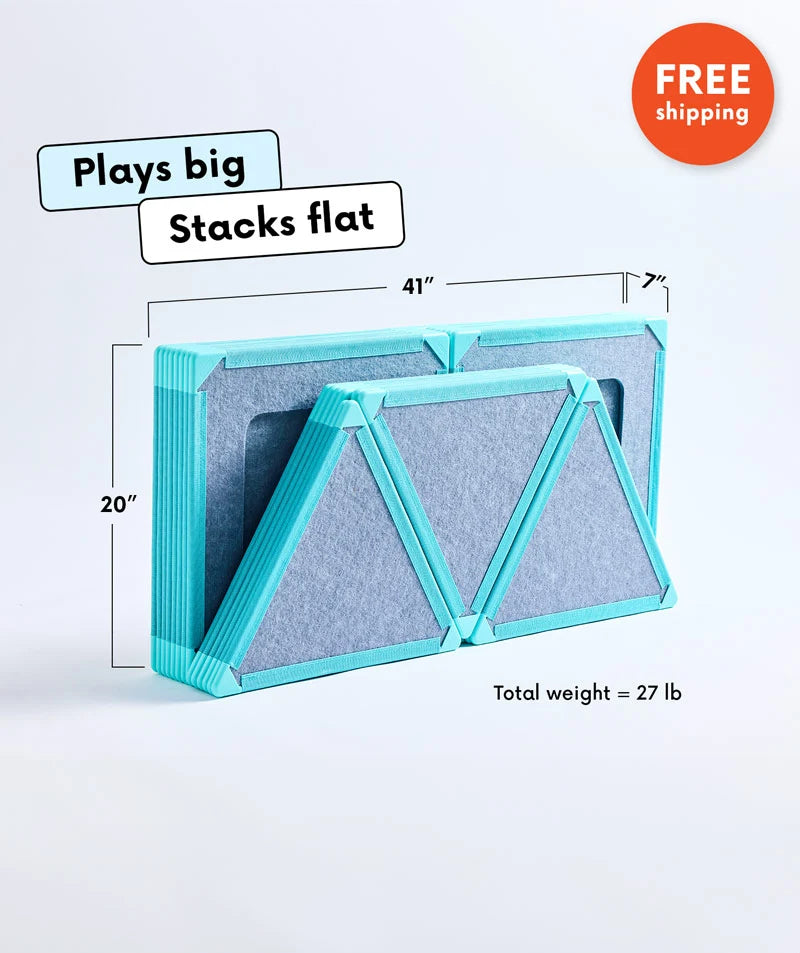
Superspace giant magnetic building sets are built exactly for this. The panels are roughly two feet by three feet, made from soft eco-felt with auto-aligning magnets, so children build life-sized forts, houses, tunnels, and vehicles they can climb right into.
Because there is no wrong way to connect the pieces, a single set becomes hundreds of different builds. One afternoon it is a rocket ship, the next it is a castle, a cozy reading nook, or an obstacle course. The play never runs out because your child is the one inventing it.
This is open-ended, child-led play of exactly the kind the American Academy of Pediatrics highlights for building executive function and creativity [5]. It is also a full-body workout in disguise, as kids reach, lift, carry, and crawl through the structures they design.
For younger builders, the Superspace Little Set is a great starting point, while the Big Set supports the elaborate forts older kids love. Both fold flat for easy storage, so a boredom buster that delivers hours of play does not have to take over your living room.

How Should Parents Respond When a Child Says "I'm Bored"?
How you respond to "I'm bored" shapes whether it becomes a power struggle or a creative spark. The goal is to give ownership rather than stimulation.
Here is a simple, autonomy-supportive approach:
- Do not rush to fix it. A pause gives your child space to come up with their own idea, which is often what happens within a few minutes.
- Acknowledge the feeling. A calm "Yeah, boredom is uncomfortable, isn't it?" beats an anxious scramble to entertain.
- Offer a choice, not a plan. Point to the boredom buster jar or the toy shelf instead of assigning an activity.
- Reframe it out loud. Try "Boredom is your brain looking for something to invent." Kids absorb this framing over time.
A few gentle house rules help too. Many families find that "screens don't count as a boredom buster," "outside first when the weather is nice," and "one 'I'm bored' means you get to pick a job" quickly turn complaints into action. If screens have become the default, our guide on reducing screen time offers gentle, practical steps.
The message underneath all of it is that your child is capable of filling their own time. When you trust them with that, they start to trust themselves. For more on stepping back without guilt, see our take on the pressure of play and parental burnout.

Turning "I'm Bored" Into Creativity
Boredom is not the enemy of a good childhood. It is often the beginning of the most creative, self-directed play your child will do all day.
You do not need a packed schedule or a screen to fix it. Set up a few open-ended, screen-free options ahead of time, protect some genuine free time, and then step back and let your child lead.
The next time you hear "I'm bored," take it as a cue rather than a crisis. Point to the jar, open a box of Superspace sets, or simply say "I bet you can figure something out." More often than not, they will. For more research-backed play ideas, explore the Superspace Play Magazine.
Frequently Asked Questions
Is it good for kids to be bored?
Yes, in moderation. Research suggests short periods of boredom can spark creativity and problem-solving because an under-stimulated mind starts looking for something new to do [2][3]. Boredom also gives children practice at entertaining themselves, which builds independence.
What are the best boredom busters for kids?
The best boredom busters are open-ended and screen-free: building forts and structures, drawing and storytelling, outdoor play and movement, and simple projects like baking or inventing a game. Open-ended building toys like Superspace keep kids engaged for hours because there is no single right way to play.
What should I do when my child says "I'm bored"?
Try not to rush in and fix it. Acknowledge the feeling, then offer a choice rather than a plan, such as pointing them to a boredom buster jar or an open-ended toy. Giving kids ownership over what happens next turns boredom into creativity instead of a power struggle.
How do I keep my kids busy without screens?
Set up a few screen-free options ahead of time so you are ready before the whining starts. Rotate open-ended toys, keep art supplies within reach, plan easy outdoor play, and build a loose daily rhythm with protected free-play time. A boredom buster jar makes screen-free choices the default. Our guide to unplugged playtime has more ideas.
Why does my child get bored so quickly?
Children often get bored fast when play is over-structured or when toys only do one thing. Once the novelty wears off, there is nothing left to explore. Open-ended materials that can become anything help because the play changes every time.
What are good boredom busters for older kids and tweens?
Older kids do best with challenges and multi-day projects: build the biggest possible fort, design and film a stop-motion video, invent a game with rules, or take on a real building project. Framing it as a challenge rather than "a list of activities" keeps tweens engaged.
How does Superspace help beat boredom?
Superspace giant magnetic building sets give kids open-ended, screen-free, full-body play. Children build life-sized forts, tunnels, and structures they can climb inside, so a single set becomes hundreds of different creations and hours of self-directed play.
References
- Bench, S. W., & Lench, H. C. (2013). "On the Function of Boredom." Behavioral Sciences, 3(3), 459-472. https://doi.org/10.3390/bs3030459
- Mann, S., & Cadman, R. (2014). "Does Being Bored Make Us More Creative?" Creativity Research Journal, 26(2), 165-173. https://doi.org/10.1080/10400419.2014.901073
- Gasper, K., & Middlewood, B. L. (2014). "Approaching novel thoughts: Understanding why elation and boredom promote associative thought more than distress and relaxation." Journal of Experimental Social Psychology, 52, 50-57. https://doi.org/10.1016/j.jesp.2013.12.007
- Barker, J. E., Semenov, A. D., Michaelson, L., Provan, L. S., Snyder, H. R., & Munakata, Y. (2014). "Less-structured time in children's daily lives predicts self-directed executive functioning." Frontiers in Psychology, 5, 593. https://doi.org/10.3389/fpsyg.2014.00593
- Yogman, M., Garner, A., Hutchinson, J., Hirsh-Pasek, K., Golinkoff, R. M., & AAP Committee on Psychosocial Aspects of Child and Family Health (2018). "The Power of Play: A Pediatric Role in Enhancing Development in Young Children." Pediatrics, 142(3), e20182058. https://doi.org/10.1542/peds.2018-2058
- American Academy of Pediatrics (2025). "Digital Ecosystems: Children and Adolescents." Pediatrics. https://publications.aap.org/pediatrics/article/doi/10.1542/peds.2025-075320/206129