The Pressure of Play: Why Parental Burnout Starts Where Fun Should
Ant ErwinYou sat down to play with your kid. You had fifteen minutes. And somehow, those fifteen minutes felt like another item on a list that never ends.
If that sounds familiar, you're not alone. Nearly half of all parents say their stress is completely overwhelming, and parental burnout is now recognized as a public health concern.
But here is the part no one talks about: for many parents, the pressure starts in the one place that should feel easy. Play.
This is what the research says about why play feels so hard, and what tools like Superspace are helping families rediscover about letting go.

Key Takeaways
- 48% of parents report their stress is "completely overwhelming," according to the U.S. Surgeon General's 2024 advisory on parental mental health.
- Parental burnout rates reach 5-8% in Western cultures, driven largely by intensive parenting expectations and perfectionism.
- Research shows that unstructured, child-led play is more developmentally beneficial than adult-directed "enrichment" activities.
- The American Academy of Pediatrics confirms that play "enhances brain structure and function" and recommends pediatricians prescribe it.
- The simplest fix for play pressure is to stop performing and start participating.
Table of Contents
- Parenting Stress by the Numbers: Why So Many Parents Feel Like They're Failing
- How Play Became Another Thing to Get Right
- What Research Actually Says About Play (and Why It Should Make You Feel Better)
- Permission Granted: Practical Ways to Shift From Performance to Presence
- Tools That Take the Pressure Off (Without Adding to It)
- Play Was Never Meant to Be a Job
- References
Parenting Stress by the Numbers: Why So Many Parents Feel Like They're Failing
In 2024, the U.S. Surgeon General issued an unprecedented advisory declaring parental stress an urgent public health issue. The numbers behind it are staggering.
According to the advisory, 33% of parents report high levels of stress in the past month, compared to just 20% of other adults. Even more alarming, 48% of parents say their stress is completely overwhelming, nearly double the rate of non-parents [1].
These are not numbers that describe a bad week. They describe a systemic problem.
Parental burnout is a clinical concept that goes well beyond ordinary tiredness.
Researchers define it through four distinct dimensions: emotional exhaustion, emotional distancing from your child, a painful contrast with the parent you used to be, and a persistent feeling of being fed up with the role itself [2].
What makes this particularly striking is that parental burnout is not distributed equally around the world.
A landmark study of more than 17,000 parents across 42 countries found that burnout rates reach 5-8% in individualistic Western cultures, significantly higher than in collectivist societies [2].
The implication is clear.
This is not a problem of individual weakness. It is a cultural one, rooted in the expectations modern Western societies place on parents.

What Parental Burnout Actually Looks Like
Parental burnout does not always look like tears and breakdowns. More often, it looks like going through the motions.
It is brain fog during a conversation with your child. A shorter temper than you recognize as your own. The quiet guilt of checking your phone during a board game because you simply cannot focus.
Researchers have found that one of the most painful aspects is the contrast between who you are now and who you were before.
Parents experiencing burnout often describe feeling like a shadow of their former selves, which triggers a cycle of shame and guilt that deepens the exhaustion [2].
The physical signs are just as real. Chronic headaches, disrupted sleep, a weakened immune system, and stomach problems are all documented symptoms of parental burnout [1].
And here is where it connects to play.
When you are already running on empty, the idea of getting on the floor to build a tower or invent a game can feel less like fun and more like one more performance you do not have the energy to deliver.

How Play Became Another Thing to Get Right
There was a time when play meant being told to go outside and come back when the streetlights turned on. No lesson plans. No developmental objectives. No Pinterest boards.
That era is gone. Today, parenting has absorbed a level of intensity that would have been unrecognizable a generation ago. Seventy percent of U.S. parents report feeling overwhelmed by their responsibilities, according to the American Psychological Association [3].
The shift happened gradually. Structured activities replaced free afternoons. Flash cards replaced sandboxes.
By preschool, some children are enrolled in more weekly commitments than their grandparents had in an entire childhood. Parents began labeling every activity with developmental language, as if a child stacking blocks was only worthwhile when framed as "spatial reasoning practice."
This is what researchers call intensive parenting, a cultural model in which every moment of childhood is treated as an opportunity for optimization.
By middle school, some families operate like logistics companies, coordinating schedules across tutoring, sports leagues, music lessons, and enrichment programs.
The result is a generation of parents who have internalized a simple, crushing equation: more effort equals better outcomes. And that equation has transformed play from something children do into something parents must provide, curate, and justify.
The Performance Trap
Stanford's Challenge Success program has identified a phenomenon they call "second-hand performance anxiety," where parents absorb their children's outcomes as personal report cards [3].
The logic feels inescapable. If your child is not enrolled in enough activities, you are failing. If the playdate is not educational, you are wasting time. If another parent's craft project looks better than yours, you must try harder.
This pressure is amplified by social media, where other families' highlight reels become your measuring stick. The parent who built an elaborate sensory bin becomes the standard. The one who handed their kid a cardboard box feels inadequate.
But the research tells a completely different story about what children actually need.
When Every Moment Must Be "Educational"
The pressure to make every moment count has created a paradox. Parents feel compelled to label each activity in developmental terms. A puddle is not just a puddle; it is "sensory exploration." A pile of cushions is not play; it needs to be a "gross motor circuit."
This relentless framing does not serve children. A systematic review of parental burnout risk factors found that perfectionism and unrealistically high expectations are among the strongest predictors of burnout in parents [4].
When creative play becomes another thing to optimize, it stops being play. And when parents feel they need a curriculum to justify letting their child have fun, something fundamental has gone wrong.
The irony is that the toys and activities marketed as "enriching" often provide less developmental value than the open-ended play they replaced.
Research consistently shows that children develop critical cognitive skills not from following instructions, but from inventing their own games, negotiating their own rules, and solving their own problems.
When a child's world is filled with too many toys that dictate how to play, the imagination that drives real development has no room to grow.

What Research Actually Says About Play (and Why It Should Make You Feel Better)
If everything in the previous sections felt heavy, this is the turn. Because the research on play is, genuinely, good news for exhausted parents.
In 2018, the American Academy of Pediatrics published a landmark clinical report called "The Power of Play." Its central finding deserves to be repeated to every parent who has ever felt guilty about not doing enough. Play, the AAP wrote, "is not frivolous: it enhances brain structure and function and promotes executive function" [5].
Executive function is the set of cognitive skills that allows children to plan, focus, remember instructions, and manage multiple tasks. It is the foundation for learning.
And according to the AAP, it is developed through the process of play itself, not through the content of any particular activity [5].
This means a child stacking blocks on the living room floor is building the same neural pathways as a child in a structured STEM program. In many cases, the child on the floor is building more, because they are directing the activity themselves.
The AAP went further, recommending that pediatricians "write a prescription for play" during well-child visits. They also highlighted a finding that should ease the minds of every burned-out parent: mutual joy during play literally regulates the body's stress response [5].
That means relaxed, genuine play between a parent and child is not just emotionally beneficial. It is physiologically healing for both of you. You do not need a lesson plan to make that happen. You just need to be there.
The AAP also warned that early childhood programs are increasingly pressured to replace playful learning with didactic instruction, and that this shift is counterproductive.
Play is how children learn. Removing play from learning does not make learning more serious. It makes it less effective [5].
Research psychologist Peter Gray at Boston College has spent decades studying what happens when free play disappears. In a 2023 analysis published in the Journal of Pediatrics, Gray and his co-authors found that the continuous decline in children's independent activity since the 1960s directly corresponds with a well-documented rise in anxiety, depression, and suicide among young people [6].
"Play makes children happy and resilient," Gray has written. "We have been taking play away from children, and, lo and behold, children are becoming less happy and psychologically resilient" [6].
The Unstructured Play Advantage
The developmental power of unstructured play is specific and well-documented. When children play without adult direction, they practice skills that structured activities simply cannot teach.
They learn to negotiate with peers, because no one will play with a child who always insists on making the rules. They develop emotional resilience by managing small disappointments, like losing a game they invented. They build problem-solving capacity by figuring things out without someone handing them the answer.
Gray points to an uncomfortable truth about modern childhood.
Children are not on screens because they prefer screens. They are on screens because adults have systematically removed the alternatives. "I don't think they're on social media instead of getting together," he has said. "They're on social media because they can't get together."
The research on executive functioning through play reinforces this point. Children who engage in self-directed play show stronger cognitive flexibility, working memory, and inhibitory control, the exact skills parents are trying to build through enrichment activities.
The message from the research is clear.
The most developmentally powerful thing you can do for your child is not to engineer their play. It is to protect their freedom to play. Active play and physical exploration, from climbing to fort building, develop gross motor skills alongside the cognitive benefits. The body and the brain are not separate systems. They learn together.

Permission Granted: Practical Ways to Shift From Performance to Presence
You do not need a Pinterest board. You do not need a curriculum. You need a cardboard box and fifteen minutes.
If parental burnout is driven by impossible standards, the antidote is not trying harder. Researchers who have studied parental burnout for over fifteen years have found that prevention is significantly more effective than treatment [7].
The shift starts with changing what you expect of yourself. Here are five evidence-backed ways to reduce play pressure, starting today.
1. Follow, don't lead.
Let your child direct the play. Sit nearby. Respond when invited. But resist the urge to steer, teach, or correct. Research shows that child-led play builds more cognitive and social-emotional skills than adult-directed activities because it requires the child to plan, decide, and adapt in real time [5].
Your job is to be present, not to perform.
2. Protect unstructured time.
Block out "nothing time" on the calendar and guard it the same way you would guard a doctor's appointment. The best play often emerges from boredom. When children have no agenda, they invent. When every minute is scheduled, they wait for instructions.
If your family calendar feels like a logistics operation, that is a sign something needs to come off, not that something else needs to go on. Research consistently shows that overscheduling leaves no room for the self-directed play that children need most for healthy cognitive development.
3. Redefine "good enough."
A walk around the block is enough. A puddle is enough. A pile of couch cushions is enough. The Surgeon General's advisory affirmed that the work of parenting is essential, but it never said that work must be perfect [1].
Good enough is not settling. It is sustainable.
4. Notice the joy, not the outcome.
Shift your lens from "what did they learn?" to "did they enjoy it?" Joy is not a byproduct of effective play. According to the AAP, mutual joy during play is itself the mechanism that regulates stress and builds connection [5].
If your child was laughing, you did enough. If you were laughing too, you did more than enough.
5. Connect with other parents.
Parental isolation is one of the strongest drivers of burnout identified in the Surgeon General's advisory [1].
Shared play, whether it is a simple park meetup or an unstructured playdate, reduces the pressure on any single parent to be everything. You do not have to do this alone. And research suggests your children benefit from building resilience and confidence through mixed-age, community-based play just as much as they benefit from one-on-one time with you.
When families commit to reducing screen time and replacing it with unstructured play, the shift in mood and engagement is often immediate for both parent and child.

Tools That Take the Pressure Off (Without Adding to It)
If the goal is to step back and let play happen, the tools you choose matter.
The research distinguishes between prescriptive toys, which have one "right" way to be used, and open-ended toys, which adapt to whatever a child imagines.
Prescriptive toys tend to hold a child's attention for a short burst before being abandoned. Open-ended toys grow with the child because the child is the one deciding what they become.
The best play tools share a few qualities.
They require no adult assembly guide or instruction manual. They do not dictate what to build or how to play. They reward imagination rather than compliance. And they last, because a child who invents the game never runs out of ways to play.
This is why tools like Superspace resonate with families navigating parental burnout.
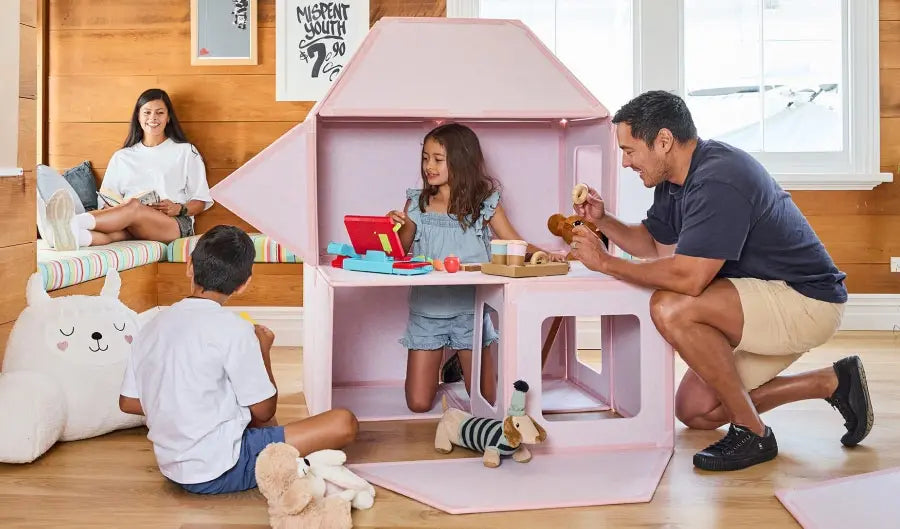
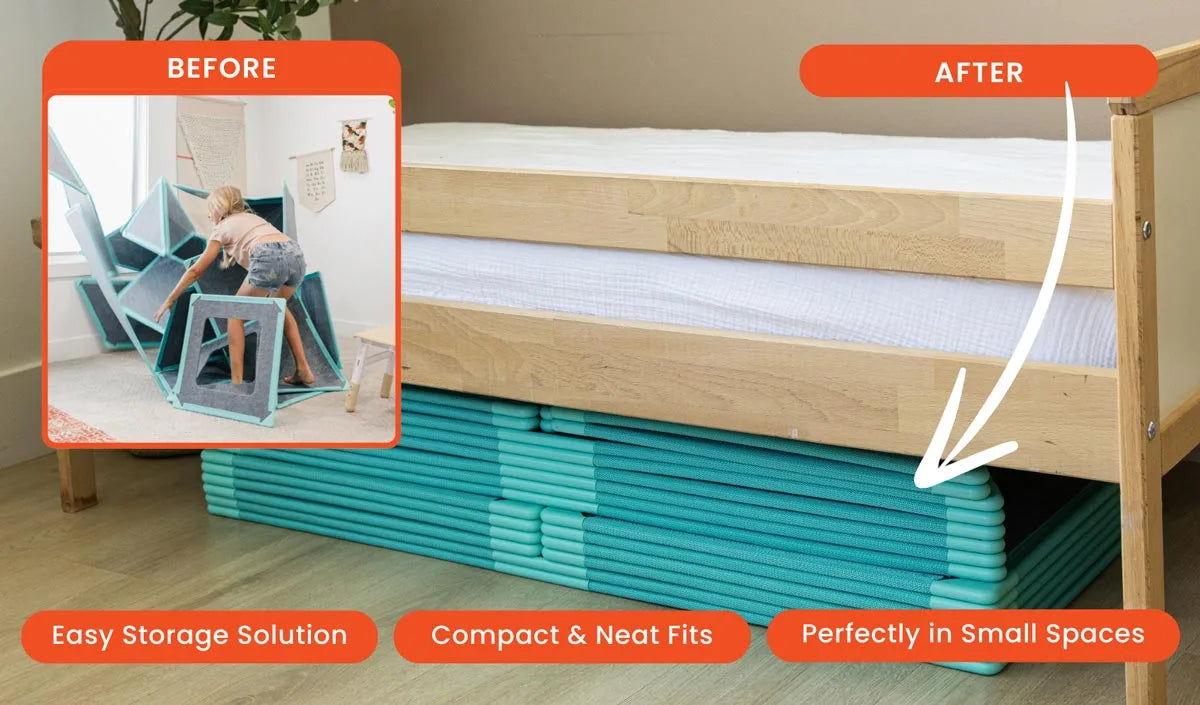
The giant magnetic tiles connect in dozens of configurations, and children decide what to build: a fort, a spaceship, a reading nook, or a veterinary clinic.
There's no script. There's no curriculum. There is just play.
"Most of the toys we buy are used for a week and forgotten," one parent shared. "With Superspace, my kids disappear for hours, and I get to just... breathe."
That breathing room is not a luxury. For a parent managing burnout, it is essential.
When a child is deeply engaged in self-directed play, the parent gets something rare: a moment to not perform, not direct, not worry about whether the play is "enough."
Whether it is a Superspace set, a pile of wooden blocks, or an afternoon with nothing but a backyard and a hose, the principle is the same. The tools that reduce play pressure are the ones that put children in charge and give parents permission to step back.
You don't need more toys. You need fewer toys that do more.
Research on how too many toys affect creativity confirms this: children with fewer, higher-quality play options demonstrate longer attention spans and deeper imaginative play than children surrounded by choice overload.
For families exploring what hands-on learning looks like without the pressure, this shift from quantity to quality is where it starts.

Play Was Never Meant to Be a Job
Play was never meant to be a job. It was meant to be a break from one.
The research could not be more clear.
The best thing you can do for your child's development is not to choreograph every moment of their play. It is to protect their freedom to play on their own terms, in their own way, at their own pace.
Parental burnout is not a sign that you are failing. It is a sign that the expectations placed on modern parents have become unsustainable.
The Surgeon General called it a public health crisis. Researchers across 42 countries have documented its roots in cultural pressure, not personal inadequacy [1][2].
The next time you feel the weight of making play "count," remember this: your presence is the only thing that counts. Not the activity. Not the lesson. Not the Instagram post. Just you, sitting nearby, willing to follow your child's lead.
That is enough. The research says so.
Explore more on how play supports your child's development in our Play Magazine, or discover what makes Superspace sets a favorite for families looking to bring more joy and less pressure into playtime.
References
- Office of the Surgeon General. (2024). Parents Under Pressure: The U.S. Surgeon General's Advisory on the Mental Health and Well-Being of Parents. U.S. Department of Health and Human Services. https://www.hhs.gov/surgeongeneral/reports-and-publications/parents/index.html
- Roskam, I., Aguiar, J., Akgun, E., et al. (2021). Parental Burnout Around the Globe: a 42-Country Study. Affective Science, 2, 58-79. https://doi.org/10.1007/s42761-020-00028-4
- American Psychological Association. (2023). Stress in America Survey. https://www.apa.org/news/press/releases/stress
- Ren, X., Cai, Y., Wang, J., & Chen, O. (2024). A systematic review of parental burnout and related factors among parents. BMC Public Health, 24, 376. https://doi.org/10.1186/s12889-024-17829-y
- Yogman, M., Garner, A., Hutchinson, J., Hirsh-Pasek, K., & Golinkoff, R. M. (2018). The Power of Play: A Pediatric Role in Enhancing Development in Young Children. Pediatrics, 142(3), e20182058. https://doi.org/10.1542/peds.2018-2058
- Gray, P., Lancy, D. F., & Bjorklund, D. F. (2023). Decline in Independent Activity as a Cause of Decline in Children's Mental Health: Summary of the Evidence. Journal of Pediatrics, 260, 113352. https://www.jpeds.com/article/S0022-3476(23)00111-7/abstract
- Mikolajczak, M., Aunola, K., Sorkkila, M., & Roskam, I. (2023). 15 Years of Parental Burnout Research: Systematic Review and Agenda. Current Directions in Psychological Science, 32, 276-283. https://doi.org/10.1177/09637214221142777