What Is Constructive Play? Definition, Benefits, Examples & Best Toys for Kids
Ant ErwinYour child stacks blocks, shapes play-dough, or builds a blanket fort from nothing. It looks like simple play. It is not.
Constructive play is one of the most powerful forms of learning in childhood. By age four, children choose it more than half the time during free play.
Research shows that children who regularly build and create develop stronger math skills, spatial reasoning, and executive function [8].
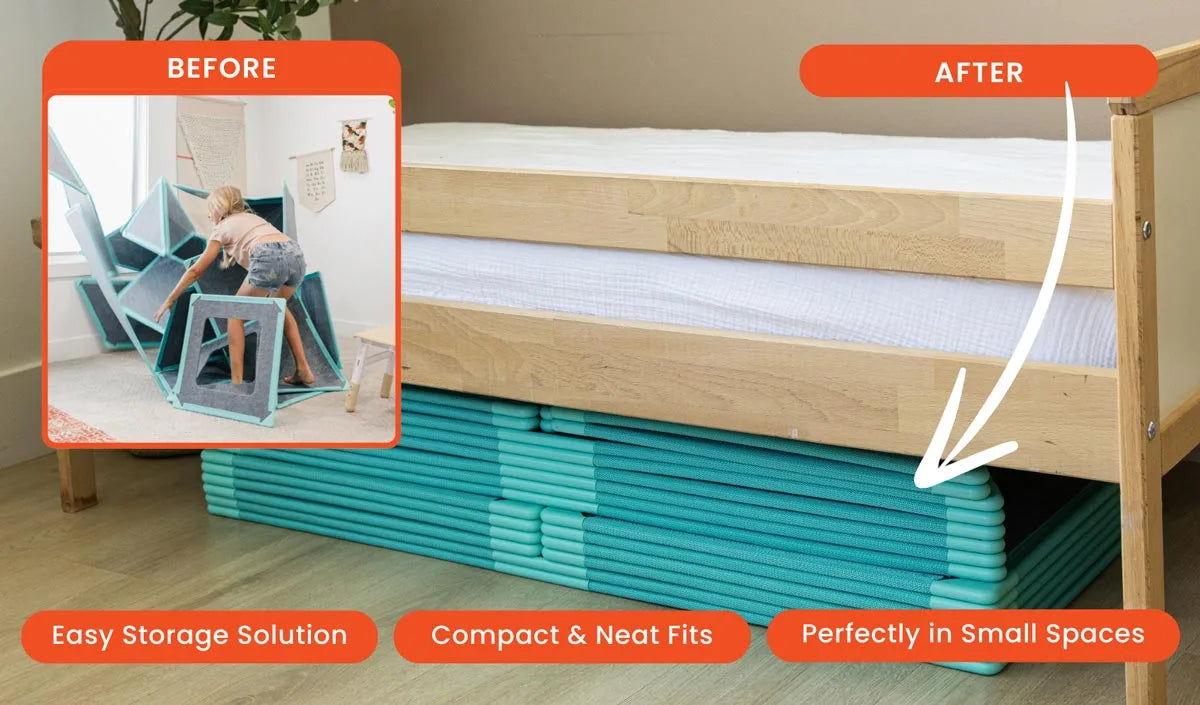
Tools like Superspace giant magnetic building sets let children build life-sized structures, turning constructive play into a full-body learning experience.

Key Takeaways
- Constructive play is organized, goal-oriented play where children use materials to build or create, and by age 3-4, it becomes the most common form of play.
- Research confirms that block play and construction activities develop math skills, spatial reasoning, and executive function simultaneously.
- Children who engage in regular constructive play show better math and reading achievement from elementary through high school.
- Life-sized building play adds gross motor development and proprioceptive input that small-scale block play cannot provide.
- Parent scaffolding through open-ended questions amplifies the cognitive benefits of constructive play.
- A 2026 meta-analysis of 26 studies confirms a significant positive connection between play and executive function development.
- The best constructive play toys are open-ended, with no single "right" way to build.
Table of Contents
- What Is Constructive Play? Definition and Piaget's Framework
- Why Constructive Play Matters for Child Development
- The Cognitive and STEM Benefits of Constructive Play
- How Constructive Play Builds Motor Skills
- Social and Emotional Growth Through Building Together
- Constructive Play Examples by Age
- The Best Constructive Play Toys and Materials
- How to Encourage Constructive Play at Home
- Building Thinkers, One Structure at a Time
- References
What Is Constructive Play? Definition and Piaget's Framework
Constructive play is organized, goal-oriented play in which children use materials like blocks, sand, art supplies, or building toys to create or build something. Unlike random exploration, constructive play involves a clear intention. The child has an idea and works toward making it real.
Developmental psychologist Jean Piaget first described constructive play as part of his framework for understanding how children learn through play. His model identifies four stages that children move through as they develop.
The Four Stages of Play
Functional play is the earliest stage. Infants and young toddlers explore materials through their senses, shaking, mouthing, and banging objects to discover what they do.
Constructive play emerges next, usually between ages two and three. Children begin using materials with purpose, stacking blocks into towers, molding sand into shapes, or assembling pieces into structures. This shift from exploration to intentional creation marks a significant cognitive leap.
Symbolic play follows, as children use objects and scenarios to represent things that are not physically present. A cardboard box becomes a spaceship. A stick becomes a magic wand.
Games with rules are the final stage, where children engage in structured play with predetermined rules and outcomes.
The progression is not strictly linear. Children often move between stages within a single play session, and constructive play remains valuable well beyond early childhood.
Why Constructive Play Is Not Just a "Bridge"
Some developmental frameworks treat constructive play as merely a stepping stone to fantasy and symbolic play. Research suggests otherwise.
Studies show that children choose constructive play more than 50% of the time during free play periods, making it the dominant form of play by age four.
The American Academy of Pediatrics, in its landmark clinical report on the power of play, emphasized that play develops executive function, language, and math skills simultaneously [8].
This is not a phase to rush through. Constructive play is a form of open-ended play that continues to benefit children through elementary school and beyond.

Why Constructive Play Matters for Child Development
When a child picks up building materials and starts creating, something remarkable happens. Multiple areas of development activate at once. Cognitive, motor, social, emotional, and creative skills all fire simultaneously.
This is what makes constructive play different from many other activities. It is not isolated skill-building. It is whole-child development happening through a single, intrinsically motivating experience.
The AAP's clinical report on play found that guided play "captures the strengths of both free play and direct instruction," making it one of the most effective approaches to early learning [8].
Constructive play teaches children to become flexible thinkers. When a structure falls, they adapt. When materials run out, they improvise. When building with a friend, they negotiate. These are the same adaptive skills they will rely on throughout school and life.
What sets constructive play apart from passive forms of learning is the hands-on nature of the experience. Children are not receiving information. They are discovering it through direct interaction with physical materials.
Research on hands-on learning consistently shows that children retain more and develop a deeper understanding when they can touch, move, and manipulate objects rather than simply observe.
Constructive play in early childhood lays the foundation for skills that matter across every domain of development, from spatial reasoning in math class to conflict resolution on the playground.

The Cognitive and STEM Benefits of Constructive Play
Spatial Reasoning and Math Skills
One of the most studied benefits of constructive play is its impact on spatial reasoning and mathematics. When children build, they are constantly making spatial judgments. Which piece fits here? How tall can this wall get before it falls? What shape fills this gap?
A study published in Frontiers in Psychology found a positive relationship between constructive play activities and spatial ability in children.
The researchers demonstrated that spatial ability mediates the connection between constructive play and math performance, meaning that building play does not just improve spatial skills. It creates a direct pathway to mathematical understanding [2].
Research from Florida International University confirmed that children as young as three use the same mental rotation strategies as adults when engaging in spatial tasks. Spatial reasoning was identified as one of the strongest predictors of later STEM success [10].
A separate study found that preschoolers with high-level block construction attain better math and reading achievement through elementary and into high school. Block play develops technological thinking, critical thinking, problem-solving, creativity, and abstract thinking [5].
Construction play also develops children's understanding of real physics concepts. Research on five- to six-year-olds demonstrated that building activities support the acquisition of mathematical and spatial skills while teaching intuitive understanding of stability, balance, and gravity [4].
These findings point to a clear conclusion. The blocks, tiles, and building materials your child plays with today are building the cognitive architecture for tomorrow's STEM skills.
Executive Function: Planning, Flexibility, and Focus
Executive function refers to the set of cognitive skills that allow children to plan, focus, remember instructions, and manage their behavior. It includes three core components: working memory, inhibitory control, and cognitive flexibility [9].
These skills are among the strongest predictors of academic achievement, social competence, and mental health across the lifespan [9].
Building play exercises all three simultaneously.
Working memory is engaged when a child holds a mental blueprint while constructing. Inhibitory control develops when a wall falls, and the child resists the impulse to quit.
Cognitive flexibility is practiced every time the original design fails, and a new approach is needed.
A randomized controlled trial found that semi-structured block play improved both math skills and executive functioning in preschool children ages three to five, after just 14 sessions of 15 to 20 minutes each [1].
A 2026 meta-analysis of 26 studies involving 2,915 children confirmed a statistically significant positive relationship between play and executive function, with no publication bias detected [7].
Research on open-ended constructive play materials found that they directly develop executive function and cognitive self-regulation, with even short daily sessions showing measurable improvements [3].
For a deeper look at how play supports these critical skills, our guide on executive functioning through play explores specific strategies and research.

How Constructive Play Builds Motor Skills
Fine Motor Development
Every time a child grasps a block, connects two pieces, or aligns edges to create a structure, they are strengthening the small muscles in their hands and fingers.
These fine motor skills are essential for writing, drawing, buttoning clothes, and using utensils.
Constructive play provides repetitive, purposeful practice without feeling like exercise. The child is motivated by the goal of building something, and the fine motor development happens as a natural byproduct.
Small-scale building with blocks, magnetic tiles, and interlocking pieces develops hand-eye coordination, bilateral coordination, and the precise finger movements children need for academic tasks.
Gross Motor Development Through Life-Sized Building
Most discussions of constructive play focus on tabletop-sized materials. But life-sized building introduces an entirely different physical dimension.
When children build with large panels and pieces, they engage their whole body.
Lifting, carrying, and positioning building components provides proprioceptive input, the deep-pressure feedback from muscles and joints that helps children regulate their nervous system.
Life-sized building also develops balance, coordination, and core strength. Children stretch overhead to place panels, squat down to build foundations, and crawl through the structures they have created.
Superspace panels are two feet by three feet, which means constructing with them requires genuine physical effort.
This transforms constructive play from a fine motor activity into a full-body experience that develops both fine and gross motor skills simultaneously.
The connection between gross motor development and fort building adds a dimension of constructive play that small-scale block play simply cannot provide.

Social and Emotional Growth Through Building Together
Cooperation, Communication, and Shared Goals
When two or more children build together, constructive play becomes a powerful social learning experience. Building creates a structured framework for interaction that many children find more comfortable than unstructured social play.
The shared goal of creating something provides natural roles and responsibilities. One child holds the wall while the other connects a piece.
One suggests a design while the other figures out how to execute it. This kind of functional communication develops language skills and social competence organically.
Children practice negotiation, compromise, and turn-taking in a context that feels meaningful rather than forced.
The building project gives social interaction a purpose, which is especially valuable for children who find unstructured group dynamics challenging.
Exploring the connection between creative play and social development reveals how construction activities build communication skills alongside creativity.
Self-Esteem and Emotional Resilience
Creating something tangible gives children a visible sense of accomplishment.
A child who builds a structure can point to it and say, "I made that." This is fundamentally different from the abstract sense of achievement that comes from a test score or a sticker chart.
The build-fail-rebuild cycle of constructive play also develops emotional resilience. When a structure collapses, the child faces a natural consequence and a natural choice: give up or try again. With practice, most children learn to try again.
Open-ended constructive play removes the pressure of "right" answers. There is no instruction sheet to follow and no standard to meet.
This freedom allows children to take creative risks without fear of failure, building confidence that transfers to other areas of life.

Constructive Play Examples by Age
Constructive play evolves as children develop. Here are concrete examples of constructive play activities organized by developmental stage, so you can recognize and encourage this type of play at every age.
Ages 2-4: Toddlers and Early Builders
At this stage, children are transitioning from functional play to intentional building. The focus is on process, not product.
- Stacking and knocking down wooden blocks or soft blocks
- Simple sandcastle building at the beach or in a sandbox
- Play-Doh sculpting with basic tools
- Nesting cups and shape-sorting toys
- Cardboard box constructions (cutting holes, decorating)
- Stacking large magnetic panels into simple walls
Repetitive building is normal and healthy at this age. When your toddler builds and topples the same tower ten times in a row, their nervous system is finding regulation through the predictable pattern. This is not stagnation. It is purposeful practice.
Ages 4-7: Creative Constructors
Children in this stage begin building with clear goals. Their structures become more complex, and collaborative building with peers and siblings becomes increasingly valuable.
- Building enclosed forts and structures large enough to play inside
- Multi-piece designs with Legos, blocks, or magnetic tiles
- Art projects combining multiple materials (paint, glue, recycled items)
- Collaborative construction projects with siblings or friends
- Creating scenes and environments for imaginative play
- Simple engineering challenges ("Can you build a bridge?")
This is the age when constructive play and symbolic play begin to overlap naturally. A child builds a castle and then populates it with characters and stories. Both types of play reinforce each other.
For age-appropriate building toys that support this developmental stage, explore our guide to Montessori toys for ages 3 to 10.
Ages 7-10+: Design Engineers
Older children approach constructive play with more sophisticated planning and problem-solving abilities.
- Complex engineering challenges (tallest tower, strongest bridge)
- Multi-day building projects that require sustained planning
- Designing for others ("Build something your sibling can use")
- Reverse engineering existing structures
- Problem-solving with deliberate constraints ("Use only 10 pieces")
At this age, the iterative design process of plan, build, test, and revise mirrors real-world engineering thinking. Life-sized building sets are especially engaging for this age group because the structures are large enough for real use, adding purpose and motivation to the design process.
The Best Constructive Play Toys and Materials
Not all toys support constructive play equally. The best constructive play toys share a few key characteristics: they are open-ended, they can be used in multiple ways, and they grow with the child.
Traditional building blocks remain one of the most effective constructive play materials available. Wooden unit blocks are simple, versatile, and extensively research-validated for their developmental benefits [1].
Interlocking building systems like Legos and Duplo add complexity and precision to constructive play. These materials develop fine motor skills through the detailed connection process and encourage sustained, goal-oriented building.
Natural and unstructured materials, including sand, water, clay, sticks, and recyclables, are some of the most powerful constructive play materials. They require creativity because they have no predetermined form.
Art supplies like paper, tape, glue, scissors, and paint support constructive play by allowing children to create two-dimensional and three-dimensional projects from raw materials.
Life-sized building toys represent the next evolution of constructive play. When children can build structures they physically enter, the play experience transforms. Superspace giant magnetic building sets use soft eco-felt panels with auto-aligning magnets that let children build forts, houses, and vehicles at body scale.
There is no wrong way to connect the pieces, and the resulting structures are large enough to climb inside.
The principle of fewer, higher-quality toys over overflowing toy bins applies directly to constructive play.
A focused selection of versatile building materials inspires deeper engagement than a room full of single-purpose toys.
For a comprehensive guide to building toys, explore our magnetic building toys guide.

How to Encourage Constructive Play at Home
You do not need special training to support constructive play at home. Small changes to your environment and approach can make a significant difference in how your child engages with building.
Create a dedicated building space with room for large structures. When children have a predictable area where building is encouraged, they are more likely to initiate and sustain constructive play on their own.
Allow "build-in-progress" zones where children can return to unfinished projects. Multi-session building develops planning, sustained attention, and the executive function skill of task persistence.
Scaffolding is one of the most effective strategies parents can use during constructive play. The AAP recommends guided play, where adults support children's exploration through open-ended questions rather than direct instruction [8].
Try questions like "What would happen if you tried it a different way?" or "I notice that side is wobbly. What do you think might help?" These prompts encourage problem-solving and flexible thinking without taking over the child's creative process.
Research confirms that scaffolding-focused approaches improve both the quality of children's play and the cognitive outcomes associated with constructive activities [6].
Model constructive play yourself. Build alongside your child. When your structure falls, narrate your thinking: "That did not work. Let me try a different approach." Children learn flexible thinking partly by watching the adults around them navigate setbacks with curiosity.
Celebrate the process, not the product. Instead of "What a beautiful tower," try "You tried three different designs before that one worked. That takes patience."
Replace screen time with building time. Research on reducing screen time consistently shows that hands-on play provides developmental benefits that digital activities cannot replicate.
Let your child lead. The most powerful constructive play happens when the child decides what to build, how to build it, and when they are finished. Your role is to provide the materials, the space, and the encouragement.
Building Thinkers, One Structure at a Time
Constructive play is not a minor childhood activity. It is one of the most powerful, most natural, and most enjoyable forms of learning available to children. From the moment a toddler stacks their first block to the day a ten-year-old engineers a multi-room fort, every build is shaping the brain.
Research confirms that children who regularly build, create, and construct develop stronger cognitive, motor, social, and emotional skills [1][5][8].
Every stacked block, molded sandcastle, and assembled structure is building neural pathways that support academic success, social competence, and creative confidence.
The best part? Your child does not need to know any of this. They just need materials, space, and the freedom to build. Explore Superspace giant magnetic building sets and discover how life-sized constructive play can support your child's development through purposeful, hands-on creation. Visit Superspace to learn more.
References
- Schmitt, S. A., Korucu, I., Napoli, A. R., Bryant, L. M., & Purpura, D. J. (2018). Using block play to enhance preschool children's mathematics and executive functioning: A randomized controlled trial. Early Childhood Research Quarterly, 44, 181-191. https://doi.org/10.1016/j.ecresq.2018.04.006
- Nath, S., & Szücs, D. (2014). The relation between children's constructive play activities, spatial ability, and mathematical word problem-solving performance. Frontiers in Psychology, 5, 782. https://pmc.ncbi.nlm.nih.gov/articles/PMC4102248/
- Cankaya, O., & Korkmaz, A. (2023). Preschool Children's Loose Parts Play and the Relationship to Executive Function. International Journal of Environmental Research and Public Health, 20(15). https://pmc.ncbi.nlm.nih.gov/articles/PMC10456023/
- The Impact of a Construction Play on 5- to 6-Year-Old Children's Reasoning About Stability. (2020). Frontiers in Psychology, 11. https://pmc.ncbi.nlm.nih.gov/articles/PMC7372995/
- Spatial Skills Associated With Block-Building Complexity in Preschoolers. (2020). Frontiers in Education. https://pmc.ncbi.nlm.nih.gov/articles/PMC7649809/
- Building minds with blocks: The impact of a play-based professional development on preschool teachers' competencies and children's learning. (2025). Teaching and Teacher Education, 165, 105144. https://www.sciencedirect.com/science/article/pii/S0742051X25002215
- A Head Taller: A Meta-Analysis on the Relation Between Pretend Play and Executive Functions in Early Childhood. (2026). Developmental Review, 79, 101249. https://www.sciencedirect.com/science/article/pii/S0273229726000055
- Yogman, M., Garner, A., Hutchinson, J., Hirsh-Pasek, K., & Golinkoff, R. M. (2018). The Power of Play: A Pediatric Role in Enhancing Development in Young Children. Pediatrics, 142(3), e20182058. https://doi.org/10.1542/peds.2018-2058
- Diamond, A. (2013). Executive Functions. Annual Review of Psychology, 64(1), 135-168. https://doi.org/10.1146/annurev-psych-113011-143750
- FIU Center for Children and Families. (2025). Building Preschoolers' STEM Skills is Child's Play. Infant and Child Development. https://news.fiu.edu/2025/building-preschoolers-stem-skills-is-childs-play