Fine Motor Skills Development: Best Toys by Age [2026 Guide]
Craig SpencerQuick answer: The best fine motor skills toys match your child's developmental stage: stacking rings and soft blocks for babies, play dough and peg puzzles for toddlers, lacing beads and safety scissors for preschoolers, and Lego, origami, and bead kits for school-age kids. Play-based practice builds hand strength and coordination more effectively than repetitive drills.
Your toddler fumbles with a jacket zipper for the third time this morning. It is a small moment, but it points to something big.
Fine motor skills are the small muscle movements in our hands, fingers, and wrists. They are the foundation for writing, self-care, and daily independence.
The good news is that the right toys turn this development into something your child genuinely enjoys, building strength and coordination through play.
This guide covers the best fine motor skills toys by age, plus why pairing them with whole-body play tools like Superspace creates a complete developmental picture.

Key Takeaways
- Fine motor skills develop in predictable stages from birth through age 8, following milestones tracked by the CDC.
- Research shows that fine motor skills positively correlate with academic achievement in over 83% of studies examined.
- Play-based approaches produce better fine motor outcomes than structured drill exercises.
- Different ages require different types of fine motor challenges, from grasping rings to threading beads.
- Both fine and gross motor skills are essential for whole-child development. They are not interchangeable.
- Simple household items like play dough, tongs, and crayons are among the most effective fine motor tools available.
Table of Contents
- What Are Fine Motor Skills and Why Do They Matter?
- How Do Toys Support Fine Motor Development?
- What Are the Best Fine Motor Skills Toys by Age?
- Fine Motor vs Gross Motor Skills: Why Children Need Both
- What Are the Signs Your Child May Need Fine Motor Support?
- How Can You Build Fine Motor Skills at Home?
- Building a Foundation, One Small Movement at a Time
- Frequently Asked Questions
- References
What Are Fine Motor Skills and Why Do They Matter?
Fine motor skills refer to the coordinated movements of small muscles in the hands, fingers, and wrists. These are the movements your child uses every day, from picking up a piece of cereal to holding a crayon, buttoning a coat, or turning the page of a book.
While gross motor skills involve large muscle groups used for running, jumping, and climbing, fine motor skills are about precision and control. Both are essential parts of physical development, and they work together more closely than most parents realize.
The impact of fine motor skills extends well beyond the playground.
A 2024 meta-analysis published in Frontiers in Sports and Active Living found that fine motor skills, particularly visual-motor coordination and fine motor precision, show a moderate positive correlation with academic abilities in children [1].
In practical terms, this means that the child who can grip a pencil comfortably, cut along a line, and manipulate small objects is also building the foundation for handwriting, math manipulation, and classroom independence.

The Connection Between Fine Motor Skills and Academic Success
The relationship between fine motor development and school readiness is well documented. A systematic review of 78 studies found that fine motor skills showed a positive correlation with overall academic performance in 83.3% of the associations examined [2].
The connection makes intuitive sense. Writing requires precise finger control. Math activities involve counting small objects, drawing shapes, and using tools. Science and art depend on cutting, gluing, and detailed manipulation.
Even using a computer or tablet requires the finger isolation and control that fine motor practice builds.
For parents, this research carries an encouraging message. The time your child spends playing with blocks, threading beads, or squishing play dough is not "just" play. It is laying the neurological groundwork for academic skills they will use for years.
Investing in hands-on learning experiences during early childhood pays dividends well into the school years.
Key Fine Motor Milestones by Age
Every child develops at their own pace, but fine motor skills generally follow a predictable progression. These milestones, adapted from CDC developmental guidelines, offer a helpful reference [3].
- 0-6 months: Reaching for objects, bringing hands to mouth, beginning to grasp
- 6-12 months: Developing pincer grasp (thumb and forefinger), transferring objects between hands, banging objects together
- 1-2 years: Stacking 2-4 blocks, scribbling with a crayon, turning pages in a board book, using a spoon
- 2-3 years: Stringing large beads, attempting to use scissors, drawing circles and lines, turning doorknobs
- 3-4 years: Cutting along a line, drawing recognizable shapes, beginning to dress independently, using a fork
- 4-5 years: Writing some letters, buttoning and unbuttoning, using scissors with control
- 5-8 years: Fluent handwriting, tying shoes, detailed drawing, complex building
If your child is consistently behind these benchmarks, it does not necessarily indicate a problem. But it may be worth discussing with your pediatrician.

How Do Toys Support Fine Motor Development?
Children do not sit down and decide to practice their pincer grasp. They pick up a puzzle piece because they want to finish the picture. They squeeze play dough because it feels satisfying. They stack blocks because they want to build something tall.
This is exactly why toys are such powerful developmental tools. They provide the repetitive, motivated practice that builds motor pathways, without the child ever feeling like they are working.
The Science Behind Play-Based Motor Learning
Research supports what occupational therapists have long observed in practice. A landmark study by Case-Smith found that play-focused therapy sessions produced significantly better fine motor outcomes than more structured approaches [4].
Among preschoolers with fine motor delays, those whose therapy incorporated play goals showed greater improvement in both fine motor and visual motor performance. As the study concluded, "a focus on play in intervention activities can enhance fine motor and visual motor performance" [4].
The American Academy of Pediatrics reinforces this finding. Their clinical report on the power of play states that play "enhances brain structure and function" and promotes the executive function skills children need for learning [5].
When children are intrinsically motivated by play, they willingly repeat movements hundreds of times. They challenge themselves at their own edge. And they build neural pathways through joyful repetition rather than forced practice.
This is why creative play is such a powerful vehicle for motor development.
What to Look for in Fine Motor Toys
Not all toys are equally effective for building fine motor skills. Research has validated that different types of toys develop different motor abilities, confirming that thoughtful selection matters [6].
When choosing fine motor skills toys, look for these qualities:
- Age-appropriate challenge: Difficult enough to require effort, easy enough to avoid frustration
- Safety: No choking hazards for the target age group
- Multiple skill engagement: Toys that combine grip, coordination, and problem-solving
- Open-ended design: Toys that can be used in many ways hold attention longer and encourage open-ended play
- Material variety: Different textures (wood, silicone, fabric) provide diverse tactile experiences
The most effective fine motor toys do not come with instructions. They invite exploration.

What Are the Best Fine Motor Skills Toys by Age?
Choosing the right fine motor skills toys means matching the challenge to your child's developmental stage. What builds confidence at 12 months will bore a 4-year-old. What excites a preschooler may frustrate a toddler.
Here is a research-informed breakdown of the best toy categories for each age group.
Best Fine Motor Toys for Babies (6-12 Months)
At this stage, your baby is developing their pincer grasp, learning to transfer objects between hands, and beginning to reach with purpose. Toys should be easy to hold, safe to mouth, and satisfying to manipulate.
Stacking rings and cups. These teach grasping, releasing, and basic size awareness. Babies learn cause and effect as towers topple, and they practice bilateral coordination by holding one cup while placing another.
Soft blocks and clutching toys. Lightweight blocks that are easy to grip help build hand strength. Look for blocks with different textures to add a sensory dimension to the motor practice.
Shape sorters (simple versions). Even before babies can match shapes correctly, they practice hand-eye coordination by attempting to fit objects into openings. Start with models that have larger holes and only 3-4 shapes.
Board books with tabs and flaps. Lift-the-flap books are excellent for finger isolation and pincer grasp. Each tiny tab requires the precise thumb-and-forefinger coordination that supports later writing skills.
Textured sensory balls. Balls with bumps, ridges, and varied surfaces encourage different grip patterns. Rolling, squeezing, and passing these balls between hands builds foundational coordination.
Exploring sensory play toys at this age supports both tactile and motor development.
Parent tip: Let babies explore at their own pace. Resist the urge to show them the "right" way to use a toy. Self-discovery builds both motor skills and confidence.

Best Fine Motor Toys for Toddlers (1-2 Years)
Toddlers are refining their pincer grasp, beginning to stack four or more blocks, and experimenting with early mark-making. This is the age where hand strength and wrist control start developing rapidly.
Wooden building blocks. Stacking, balancing, and knocking down blocks develops spatial awareness, grip control, and bilateral coordination. Start with larger blocks and gradually introduce smaller ones as skills improve.
Play dough and modeling clay. Squeezing, rolling, flattening, and pinching play dough is one of the most effective fine motor exercises at any age. It builds hand strength, finger isolation, and creativity simultaneously. Best of all, you can make it at home for almost nothing.
Large peg puzzles. These require the child to grasp a small knob and place the piece accurately, practicing both grip precision and hand-eye coordination. Start with puzzles that have 4-6 pieces and obvious shape cues.
Nesting and stacking toys. Size ordering activities teach spatial reasoning while requiring controlled hand movements. Nesting cups, stacking rings, and graduated blocks all serve this purpose well.
Chunky crayons and sidewalk chalk. Early mark-making does not require a perfect pencil grip. Fat crayons and chalk encourage whole-hand grasping, which is developmentally appropriate at this stage and strengthens the hand muscles needed for a mature grip later.
Parent tip: Play dough is one of the single most effective fine motor tools available, and it works for every age group in this guide. Keep it accessible.

Best Fine Motor Toys for Preschoolers (3-4 Years)
This is a critical period for fine motor development. Your child is learning to use scissors, draw recognizable shapes, dress independently, and establish hand dominance. Toys at this age should stretch their precision and introduce bilateral coordination challenges.
Safety scissors and cutting activities. Learning to cut is one of the most complex fine motor tasks a preschooler faces. It requires bilateral coordination (one hand holds the paper, the other cuts), controlled opening and closing of the hand, and visual tracking. Start with cutting play dough before moving to paper.
Lacing cards and threading beads. Stringing beads on a cord or lacing a card with a shoelace practices sequencing, hand-eye coordination, and finger dexterity. These activities are staples in Montessori classrooms for good reason. Many parents find that the best Montessori toys incorporate these same threading and lacing principles.
Duplo and large construction toys. Pressing bricks together and pulling them apart builds hand strength and precision. Construction play also encourages planning and spatial reasoning, connecting fine motor practice to cognitive development.
Activity and busy boards. Boards with zippers, buttons, latches, snaps, and buckles give preschoolers concentrated practice on the self-care skills they are starting to master. These tools turn functional tasks into engaging puzzles.
Stamp and sticker activities. Placing stickers and pressing stamps require finger isolation and placement precision. These are also among the easiest fine motor activities to bring along for restaurants or waiting rooms.
Parent tip: This is the age where "real tools" become exciting. Child-safe tweezers, tongs, and eyedroppers turn mealtime and bath time into fine motor practice without any extra effort.

Best Fine Motor Toys for School-Age Kids (5-8 Years)
By this stage, children are developing fluent handwriting, using utensils independently, tying shoes, and engaging in complex construction. Fine motor practice at this age naturally shifts toward hobbies, crafts, and detailed building.
Lego and small construction sets. Following instructions to build a specific model requires reading, sequencing, spatial reasoning, and extreme finger precision. Free-building encourages creativity while still demanding fine motor control.
Lego is also a strong entry point into STEM learning, bridging motor skills with engineering thinking.
Origami and paper crafts. Folding paper along precise lines develops bilateral coordination, spatial reasoning, and patience. Start with simple models like boats and planes and progress toward more complex designs as skills grow.
Bead kits and jewelry making. Threading small beads onto string or wire requires sustained fine motor precision and hand-eye coordination. Many children find this meditative and self-motivating, which means they practice for extended periods without prompting.
Model building kits. Snap-together models, balsa wood planes, and similar kits require following sequential steps while manipulating small components. These develop planning skills alongside fine motor dexterity.
Hama and Perler beads. Placing tiny beads onto pegboards according to a pattern demands extreme fine motor precision and sustained attention. This is one of the most challenging fine motor activities for this age group, and children love the finished products.
Beginner knitting or weaving looms. These tools introduce repetitive precision movement with a tangible result. Children develop bilateral coordination, rhythm, and patience while creating something they can actually wear or give as a gift.
Parent tip: At this age, fine motor practice shifts from exercises to interests. A child who loves drawing will build hand strength through sketching.
A child who enjoys building will develop precision through construction. Follow their enthusiasm. The best fine motor development happens when children do not realize they are practicing.

Fine Motor vs Gross Motor Skills: Why Children Need Both
If you have spent time researching fine motor skills toys, you have probably encountered the term "gross motor skills" as well. Understanding the difference and the connection between them is key to supporting your child's complete physical development.
Fine motor skills involve the small muscles of the hands, fingers, and wrists. Gross motor skills involve the large muscles of the arms, legs, and core. Both are essential, and they develop alongside each other throughout childhood.
The same systematic review that documented the fine motor and academic connection also found that gross motor skills showed a positive correlation with academic achievement, appearing in 65% of the studies examined [2].
This means that a child's ability to run, jump, climb, and balance is not separate from their ability to write, cut, and draw. It is foundational to it.
How Does Gross Motor Play Support Fine Motor Development?
The connection is biomechanical. To control a pencil, a child first needs a stable shoulder. To have a stable shoulder, they need core strength. To develop core strength, they need active, whole-body play.
This is why occupational therapists often prescribe gross motor activities alongside fine motor interventions. A child who cannot sit upright without effort is going to struggle with the hand control needed for writing, regardless of how many pencil-grip exercises they do.
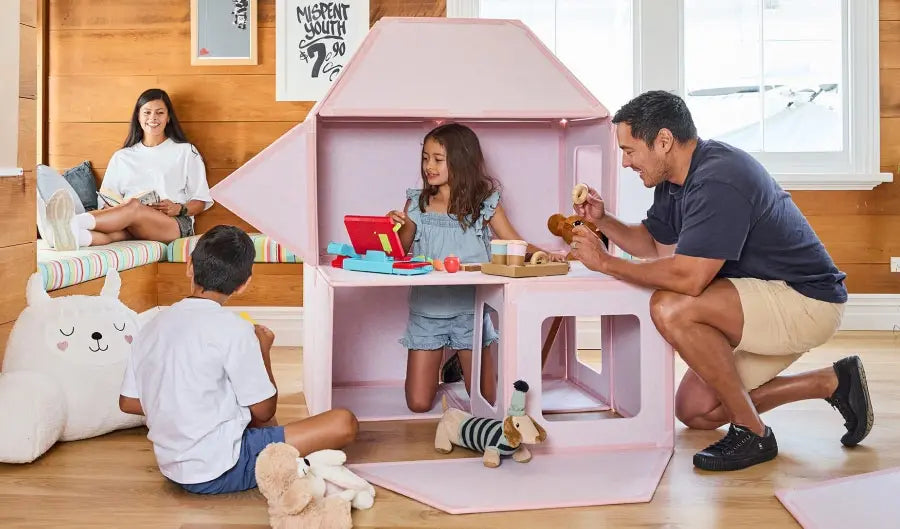
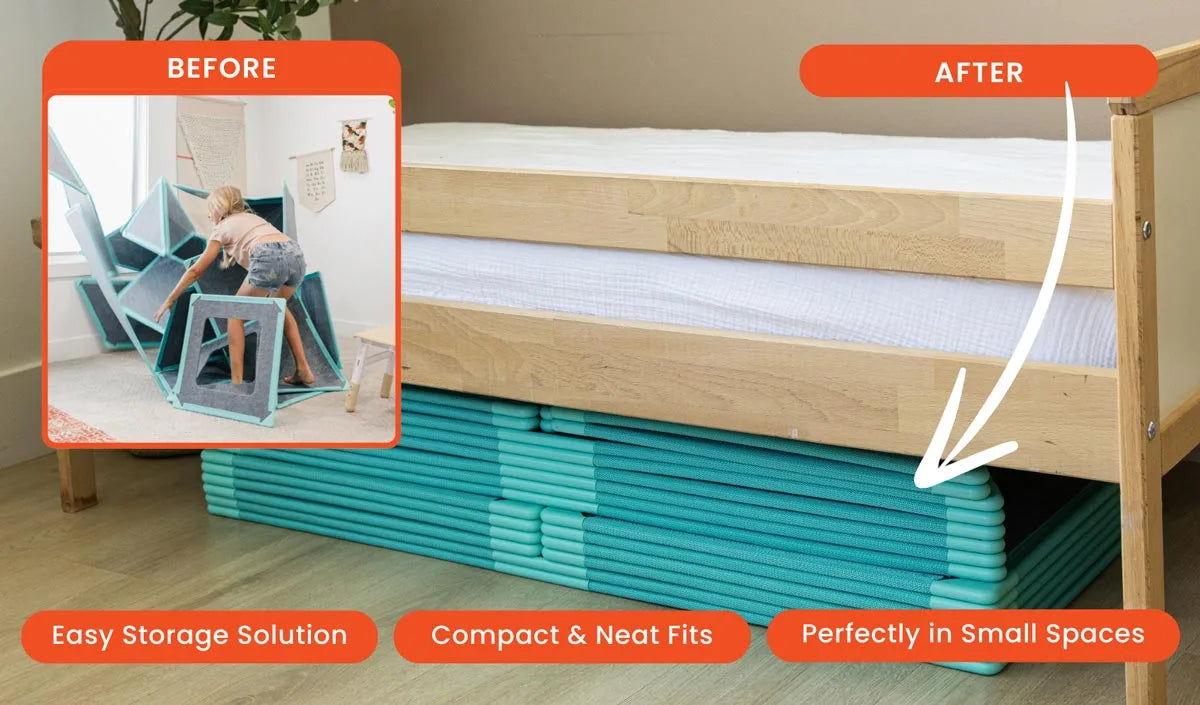
Activities like climbing, crawling, carrying heavy objects, and building at a large scale develop the foundational stability that fine motor precision relies on. Tools like Superspace magnetic building panels engage the whole body, as children reach, lift, carry, and crawl through life-sized structures they design themselves. This kind of active play builds the gross motor foundation that supports everything from handwriting to buttoning a coat.
For a deeper look at how large-scale building supports physical development, see our guide to gross motor development through fort building.
The takeaway for parents is straightforward. Fine motor toys develop the small muscles. Gross motor play develops the large muscles that support them. Your child needs both. A balanced toy collection includes tabletop activities for precision and active play tools for strength, coordination, and balance.

What Are the Signs Your Child May Need Fine Motor Support?
Every child develops at their own pace, and variation is completely normal. Some children pick up a crayon at 18 months and scribble with joy. Others show little interest in drawing until well past their third birthday.
That said, there are signs that may suggest a child could benefit from additional fine motor support. Watch for these patterns:
- Consistently avoids activities that require hand use (coloring, building, cutting)
- Shows significantly less hand control than peers of the same age
- Experiences visible frustration or fatigue during drawing, writing, or self-care tasks
- Has difficulty with age-appropriate self-care (eating with utensils, dressing, tooth brushing)
- Struggles with bilateral tasks like cutting, opening containers, or catching a ball
- Has not developed a clear hand preference by age 5-6
If you notice several of these patterns, it is not a cause for alarm. It is an opportunity for early support.
When to Consult an Occupational Therapist
Occupational therapists specialize in helping children develop the motor skills they need for daily life. An OT evaluation is non-threatening and typically play-based, which means your child will likely enjoy the process.
Start by mentioning your concerns to your pediatrician, who can provide a referral. Many school districts also offer free developmental screenings.
Early intervention consistently produces better outcomes. The same play-based approaches discussed throughout this article form the foundation of most occupational therapy programs. An OT can help identify the specific skill gaps your child is working through and recommend targeted activities. For children with additional challenges like ADHD, play therapy approaches can be especially effective for building both motor skills and self-regulation.

How Can You Build Fine Motor Skills at Home?
You do not need specialty toys to support fine motor development. Many of the most effective activities use items you already have at home.
Kitchen activities. Let your child stir batter, pour water between cups, use tongs to serve salad, or spread butter on toast. These everyday tasks build grip strength, wrist rotation, and bilateral coordination without any special equipment.
Art and craft activities. Tearing paper, finger painting, using dot markers, and pressing stamps all develop different aspects of fine motor control. Keep a simple art station accessible so your child can practice whenever inspiration strikes.
Sensory play. Water play with eyedroppers and turkey basters builds hand strength and control. Sand play with scoops and molds develops grip patterns. Play dough with cookie cutters, rolling pins, and plastic knives covers nearly every fine motor skill in one sitting.
Self-care practice. Buttoning, zipping, tooth brushing, and hair brushing are fine motor activities that happen every day. Instead of rushing through these tasks, give your child extra time to practice them independently. The repetition builds skill and confidence.
Nature play. Picking up small leaves, rocks, and sticks develops pincer grasp naturally. Digging with child-sized tools builds hand and wrist strength. Arranging found objects into patterns combines fine motor precision with creativity.
The key principle across all these activities is the same one supported by the research. When fine motor practice is embedded in play and daily life rather than treated as a separate exercise, children are more motivated, practice longer, and develop skills more effectively [4].
Parent tip: The most powerful thing you can do is give your child time. Fine motor development is a marathon, not a sprint. Consistent, low-pressure exposure to activities that require hand control will produce steady progress.

Building a Foundation, One Small Movement at a Time
Fine motor development is a journey that begins in infancy and continues well into the school years.
The good news is that supporting it does not require expensive programs or complicated interventions. It requires the right toys, a little patience, and a willingness to let your child learn through play.
Match toys to your child's developmental stage.
Let them struggle productively with challenges that are just beyond their current ability. And remember that the mess, the imperfect scissor cuts, and the wobbly block towers are all signs of a brain and body learning together.
As you invest in fine motor development, do not overlook the other half of the equation.
Gross motor skills, the large-muscle movements that come from climbing, building, and active play, provide the physical foundation that fine motor precision depends on.
Explore how life-sized building with Superspace panels supports strength, coordination, and balance through creative, active play.
For more research-backed parenting guides on play and child development, visit our Play Magazine, or explore the full range of Superspace sets.
Frequently Asked Questions
What toys help develop fine motor skills?
Toys that require grasping, pinching, threading, and precise placement are the most effective. Play dough, building blocks, peg puzzles, lacing beads, and safety scissors all build hand strength and coordination. The best choice depends on your child's age and current developmental stage.
What fine motor skills should a 5-year-old have?
By age five, most children can write some letters, button and unbutton clothing, use scissors with control, and draw recognizable shapes. Fluent handwriting, tying shoes, and detailed drawing typically develop between ages five and eight. Every child progresses at their own pace.
What is the difference between fine and gross motor skills?
Fine motor skills involve the small muscles of the hands, fingers, and wrists, used for writing, cutting, and buttoning. Gross motor skills involve the large muscles of the arms, legs, and core, used for running, climbing, and jumping. Children need both, and gross motor strength provides the stable foundation that fine motor precision relies on.
What are the best fine motor skills toys for 2-year-olds?
Toddlers benefit most from wooden building blocks, play dough, large peg puzzles, nesting and stacking toys, and chunky crayons. These toys build the hand strength, pincer grasp, and early mark-making skills that develop rapidly between ages one and two.
How can I improve my child's fine motor skills at home?
You do not need specialty toys. Everyday activities like stirring batter, pouring water, using tongs, tearing paper, finger painting, and practicing buttoning and zipping all build fine motor control. Embedding practice in play and daily routines keeps children motivated and produces steady progress.
When should I worry about my child's fine motor development?
Consider seeking support if your child consistently avoids activities that require hand use, shows significantly less hand control than peers, experiences frustration or fatigue during drawing and self-care, or has not developed a clear hand preference by age five or six. Start by mentioning concerns to your pediatrician, who can refer you to an occupational therapist.
References
- Li, Y., Wu, X., Ye, D., Zuo, J., & Liu, L. (2024). Research progress on the relationship between fine motor skills and academic ability in children: a systematic review and meta-analysis. Frontiers in Sports and Active Living, 6, 1386967. https://doi.org/10.3389/fspor.2024.1386967
- Wang, L., & Wang, L. (2024). Relationships between motor skills and academic achievement in school-aged children and adolescents: a systematic review. Children, 11(3), 336. https://doi.org/10.3390/children11030336
- Centers for Disease Control and Prevention. Learn the Signs. Act Early: Developmental Milestones. https://www.cdc.gov/act-early/milestones/index.html
- Case-Smith, J. (2000). Effects of occupational therapy services on fine motor and functional performance in preschool children. American Journal of Occupational Therapy, 54(4), 372-380. https://doi.org/10.5014/ajot.54.4.372
- Yogman, M., Garner, A., Hutchinson, J., Hirsh-Pasek, K., & Golinkoff, R. M. (2018). The Power of Play: A Pediatric Role in Enhancing Development in Young Children. Pediatrics, 142(3), e20182058. https://doi.org/10.1542/peds.2018-2058
- Brons, A., de Schipper, A., Mironcika, S., Toussaint, H., Schouten, B., Bakkes, S., & Kröse, B. (2021). Assessing Children's Fine Motor Skills With Sensor-Augmented Toys: Machine Learning Approach. Journal of Medical Internet Research, 23(4), e24237. https://doi.org/10.2196/24237