Parallel Play: What It Is, When It Starts, and How to Support It
Craig SpencerYour toddler is sitting right next to another child at a playdate. Same toys. Same table. But there's zero interaction.
They're not ignoring each other, and nothing is wrong.
What you are watching is called parallel play, and it is one of the most important stages in early childhood development.
Research shows that playing side by side builds the social, cognitive, and emotional skills children need for friendships and school readiness.
Building toys like Superspace giant magnetic building sets makes this stage even more powerful by naturally bridging solo play and cooperative play.

Key Takeaways
- Parallel play is when children play side by side without directly interacting, and it typically occurs between ages 2 and 4.
- It is the fourth of six developmental play stages identified by researcher Mildred Parten in 1932.
- Parallel play builds social skills, language, motor development, empathy, and emotional regulation without the pressure of direct interaction.
- Research shows parallel play acts as a "bidirectional bridge" between solitary play and cooperative play.
- Building and construction activities are among the most common and effective parallel play activities.
- Parents can support parallel play by providing shared spaces, similar materials, and resisting the urge to force interaction.
- Every child moves through play stages at their own pace, and parallel play preferences are not a cause for concern.
Table of Contents
What Is Parallel Play?
If you have ever watched two toddlers sit side by side at a table, each building their own block tower without talking, sharing, or acknowledging each other, you have seen parallel play in action.
Parallel play is when children play independently in the same space, often with similar materials, without directly interacting with each other. It was first identified by sociologist Mildred Parten in her landmark 1932 study of preschool social behavior [1].
Parten classified parallel play as the fourth of six developmental stages of social play. Unlike earlier stages where children play completely alone or simply watch others, parallel play involves a key shift: children actively choose to be near their peers.
Parallel Play Definition
The formal parallel play definition is a form of play in which children engage in similar activities alongside each other without attempting to influence or interact with one another [1].
What makes parallel play different from simply playing alone is proximity and awareness. Children in parallel play are not ignoring each other.
Research by Rubin, Maioni, and Hornung (1976) found that children who play beside others "desire the company of other children but may not yet have the skills required to play in an associative or cooperative manner" [3].
In practice, parallel play looks like this: two toddlers at a sensory table, each scooping sand into their own bucket. Two children at a drawing table, each coloring their own picture. Two kids on the floor, each stacking blocks into their own tower.
They are aware of each other. They glance over. They sometimes imitate what the other child is doing. But the play itself remains independent.
This is not avoidance or social difficulty. It is a critical developmental step toward playing together.

Parten's Six Stages of Play
Understanding where parallel play fits in the bigger picture helps parents appreciate what their child is working toward.
In 1932, sociologist Mildred Parten studied preschool-aged children and identified six stages of social play that children move through as they develop [1].
These stages describe how children gradually become more socially engaged with their peers:
- Unoccupied play (0-3 months): The child makes random movements and explores their own body with no clear purpose to the activity.
- Solitary play (0-2 years): The child plays alone with toys or objects, showing little interest in what others are doing nearby.
- Onlooker play (2+ years): The child watches other children play with interest but does not join in. They may ask questions or comment but stay on the sidelines.
- Parallel play (2-4 years): The child plays alongside other children with similar materials but without direct interaction. This is the stage most parents notice during playdates.
- Associative play (3-4 years): Children begin interacting loosely. They share materials and talk about what they are doing, but there is no organized group goal.
- Cooperative play (4+ years): Children play together with shared goals, assigned roles, and organized rules. This is what most adults think of as "playing together."
Where Parallel Play Fits
Parallel play sits at a pivotal point in this progression. It is the first stage where children voluntarily seek out the company of peers, even though they are not yet ready for direct collaboration.
Robinson et al. (2003) described parallel play as a "bidirectional bridge" between solitary and cooperative play [2].
Children use parallel play as a way to enter social groups, observe social norms, and practice being near others before taking the leap into shared play.
It is important to note that children do not always move through these stages in a strict, linear order. Smith (1978) found that children can move between stages fluidly, and parallel play may remain important even as cooperative play skills develop [4].
The stages of play are a general framework, not a rigid timeline. Some children skip stages, and others move back and forth depending on the day, the environment, and the peers around them.
When Does Parallel Play Start and End?
Parallel Play Age Range
Parallel play typically begins to emerge between 18 and 24 months of age. Research by Eckerman, Whatley, and Kutz (1975) documented the growth of social play during the second year of life, showing that toddlers naturally begin to seek proximity to peers as they become more aware of the social world around them [8].
The peak period for parallel play is between ages 2 and 3. During this time, you will notice your child consistently choosing to play near other children at playdates, in daycare, or at the playground.
By ages 3 to 4, most children begin transitioning toward associative play and eventually cooperative play. The shift from parallel play to associative play often happens gradually, as children start sharing materials and loosely interacting without a defined goal.
However, this timeline varies widely depending on the individual child, their temperament, sibling exposure, and how often they interact with peers.
Children who attend daycare or have older siblings may transition earlier simply because they have more opportunities for peer interaction.

Signs Your Child Is Ready
You will know your child has entered the parallel play stage when you notice these behaviors:
- They sit near other children voluntarily
- They watch peers with curiosity and interest
- They imitate actions or play themes they observe
- They tolerate shared space without becoming upset
- They use similar toys or materials alongside others
Every child moves through play stages at their own pace. If your toddler prefers parallel play longer than expected, that is completely normal and not a reason for concern.
Benefits of Parallel Play
The quiet nature of parallel play can make it look unproductive, but research tells a very different story. Parallel play is an active learning experience that builds critical skills across multiple developmental domains.
Social Skills Development
During parallel play, children learn some of the most fundamental social skills without the pressure of direct interaction. They practice tolerating shared space, respecting another child's work, and observing social cues like body language and facial expressions.
Howes (1988) found that early peer experiences, including parallel play, are strong predictors of later social competence [5].
Children who had more opportunities for parallel play in their early years showed stronger social skills by kindergarten. The beauty of this stage is that learning happens through observation, not obligation.
Language and Communication
Even without direct conversation, parallel play supports language development in important ways. Children absorb new vocabulary by listening to peers and adults nearby. They hear toys being named, actions being described, and simple social phrases like "mine," "look," and "more."
Self-narration is common during parallel play. You may hear your toddler talking through their own building process, saying things like "big tower" or "more blocks." This running commentary strengthens verbal skills and lays the groundwork for future social communication.
Motor Skills Growth
Both fine and gross motor skills develop during parallel play. Stacking blocks, gripping crayons, and placing puzzle pieces build fine motor control. Crawling to a play area, reaching for materials, and maintaining balance during floor play develop gross motor abilities.
Parten's original research found that constructive work, including building activities, was one of the most common forms of parallel play among preschoolers [1].
Building and construction naturally engage both motor systems, which is why large-scale building and fort-building activities are so effective during this stage.
Emotional Regulation and Empathy
Parallel play provides a low-pressure environment for children to experience and navigate emotions. When a nearby child's tower falls and they react with frustration, your toddler observes that emotional response. Over time, this repeated exposure builds early empathy and emotional understanding.
Children also practice managing their own emotions in a shared space. They learn to stay focused when distracted, cope with minor frustrations, and experience the satisfaction of completing a project near a peer.
Independence and Confidence
Playing near others without depending on them builds genuine autonomy. Children make their own decisions about what to build, how to build it, and when to change direction.
Gray (2017) described play as "self-chosen and self-directed," emphasizing that the autonomy inherent in play is what makes it such a powerful vehicle for learning [6].
Success in independent play alongside peers builds self-esteem and prepares children for classroom settings where they will need to work independently while surrounded by others. This foundation of confidence extends into STEM learning and problem-solving as children grow.

Parallel Play Examples and Activities
Knowing the developmental value of parallel play is helpful. Knowing how to set it up at home is even better. The most effective parallel play activities share a common thread: they are open-ended play experiences that give children the freedom to explore without a single "correct" outcome.
Building and Construction
Building activities are among the most natural and effective forms of parallel play. Parten's original research identified constructive work as the number one parallel play activity among preschoolers [1].
Rubin et al. (1976) confirmed that constructive play remains the most common form of parallel play observed in preschool settings [3].
Block stacking is a classic example. Two children sit side by side, each building their own tower. They may glance at each other's work and even imitate designs, but each child's creation remains their own.
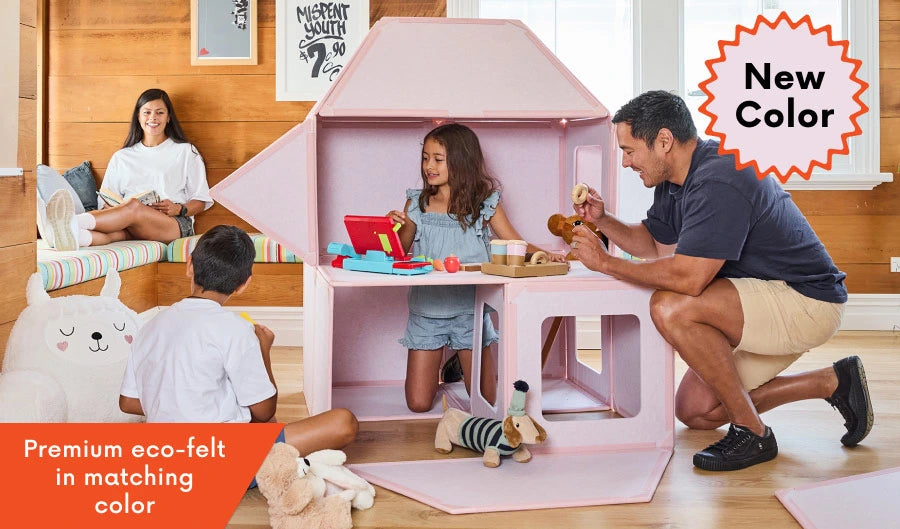
Fort building takes this concept further. With life-sized building sets like Superspace, children build their own walls and structures side by side. The large panels provide gross motor engagement while the magnetic connections offer satisfying tactile feedback.
What makes building toys especially valuable for parallel play is what happens next. As children grow more comfortable, they naturally begin combining their individual creations. Two separate walls become one shared fort. This organic transition from parallel play to cooperative play is exactly the developmental bridge that Robinson et al. (2003) described [2].
Art and Sensory Play
Art supplies are another parallel play staple. Two children drawing at the same table, each with their own paper and crayons. Side-by-side easels for painting. Individual lumps of playdough at a shared table.
Sensory play also works beautifully for parallel play. Sand tables, water play stations, and sensory bins with rice or beans give children shared materials and shared space while keeping the play experience individual.
The creative play benefits of these activities extend well beyond the play session itself, strengthening fine motor skills, self-expression, and sensory processing.
Outdoor and Physical Play
Outdoor environments naturally support parallel play. Sandbox play, where each child digs or builds independently, is one of the most common parallel play examples in early childhood.
Riding tricycles in the same area, playing on different equipment at the same playground, and splashing in separate containers at a water table are all forms of outdoor parallel play.
The key across all these activities is providing similar materials in a shared space and then stepping back to let the play unfold naturally.

How to Support Your Child's Parallel Play
One of the most important things parents can learn about parallel play is that the best support often looks like doing less, not more.
Create the Right Environment
Designate a shared play space at home that is calm, organized, and inviting. Keep the area free of electronic distractions and prioritize unplugged playtime to help children engage more deeply with the world around them.
Rotate toys regularly to maintain your child's interest. Arrange playdates with children of similar ages. You do not need elaborate activities or structured games. Simply providing the space for children to play near each other is enough.
Provide Similar Materials
Conflict during parallel play often comes from not having enough of the same toy. When one child has blocks and the other has none, frustration follows quickly.
Pediatrician Dr. Natasha Burgert, a Fellow of the American Academy of Pediatrics, recommends: "Make sure you have similar toys, so they can do the same thing at the same time."
Building sets with enough pieces for multiple children work especially well. Montessori-style toys that encourage hands-on exploration are also a strong choice for this stage.
Avoid toys that require strict turn-taking at this stage, as most toddlers are not developmentally ready for that level of sharing. Having duplicate or expandable toys reduces conflict and allows each child to engage fully in their own creative process.
Model Parallel Play Behavior
One of the most effective strategies is something parents can do right now: sit beside your child and play independently.
Build your own block tower. Draw your own picture. Show interest in what your child is creating without taking over or directing their play.
Narrate your own play: "I am going to stack this one on top." This models both the behavior and the language of play without putting pressure on your child to respond or interact.
Most importantly, resist the urge to force interaction between children. Comments like "share with your friend" or "go play together" can create pressure that undermines the natural progression of social development.
Let your child set their own pace. Parallel play is not a problem to fix. It is a stage to support.
From Parallel Play to Cooperative Play
The journey from parallel play through associative play to full cooperative play is one of the most exciting developments parents can witness. Understanding this transition helps you recognize growth as it happens and provide the right materials to support it.
Recognizing the Transition
The shift from parallel to cooperative play is gradual, and it often starts with small moments that are easy to miss. Watch for these signs:
- Your child starts commenting on another child's play: "You made a big one!"
- Imitation becomes more intentional and interactive
- They begin sharing materials voluntarily, without prompting
- Simple negotiations emerge: "Can I have that block?"
- Play themes start to overlap as children build on each other's ideas
These moments signal that your child is developing the social skills needed for cooperative play. You might also notice elements of dramatic play starting to emerge as children begin narrating shared stories during their building and creative activities.
How Building Toys Bridge the Gap
Robinson et al. (2003) found that parallel play serves as a "bidirectional bridge" to social play [2].
Building activities make this bridge especially visible. Two children start by building separate structures side by side. Over time, those structures get closer. Eventually, a wall from one creation connects to a wall from another. Separate projects become a shared one.
With life-sized building sets like Superspace, this transition happens organically. A child builds their own wall. Their sibling builds a wall nearby. Before long, they are connecting panels together to create something neither could have built alone.
The progression from "my wall" to "our fort" mirrors the developmental shift from parallel to cooperative play.
Brownell and Carriger (1990) showed that cooperation emerges gradually during the second year of life, building on the foundation of self-other differentiation that parallel play develops [7].
Building toys do not just support this transition. They make it tangible, visible, and deeply satisfying for children and parents alike.

The Power of Playing Side by Side
Parallel play may look like children ignoring each other, but it is one of the most active and important stages of early childhood development.
Research spanning nearly a century, from Parten's landmark 1932 study to Robinson's work on sequential transitions in 2003, confirms that parallel play builds the social, cognitive, emotional, and physical skills children need to thrive [1][2].
The best thing parents can do is simple: provide the space, provide the materials, and let play unfold naturally. Do not rush interaction. Do not worry about timelines. Trust that your child is learning, even when it looks like they are just playing next to someone.
Building and construction toys are uniquely suited for this stage because they naturally bridge the gap between playing alone and playing together. Life-sized building sets like Superspace let children create side by side and then, when they are ready, connect their creations into something bigger.
The next time you see your toddler playing alongside a friend without a word between them, smile. That quiet moment is development in action.
Explore Superspace giant magnetic building sets and give your child the tools to build, grow, and connect at their own pace.
References
- Parten, M. B. (1932). Social participation among preschool children. Journal of Abnormal and Social Psychology, 27(3), 243-269. https://doi.org/10.1037/h0074524
- Robinson, C. C., Anderson, G. T., Porter, C. L., Hart, C. H., & Wouden-Miller, M. (2003). Sequential transition patterns of preschoolers' social interactions during child-initiated play. Early Childhood Research Quarterly, 18(1), 3-21. https://doi.org/10.1016/S0885-2006(03)00003-6
- Rubin, K. H., Maioni, T. L., & Hornung, M. (1976). Free play behaviors in middle- and lower-class preschoolers: Parten and Piaget revisited. Child Development, 47(2), 414-419. https://doi.org/10.2307/1128796
- Smith, P. K. (1978). A longitudinal study of social participation in preschool children: Solitary and parallel play reexamined. Developmental Psychology, 14(5), 517-523. https://doi.org/10.1037/0012-1649.14.5.517
- Howes, C. (1988). Peer interaction of young children. Monographs of the Society for Research in Child Development, 53(1, Serial No. 217). https://doi.org/10.2307/1166062
- Gray, P. (2017). What exactly is play, and why is it such a powerful vehicle for learning? Topics in Language Disorders, 37(3), 217-228. https://doi.org/10.1097/TLD.0000000000000130
- Brownell, C., & Carriger, M. (1990). Changes in cooperation and self-other differentiation during the second year. Child Development, 61(4), 1164-1174. https://doi.org/10.2307/1130884
- Eckerman, C. O., Whatley, J. L., & Kutz, S. L. (1975). Growth of social play with peers during the second year of life. Developmental Psychology, 11(1), 42-49. https://doi.org/10.1037/h0076131