Flexible Play for Flexible Thinking: How Building Play Builds Executive Function
Becky WilsonYour child's block tower falls. Instead of trying again, they cry and walk away. When plans change at the last minute, the whole afternoon unravels.
These reactions are not just tantrums. They are signs that flexible thinking, your child's ability to shift gears and try new approaches, is still developing.
Research shows that one of the most effective ways to build this skill is through open-ended building play. Not worksheets. Not flashcards. Play.
Tools like Superspace are designed for exactly this kind of hands-on exploration, where every build is a chance to practice thinking flexibly.

Key Takeaways
- Flexible thinking (cognitive flexibility) is one of three core executive function skills critical for your child's academic and social success.
- Open-ended building play develops all three executive function pillars simultaneously: working memory, inhibitory control, and cognitive flexibility.
- A 2026 meta-analysis of 26 studies confirms a significant positive connection between play and executive function development in early childhood.
- Hands-on, tactile play is more effective than screen-based activities for building executive function skills.
- Parent scaffolding, asking open-ended questions instead of giving instructions, amplifies the cognitive benefits of play.
- Executive function develops most rapidly between ages 3 and 6, making early play experiences especially powerful.
- The best flexible thinking activity is one your child finds genuinely fun and returns to willingly.
Table of Contents
- What Is Flexible Thinking (And Why Does It Matter for Kids)?
- The Three Pillars of Executive Function Every Parent Should Know
- Why Open-Ended Building Play Is the Ultimate Flexible Thinking Activity
- How Building Play Strengthens Each Executive Function Skill
- How to Guide (Without Taking Over): Scaffolding Flexible Thinking
- What Flexible Thinking Looks Like During Play
- Flexible Thinking Activities by Age
- Why Therapists Love Construction Play for Executive Function
- Setting Up Play Spaces That Build Flexible Thinking
- Building Flexible Thinkers, One Structure at a Time
- References
What Is Flexible Thinking (And Why Does It Matter for Kids)?
Flexible thinking is your child's ability to shift gears when something does not go as planned. It is the skill that lets them try a different approach to a math problem, handle a change in routine without melting down, or see a disagreement from a friend's perspective.
In developmental psychology, this skill is called cognitive flexibility.
It's one of the most researched predictors of a child's success, not just in school, but in friendships, emotional regulation, and daily life [1].
Think of it this way. A child with strong, flexible thinking sees a problem and thinks, "Let me try another way."
A child still developing this skill sees the same problem and thinks, "This is the only way, and it is not working."
That second response often leads to frustration, tears, or giving up entirely.
Here is what flexible thinking looks like in everyday moments:
- Accepting a change to the dinner plan without a meltdown
- Trying a different strategy when a puzzle piece does not fit
- Sharing a toy by taking turns instead of insisting on going first
- Finding a new way to solve a homework problem after the first attempt fails
And here is what it looks like when flexible thinking is still developing:
- Becoming very upset when routines change unexpectedly
- Refusing to try a different approach, even when the current one is not working
- Getting stuck on one idea and struggling to consider alternatives
- Difficulty compromising during play with siblings or peers
It's important to understand that rigid thinking in young children is not a behavior problem. It is a developmental stage.
The prefrontal cortex, the part of the brain responsible for flexible thinking, is one of the last brain regions to fully mature [1].
The landmark review by psychologist Adele Diamond found that executive function skills, including cognitive flexibility, are among the strongest predictors of academic achievement, social competence, and mental health across the lifespan [1].
The promising news for parents is that flexible thinking is not fixed. It is a skill that can be developed. And one of the most powerful ways to develop it does not require a therapist's office or a special curriculum. It happens naturally during play.

The Three Pillars of Executive Function Every Parent Should Know
Before diving into how play builds flexible thinking, it helps to understand the bigger picture. Flexible thinking is one of three interconnected skills that researchers call executive function.
The Harvard Center on the Developing Child describes executive function as the brain's air traffic control system. It is the set of mental skills that helps children plan, focus, remember instructions, and juggle multiple tasks at once [1].
Executive function has three core components. Each one matters, and they work together.
Working memory is the ability to hold information in mind and use it. For a child, this means remembering the rules of a game while playing, following multi-step directions, or keeping a mental image of what they want to build while searching for the right pieces.
In building play, working memory shows up every time a child holds a mental blueprint while constructing. They are tracking what they have already built, what they still need, and how the pieces connect.
Inhibitory control is the ability to resist impulses and think before acting. It is what helps a child wait their turn, resist grabbing a toy, or stop themselves from blurting out an answer in class.
During construction play, inhibitory control appears when a wall does not connect as planned and the child resists the urge to knock everything down. Instead of reacting impulsively, they pause, assess, and try again.
Cognitive flexibility, the focus of this article, is the ability to shift between different ways of thinking and adapt when circumstances change. It is what allows a child to switch strategies when one approach fails, to see a problem from another angle, or to generate creative alternatives.
In building play, cognitive flexibility is exercised every time a child's original design does not work and they must find a new solution. Running out of certain pieces forces creative substitution. Collaborative building with a sibling requires negotiating different ideas.
These three skills are deeply interconnected. A child building a structure is simultaneously holding plans in working memory, controlling the impulse to give up when things get difficult, and flexing their thinking when they need to adapt.
Research shows that executive function develops most rapidly between ages 3 and 6 [1].
This is also the age when children are most naturally drawn to building, stacking, and constructing. That overlap is not a coincidence.
For a deeper look at how play supports executive function in children with ADHD, our guide on executive functioning through play explores specific strategies and research.

Why Open-Ended Building Play Is the Ultimate Flexible Thinking Activity
Most lists of flexible thinking activities focus on worksheets, card games, or digital exercises.
These can be helpful. But research increasingly points to something more powerful: open-ended building play.
Open-ended play means there is no single "right" way to use the materials.
The child decides what to build, how to build it, and when to change course. This is different from a prescriptive toy kit with step-by-step instructions, where the goal is to reproduce a specific design.
A 2023 study published in the National Library of Medicine found that Loose Parts Play, which uses materials offering multiple possibilities, directly develops executive function and cognitive self-regulation in preschool children. The researchers found that even short daily sessions of open-ended play showed improvements in executive function [3].
In 2026, a landmark meta-analysis published in Developmental Review analyzed 26 studies involving 2,915 children aged 12 to 72 months. The results confirmed a statistically significant positive relationship between play and executive function, with no publication bias detected [4].
This is not one study making a bold claim. It is the collective weight of 26.
So why does open-ended building play work so well for flexible thinking? Because it demands all three executive function skills simultaneously.
A child building with magnetic panels or wooden blocks is holding a mental model of their structure (working memory), resisting the impulse to give up when pieces do not fit (inhibitory control), and adapting their plan when something does not work (cognitive flexibility). All at once. All within a single play session.
Construction play also creates what educators call "productive struggle."
When a structure falls or a design does not hold, the child faces a natural, low-stakes problem that requires flexible thinking to solve. The feedback is immediate and tangible. The structure either stands or it does not.
This iterative cycle of build, test, revise, and rebuild mirrors the kind of adaptive thinking that flexible thinkers use throughout their lives. Every rebuild is a small act of cognitive flexibility.
A decade-long study from the Center for Early Childhood Education at Eastern Connecticut State University found that simple, open-ended, non-realistic toys inspire the highest quality play.
Children were more likely to engage in creative problem solving and peer interaction when using open-ended materials compared to electronic or single-purpose toys.
The contrast with screen-based activities is also worth noting.
While some digital games can support cognitive development, the research consistently shows that tactile, hands-on play is more effective for building executive function. The physical act of manipulating objects, testing balance, and responding to real-world constraints adds a dimension of learning that screens cannot replicate.
When children have access to open-ended play materials, they are not just having fun. They are building the neural pathways that support flexible thinking, planning, and problem solving for years to come.
Products like Superspace magnetic building panels are built on this principle: modular panels that connect in thousands of configurations, with no single "right" way to play. The child is the architect.
When a home has fewer, higher-quality play materials that invite creative exploration, the shift in a child's engagement is often immediate.

How Building Play Strengthens Each Executive Function Skill
Understanding the three pillars of executive function is useful. Seeing how they show up during building play is where it gets practical for parents.
Working Memory: Holding the Blueprint
When your child is building a fort, they are holding a mental image of the finished structure while simultaneously tracking which pieces they have used and which ones they still need. They are remembering that the wall on the left needs to be the same height as the wall on the right. They are sequencing steps in their head: base first, then walls, then roof.
When your child says "I need two more triangles for the roof," they are exercising working memory in real time. This is one reason why building systems like Superspace magnetic panels are so effective: the variety of shapes and sizes naturally demands more working memory to plan and execute a build.
Research on block play has found that this kind of spatial-constructive activity strengthens both executive function and spatial reasoning in young children [5].
Inhibitory Control: Resisting the Impulse to Quit
A wall falls. Pieces do not connect the way your child imagined. The impulse is to knock everything down, cry, or walk away.
Building play teaches children to pause in these moments. Not to avoid frustration, but to move through it. The build-fail-rebuild cycle is one of the most natural ways children develop frustration tolerance.
The freedom to build, disassemble, and rebuild teaches something critical: mistakes are not permanent failures. They are opportunities to try something new. Over time, children who practice this cycle become better at regulating their impulses in other contexts as well, from the classroom to the playground.
This is not about preventing frustration. It is about building the capacity to handle it.
Cognitive Flexibility: Adapting When Plans Change
This is where building play truly shines as a flexible thinking activity.
When the original design does not work, children must generate alternatives. When they run out of square panels, they figure out how triangles could do the job instead. When building with a sibling, they negotiate, compromise, and integrate someone else's ideas into their own plan.
Physical constraints like gravity and balance demand adaptive thinking in real time. A structure that is top-heavy forces a redesign. A doorway that is too narrow requires rethinking the proportions.
Every time your child says "Well, maybe I could do it THIS way instead," that is cognitive flexibility in action.
The research on hands-on learning reinforces this point: children learn more deeply when they can touch, move, and manipulate physical objects than when they passively receive information.

How to Guide (Without Taking Over): Scaffolding Flexible Thinking
You do not need to be an occupational therapist to help your child develop flexible thinking. But how you engage during play matters more than you might expect.
Scaffolding is a term from developmental psychology that means providing just enough support to help a child succeed at the edge of their ability. Not doing it for them. Not leaving them to struggle alone. Finding the space in between.
The American Academy of Pediatrics endorses this approach in their landmark clinical report on play, noting that guided play captures the strengths of both free play and direct instruction.
The report emphasizes that scaffolding play enables children to develop executive function, self-regulation, and decision-making skills [2].
Here are five scaffolding strategies you can use today.
1. Ask open-ended questions instead of giving instructions.
Try: "What would happen if you tried it a different way?" Or: "I notice that side is wobbly. What do you think might help?" Avoid: "Put the triangle here." Open-ended questions invite flexible thinking. Direct instructions shut it down.
2. Narrate the process, not the product.
Try: "You tried three different ways to make that arch. That takes patience." Avoid: "Your tower is so tall!" When you comment on your child's process rather than the outcome, you reinforce the value of persistence and flexible thinking. You are telling them that the effort matters, not just the result.
3. Introduce productive constraints.
"Can you build something using only squares and triangles?" "What if you could only use 10 pieces?" Constraints may seem counterintuitive, but they are one of the most powerful tools for developing flexible thinking. When options are limited, children must get creative with what they have.
4. Model flexible thinking yourself.
Build alongside your child. When your structure falls, say it out loud: "Hmm, that did not work. Let me think about another way." Children learn flexible thinking partly by watching the adults around them navigate setbacks with curiosity rather than frustration.
5. Resist the rescue.
When things go wrong during play, pause before jumping in to help. Let your child sit with the problem for a moment. The struggle is the learning.
Research confirms that skillful adult scaffolding is critical for maximizing the executive function benefits of play-based learning [6].
For more ideas on guiding creative play without directing it, our guide offers additional strategies that pair well with building play.

What Flexible Thinking Looks Like During Play
Once you understand what flexible thinking is, you can start to see it during your child's play. Knowing what to look for helps you decide when to step back and when to offer support.
Signs of growing flexibility:
- Tries multiple approaches before asking for help
- Accepts when a structure falls and starts rebuilding without melting down
- Incorporates unexpected outcomes into their design: "Oh, this could be a door instead!"
- Shares building space and negotiates ideas with siblings or peers
- Plans verbally: "First I will make the base, then the walls"
- Self-corrects: "That will not work because it is too heavy on top"
Signs that more scaffolding may help:
- Builds the same structure every time and resists trying anything new
- Refuses to continue when the first attempt fails
- Becomes very upset when pieces do not fit exactly as imagined
- Cannot adapt when a sibling or friend suggests a different approach
Rigid thinking in young children is developmental, not problematic. It is a signal that more scaffolding is needed, not that something is wrong.
Every child develops at their own pace, and some children need more opportunities to practice flexible thinking before it becomes natural.
One simple practice that strengthens flexible thinking after play is reflective dialogue. When the building session is done, ask your child: "What was the hardest part? What would you do differently next time?"
These questions encourage metacognition, the ability to think about one's own thinking. Over time, children begin asking themselves these questions without being prompted. That is the moment when flexible thinking starts becoming a habit.
Flexible Thinking Activities by Age
The best flexible thinking activities meet your child where they are developmentally. Here are building play challenges organized by age group.
Ages 3-5: Foundation Builders
At this stage, the focus is on process, not product. Simple challenges that invite exploration work best.
- "Can you build a house for this stuffed animal?"
- Stacking and enclosure challenges: "Can you make a fence around the dinosaurs?"
- Two-step building sequences: "First the floor, then the walls"
- Play "What else could this be?" with a single panel or block
- Celebrate effort and adaptation: "You found another way to do it!"
Keep sessions short. Even 10 minutes of open-ended building play, practiced regularly, shows measurable improvements in executive function [3].
For children in this age range, Montessori-aligned toys that encourage self-directed exploration complement building play well.
Ages 5-8: Creative Problem Solvers
Children in this stage are ready for more structured challenges that stretch their flexible thinking further.
- Design challenges with constraints: "Build a bridge using only 8 pieces"
- Collaborative building with a sibling or friend, which requires negotiation and compromise
- "What if" scenarios during play: "What if a giant came and needed a bigger door?"
- Build, photograph, disassemble, and rebuild from memory
- Timed challenges that add inhibitory control under time pressure
Collaborative building is especially valuable at this age. When two children share a building space, they must constantly practice cognitive flexibility to integrate each other's ideas into a shared plan. Large-format building materials like Superspace panels are ideal for collaborative building because the structures are big enough for multiple children to work on at the same time.
Ages 8+: Design Engineers
Older children benefit from engineering-style challenges that demand planning, revision, and deliberate problem solving.
- Complex engineering challenges: "Build the tallest structure that can hold a book"
- Multi-day building projects that require planning, revision, and sustained effort
- Design for others: "Build something your little sibling can play in"
- Deliberate failure experiments: "Build something that is designed to collapse in a specific way"
- Reverse engineering: look at a completed structure and try to build a copy
At this age, the iterative design process of plan, build, test, and revise closely mirrors the kind of thinking that researchers identify as mature cognitive flexibility.
These children are not just playing. They are practicing the adaptive thinking skills they will use in school, work, and relationships.

Why Therapists Love Construction Play for Executive Function
Occupational therapists and child psychologists increasingly use construction play as a clinical intervention for executive function development. There is a clear reason for that.
Construction play is inherently multi-sensory. It involves tactile feedback from manipulating pieces, proprioceptive input from pushing, pulling, and connecting, and visual-spatial processing from planning three-dimensional structures. This combination engages multiple brain systems simultaneously.
Most importantly, children do not know they are "working on skills." They are just playing. This intrinsic motivation is what makes construction play so effective compared to traditional worksheet-based approaches to executive function development.
Research on structured play therapy has found substantial gains in working memory, self-regulation, and planning among children with ADHD who participated in guided play sessions. The tactile, social, and imaginative nature of the play was identified as key to the gains observed.
Broader reviews of play-based interventions for ADHD have documented consistent improvements in cognitive flexibility, attention control, and visuospatial working memory when children engage in sensory-rich, hands-on activities.
Studies report that the most effective interventions involve physical interaction with real materials rather than screen-based alternatives.
These findings are not limited to children with ADHD.
The underlying principle applies broadly: when executive function demands are embedded in intrinsically motivating activity, learning happens more naturally and more effectively.
Construction play tools like Superspace are increasingly used in both therapeutic and educational settings because they meet children at the intersection of fun and skill-building.
For families navigating ADHD specifically, our guide on ADHD and play therapy with multi-sensory tools explores how construction play supports attention and self-regulation in greater detail.
Setting Up Play Spaces That Build Flexible Thinking
The environment you create matters as much as the materials you provide. A well-designed play space invites flexible thinking before a single piece is picked up.
Provide variety without overwhelm. A curated selection of building materials is more effective than an overflowing toy bin. Children with fewer, higher-quality options demonstrate longer attention spans and deeper engagement during play.
Include complementary loose parts. Scarves, figurines, small cards, and natural objects extend building play into imaginative play.
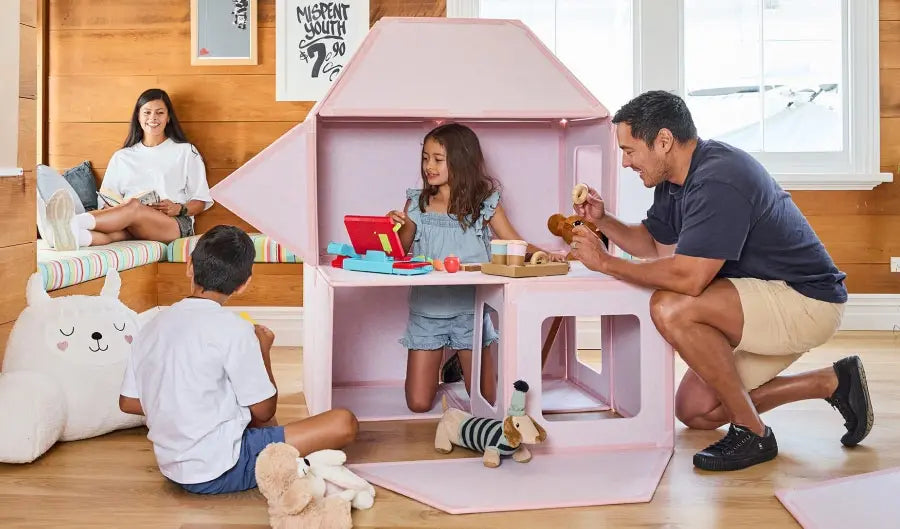
When a magnetic panel fort becomes a veterinary clinic because a child adds stuffed animals and a "waiting room sign," that is flexible thinking in action.
Allow enough space for large-scale construction. Life-sized building and fort construction require room to grow.
When children can build at body scale, the physical engagement and cognitive demands both increase significantly.
Create a build-in-progress zone where children can return to unfinished projects. Multi-session building encourages planning, revision, and sustained effort, all core executive function skills.
Display photos of completed builds to inspire new ideas and celebrate the creative process rather than just the finished product.
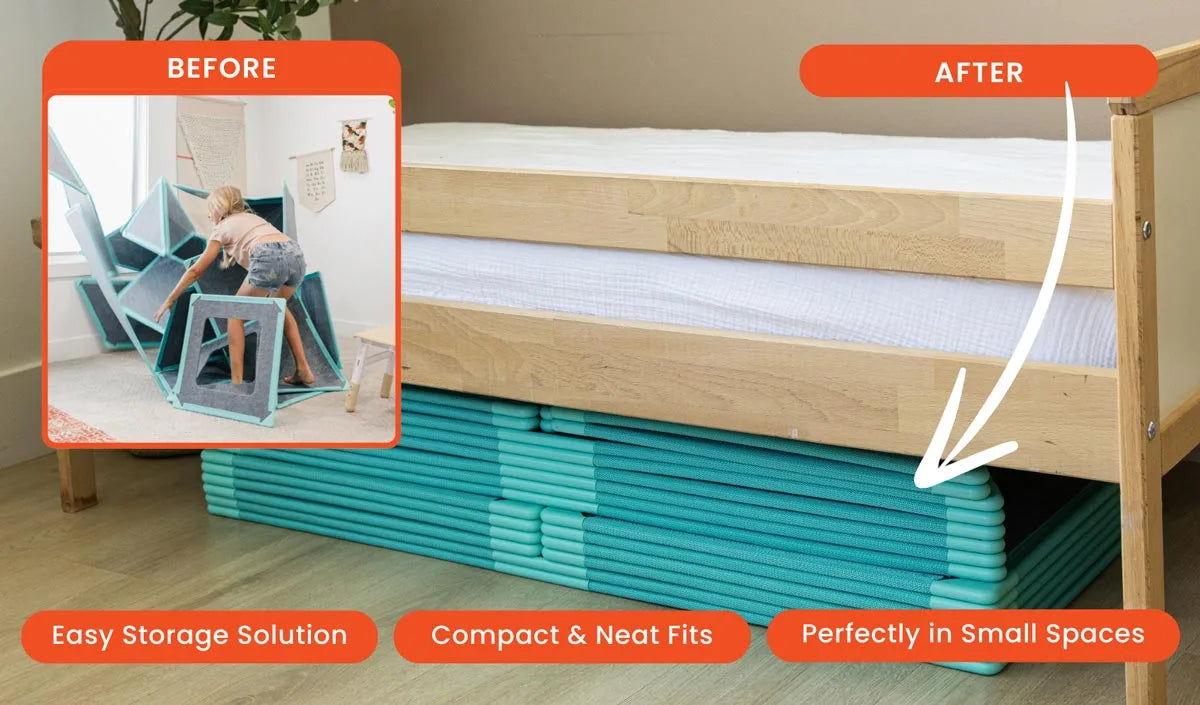
Magnetic modular panels like Superspace are ideal for this kind of play environment. They are large enough for life-sized structures, durable enough for repeated building and rebuilding, and versatile enough to become anything a child can imagine.
For parents exploring how STEM toys support cognitive development, the key differentiator is always the same: the best tools are the ones that let the child lead.

Building Flexible Thinkers, One Structure at a Time
Flexible thinking is not a skill children develop by sitting still and following instructions. It is built in moments of productive struggle, creative problem solving, and joyful exploration.
Every time your child's structure falls and they decide to try again, they are strengthening their cognitive flexibility.
Every time they adapt a design, negotiate with a sibling, or invent a new use for a familiar piece, they are exercising the executive function skills that will serve them for the rest of their lives.
The research is clear: open-ended building play is one of the most effective, most natural, and most enjoyable ways to develop these skills [2][4].
You do not need a special program or an expensive curriculum. You need open-ended materials, a little floor space, and the willingness to let your child lead.
The next time your child says "Let me try it another way," you will know exactly what is happening. Flexible thinking, built one structure at a time.
Explore more research-backed play strategies in our Play Magazine, or discover how Superspace sets help families make flexible thinking a daily habit through play.
References
- Diamond, A. (2013). Executive Functions. Annual Review of Psychology, 64(1), 135-168. https://doi.org/10.1146/annurev-psych-113011-143750
- Yogman, M., Garner, A., Hutchinson, J., Hirsh-Pasek, K., & Golinkoff, R. M. (2018). The Power of Play: A Pediatric Role in Enhancing Development in Young Children. Pediatrics, 142(3), e20182058. https://doi.org/10.1542/peds.2018-2058
- Cankaya, O., & Korkmaz, A. (2023). Preschool Children's Loose Parts Play and the Relationship to Executive Function. PMC. https://pmc.ncbi.nlm.nih.gov/articles/PMC10456023/
- A Head Taller: A Meta-Analysis on the Relation Between Pretend Play and Executive Functions in Early Childhood. (2026). Developmental Review, 79, 101249. https://www.sciencedirect.com/science/article/pii/S0273229726000055
- Gold, Z., Elicker, J., Beaulieu, B., Hestenes, L., & Acar, I. (2023). Executive Function and Spatial Skills in Block Play. Journal of Intelligence, 11(8), 151. https://doi.org/10.3390/jintelligence11080151
- Wiltshire, C. A. (2024). Building Executive Function Skills Through Games. NAEYC Young Children, Summer 2024. https://www.naeyc.org/resources/pubs/yc/summer2024/executive-function-games